Showing posts with label CELESTRON. Show all posts

Friday, May 27, 2022

Mount Calibrating Solar System Objects

Celestron Goto Mounts - Align without Stars!
Mount Calibrating Solar System Objects


Quick-Align uses all the date and time information entered at startup to align the telescope, However, instead of slewing to the alignment stars for centering and alignment, the telescope bypasses this step and simply models the sky based on the information given. This will allow you to roughly slew to the coordinates of bright objects like the Moon and planets and provides the telescope with information needed to track objects in any part of the sky (depending on accuracy of polar alignment). Quick-Align is not meant to be used to accurately locate small or faint deep-sky objects or to track objects accurately for astroimaging.

To use Quick-Align, simply select Quick Align from the alignment options and press ENTER. The telescope will automatically use the entered date/time parameters to align itself with the sky and display Alignment Successful.

By Decimal
Latitude: (+) 25.0409° N
Latitude: (+) 121.5720° E

By Degree, Minute, Second
Latitude: (+) 25° 02' 5.40" N
Longitude: (+) 121° 34' 3.59" E

Time Zone
Time zone in Xinyi District, Taipei City (GMT+8) Greenwich Mean Time
or UTC +8, Coordinated Universal Time
https://otisastro.blogspot.com/2022/03/celestron-nexstar-6-se-planet-tracking.html

SOLAR SYSTEM ALIGN WITH NESTAR 6SE
Solar System Align is designed to provide excellent tracking and GoTo performance by using solar system objects (the Sun, Moon and planets) to align the telescope with the sky. Solar System Align is a great way to align your telescope for daytime viewing and a quick way to align the telescope for basic nighttime observing.

To perform a Solar System Align
1 - Once the telescope is powered on, use the SCROLL UP and SCROLL DOWN buttons to select Solar System. Align Press ENTER

The hand control will display the last time and location information that was entered into the hand control. Press ENTER to accept the current information or press BACK to manually edit the information (see SkyAlign section on page 10 for detailed instruction on entering time/site information).

2 - The SELECT OBJECT message will appear in the top row of the display. Use the SCROLL UP and SCROLL DOWN buttons to choose a Solar System object (a planet, the Moon, etc ) to use for alignment. Press ENTER

3 - The hand control will then prompt you to use the direction arrow buttons to slew the telescope to the alignment object and carefully center it in the finderscope. Press ENTER when centered.

4 - Then, center the object in the eyepiece. Press ALIGN

Once in position, the NexStar SE will model the sky based on this information and display “Align Successful”

Celestron Nexstar 6 SE Planet Tracking

Tuesday, May 24, 2022

What's Behind the Clouds - Moon Venus Occultation

 WHAT'S BEHIND CLOUDS

What's Behind the Clouds - Moon Venus Occultation

This is a new section added to Otis 
Astro Imaging titled, "What's Behind the Clouds!"

With so much rain and overcast skies these days and nights, I decided to run a planetarium app on the iPhone and see what's being missed. What wondrous future celestial event was found? I could not believe my eyes. This is one rare event I would not want to miss. Here's a spectacular occultation of Venus by the Moon! Only a couple days away from today, it will take place Friday, May 27, 2022 at around 11:55am.

For more information and images see Celestron's Sky Portal app. The suggestion to those who have a clear sky or can shoot images through holes in clouds, a red filter will help darken the sky for better contrast.

Thursday, May 19, 2022

Celestron CGX/L Mount

Celestron CGX/L Mount
PREPPED, PRIMED & READY FOR ACTION

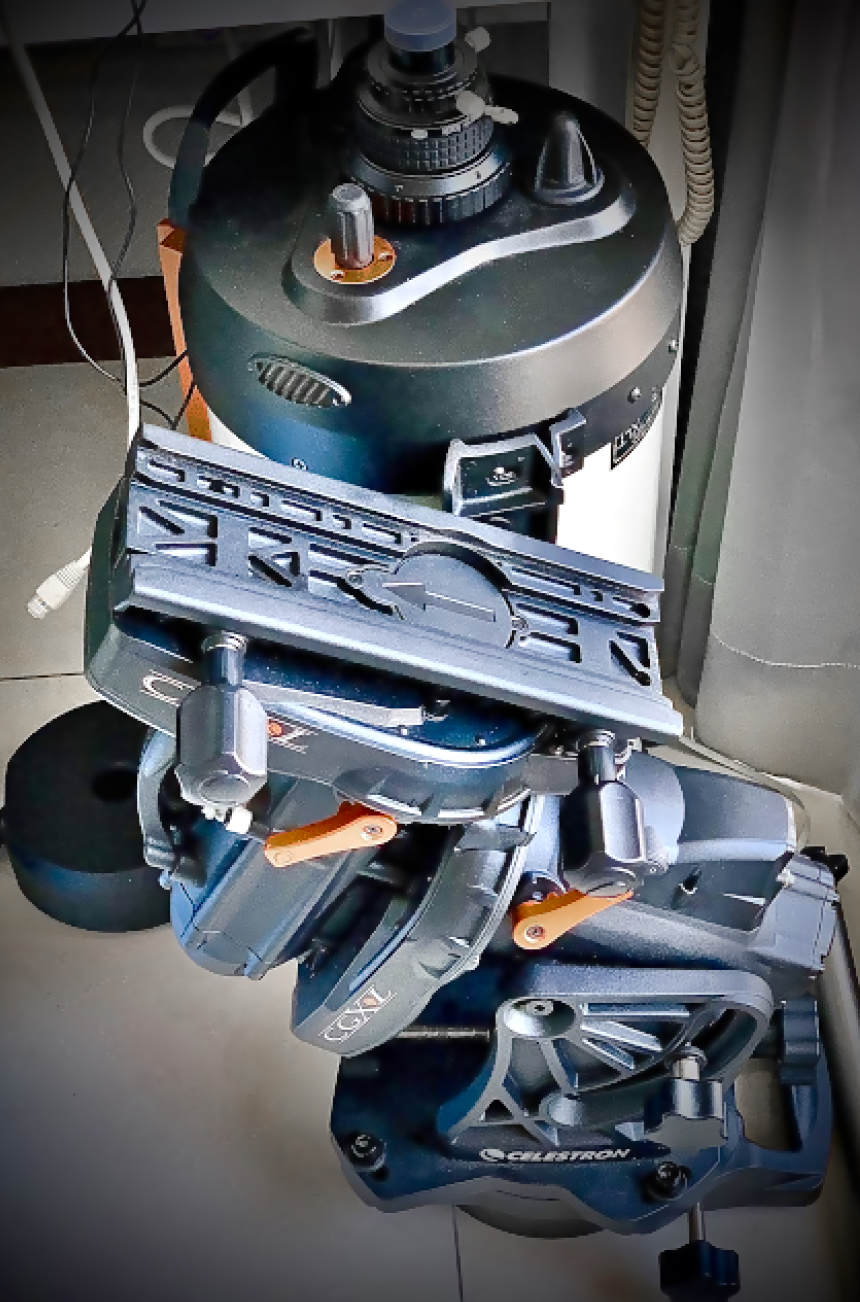
The Celestron CGX/L Mount with equatorial head is waiting for transfer to the permanent observatory.

Dwarfed in the background is a Celestron 9.25-inch Schmidt-Cassegrain EdgeHD OTA also waiting for completion of the largest observatory. The mounting and head, despite its handles, became too heavy to lift for one person.

The mount is an electronic digital goto that must avoid placement near any strong magnetic fields. The challenge is balancing the location of the largest observatory against the convenience of access.

Thursday, April 28, 2022

Nexstar Observatory Tests

Nexstar Observatory Tests
(Indoor observatory testing) The Celestron Nexstar 6SE was set up for the first time on the new platform and tested for stability. The telescope has large rubber pads that are very grippy and once set in position, there was no movement (even when shaking the platform). There was no noticed ability to topple. The telescope is extremely well balanced and stable. The platform is by far the strongest in lateral positioning. For the greatest depth stability, it will be anchored to the steel railing with the heap of bungee cords seen at the right. The window was cleaned internally and is being tested for optical glass variances of white window glass from one indoor observatory to another. The OTA will be transformable depending on the application due to the limit to carry weight. Therefore more plastic accessories will be used on the OTA to lighten up the load and increase the efficiency of the driving motors. One techniques will be to swap or remove the accessories that won't be needed for a particular observation/ astro imaging mission. A number of tests were performed to simulate earthquakes. The system handled those tests well and the OTA remain in excellent collimation. The telescope is currently connected to a power source and is fully functional. Skies have reverted to overcast so tests may resume on a clear day/night.

Friday, April 22, 2022

Astroimage Processsing with the Nexstar 6SE


Advanced AstroImage Processsing with the Nexstar 6SE by Mike Otis at the New NTO Nexstar Telescope Observatory


One invented technique by the author takes both digital and analog to create a new advanced and enhanced representation of the COSMOS that vastly outstrips the original in many technical aspects of imaging. This employs more than one method of image processing. The image shown above is taken with a Celestron Nexstar 6SE telescope in the nebulosity area of the constellation Orion where stars are born and vasts wisps of red hydrogen fill the vastness of space and time.

Techniques used are amping, a method to amplify the overall diameter of the telescope by a factor 10x and 100x, and the technique that takes the digital and combines it with the analog reminiscent of old school spectroscopic film only with the added enhancement of color. This first acquired image was shot in the throes of light pollution, upper atmospheric haze, and air pollution. These elements are subtracted out from the image to restore the clarity of the Universe with stunning success. This special occasion marks first light for the depths of deep sky Universe with the Celestron Nexstar 6SE telescope. The image is toying with the first result of additional amping to convert 6-inch diameter into 60-inch diameter, and some enhancements took it all the way up to 600-inch diameter for mind boggling incredible results.

Thursday, April 21, 2022

Observatory Log Update Celestron Nexstar 6SE Thursday April 21 2022

Observatory Log Update Celestron Nexstar 6SE Thursday April 21 2022
Update for the construction of a new Nexstar Outdoor Observatory using only simple available parts, materials and no tools

WATER BOTTLES
I now have 12 water bottles - one extra today. I don't know the liter capacity of a bottle but it appears I can down one bottle per day. So this is the data rate of expansion of the water bottle quantity per unit time. The greatest use of water is coffee, tea, drink mixes like potato and protein, other than pure water consumption. The number of empty bottles occurring per day will be monitored and increased if possible. If 50 bottles really are needed (the design may vary), that leaves another 38 required. At one per day accumulated, 38 more days are needed, or just under 6 weeks. If the rate can increase to two per day, that will take 19 days to collect the remainder of the bottles needed, just under 3 weeks in half the time.

BUNGEE CORDS
Bungee cords were ordered from two new companies and are not yet delivered to the door. However, one package will be small and small packages are held at the administration office. Since the admin has new workers, the bungees may not be delivered to the door. The Internet shows at least one package being delivered to the admin. Delivery of the first package is expected today and if it does not arrive, phone calls will be made.

Bungee Update 5:00 pm - After the phone call was made to the building administration, two packages were delivered to the door. One package has eight cords all the same size (19-inches). The 2nd package had only 2 cords (37-inches) and (48-inches). The old cord on hand is (57-inches) and appears to have lost some stretch. It can still be used by supplanting one or two 19-inch cords in the stream. I originally wanted five of each, however by connecting various lengths together, the existing cach of cords may be sufficient to fully complete the project.

WRAPPING
A simple method of wrapping and covering the observatory platform is needed to ward off intense solar radiation, pollution, wind, mist, rain, bugs, birds, dust, and the onslaught damp humidity. The platform will be bungee'd to the metal railing. A technique to insert the wrap tarp under the bungees will be needed. It's likely the solution will encompass keeping the wrap intact on the back under the bungee cords and inserting the protective flaps across the top and front.

ORDERS
Work is proceeding on solidifying the orders for the observatory telescope's accessories from a multitude of vendors. Orders are being handled one at a time. Currently the wait is for two orders for bungee cords. When this arrives in two packages, the next frame of order will include the solar observatory.

WEATHER
Weather is highly changeable as usual and has turned from cold, overcast and raining to a clear blue sunny sky with some patches of upper haze, entirely worthy of solar observations. Weather has completed defied the 10-day predictions and completely baffled the meteorologists to the happiness of local astronomers on the island.

HIGH RESOLUTION SOLAR OBSERVATORY
It has become imperative that we soon complete a new solar observatory, given the increasing number of clear sky days. The decision is not yet made in the purchase of a solar filter accessory. The problems are vendors not providing full information and not having access to full information. In lew of buying a fully equipped expensive solar telescope, a decision will be made soon to select an appropriate safe solar filter. The solar observatory is described in other postings and will be at level 1. Observations will be primarily under the classification of astro imaging with targets being the limb, granulation, sunspots, determination of solar flares and storms, transits and occultation of planets and satellites the ISS International Space Station. Additional studies may measure the variable changing size and shape of the sun, and the distances to the Earth. The telescope employed will be the new upgraded Celestron Nexstar 6 SE in potential amping modes for apertures of at least 6, 60 and 600 inches in diameter.

New Solar Observatory with the Celestron Nexstar 6-inch SE

Log Update Celestron Nexstar 6SE Thursday April 21 2022

Celestron Nexstar 6SE Log Thursday April 7 2022 - Solar Observatory

Astro Log for Monday April 11 2022

Monster Astro Projects - Observing the Sun

My Observatory Summary
Taiwan Skyscraper Rooftop Observatory - Venus Transit Across the Sun

StarryNight Solar Eclipse

Wednesday, April 20, 2022

Telescope Bag for Celestron

Telescope Bags for Celestron Nexstar 6 SE Telescope

Keeping track of small parts is very easy when using a travel bag that hangs from the tripod. The author has used two bags hooked onto the eyepiece holder at the center of the tripod for the Celestron Nexstar 6 SE. Multiple zippered pouches can encircle around the inside of the tripod. For example, the tiny bubble level goes into the zippered pouch after use and is never lost. Other items can include small tools, compass, cables, cords, connectors, more eyepieces, various accessories, and filters.

Monday, April 18, 2022

The Making of Celestron Nexstar 6SE Telescope Deck Observatory

The Making of Celestron Nexstar 6SE Telescope Deck Observa-tory
NTO, Nexstar Telescope Observatory, is a subsidiary of HSO Humanoido Singularity Observatory. 

Above: the observatory Celestron Nexstar 6 SE  telescope is being tested and configured with new accessories. The OTA can support an additional ten pounds, therefore a method of swapping and removing accessories is being developed depending on a particular night's mission. So far, testing includes a Celestron NexYT smartphone holder, Svbony finderscope, Celestron all plastic finder, a green gem laser, and a rotating turret. Other items up for testing include an automatic focus motor, 80mm CT Orion guide telescope, mount expander, rotating filter holder, and cameras. 

THE 6 SE TELESCOPE
The HSO enterprise is a conglomerate hub of nineteen observatories located on an island about a hundred miles from active volcanic mountains in a Eurasian tectonic earthquake zone. The location is unique with all forms of subtropical weather including some of the most desired astronomical seasonal seeing conditions in the world due to the island location in the middle of the Pacific Ocean.

The observatories consortium is situated thousands of feet in the air via a new modern structurally earthquake stabilized steel and granite skyscraper - with a battery of some of the world’s most powerful telescopes. When these are amped, they become some of the largest Earth-based telescopes in the world, having apertures of 20”, 200", 30”, 300", 45”, 450", 60”, 600", 92.5", 925”, 140", and 1,400-inches in diameter. 

HSO also owns and operates Adjunctive telescopes in space through the concatenation of recycled NASA equipment worth over a trillion dollars. Adjunctives are driven by a supercomputer. The Celestron Nexstar 6SE has a built in positioning GOTO computer and a database of 40,000 astronomical objects. It's also controlled with other computers for various control features, predictions with past and future recreations of the night sky, regulate CCD & CMOS astronomical imaging cameras, image process, and mega store astronomical data into modern archives.

Trials and Tribulations of Building an Observatory for the New Celestron Nexstar 6SE GOTO Telescope


Telescope & Observatory Objectives & Goals
The goal of the observatory and telescope is multi purposed. It will be used to conduct numerous programs that focus on the Moon, planets, astro imaging, tech experiments, a solar observatory in the daytime, and partake in a mountainous region conservation program studying animal and plant life from a distance of one hundred miles.

Above Photo - this is the approximate future appearance at the observatory location (with light pollution, air pollution, and haze subtracted) looking Southeast on the night of Monday, April 25th 2022 at 5:54 am in the morning. Seen is an exceptionally rich sky with Jupiter, Venus, Mars, Saturn and the Moon lining up during a conjunction. Given clear skies, this will be a veritable feast of celestial objects for testing and running the solar system observatory Nexstar 6 SE telescope through its paces. The more southern island South Pacific Ocean location brings a treat of spectacular southern constellations and objects into view to include Microscopium, Indus and Grus, and during the proper time and season - the Great Omega Centauri Star Cluster.

Optics
Why would we go through all this, the construction of an observatory, for such a lowly telescope you ask? It's because this is not a lowly telescope. The new Celestron Nexstar 6SE has lots of hidden powerful features that one would not expect. It also has something to do with the fact that the telescope is generally always sold out - in high demand due to its high quality.

The Celestron Nexstar 6SE telescope is a real gem - an optically perfected instrument that can slice through large seeing cells, using its subfacet size, in the atmosphere like butter and create holes of exceptional clarity. The industry has come of age, and developed the techniques necessary to generate optically exquisite spherical mirrors - exactly that which is the design basis of the Schmidt-Cassegrain telescope. Therefore the Celestron Nexstar 6SE has developed a reputation as being one of the finest “optically perfected” telescopes available in the world at a reasonable cost.

Left: the bookshelf is flipped on its side. From left to right, bungee cords for attaching the unit to the metal rail seen through the window, a waterproof tarp used to cover motorcycles, a small collection of the first 4 water bottles, and 3M duct tape to be used to attach the water bottles to the backing.

Overview
The goal is to inexpensively and quickly make an outdoor observatory for the Celestron Nexstar 6Se telescope to ultimately obtain high resolution observations and astroimaging of the sun, moon and planets, while conforming to all the local requirements and physical parameters. Using all common and recycled parts and components for construction, the telescope will set outside on top of a platform when in use and quickly and easily carried indoors when not in use. The platform must come from a common supplier that can both deliver across the city and assemble the unit on site in a timely fashion. It will bungee cord attach to the metal railing. It can be easily disassembled. The upper limit cost for the platform must not exceed $100. The terms balcony and deck may be used interchangeably.

— when queried about the diminutive telescope and accessories, he replied, it's destined to become one of the most powerful and capable telescopes in the world —

Left: tests include a thermal image of a cutoff bottle bottom. Remarkably the reinforced and orientated bottom of the bottle is capable of supporting a thousand pounds PSI. The observatory platform is estimated to have a bulk array of fifty bottle bottoms for a total support capability of fifty thousand pounds, enough strength for an earthquake to an estimated 5 on the richter scale. The large recycled bottle bottom is seen being tested in the Astro Imaging Lab using a thermal camera. Unlike other bottles, this bottle style contains extra plastic and is free from the distillation factory.

Telescope Retainer
It's necessary for the telescope while setting on top of the platform to have more than just rubber grippy feet. In the event of an earthquake, the telescope should have a basic anchoring system but not one with bolts. The idea is to quickly set the telescope on the platform and start observing or quickly pick up the telescope, take it indoors and stop observing. The circular mount bottom is divided into two sections - the top turns over the bottom. The bottom is stationary so this is the only area that can have a type of retainer. The retainer will be a quick fasten and quick release. To accomplish this, a taught criss crossing of bungee cords will retain the circular bottom from lateral movement. Retaining the circular top will be experimental with a fabricated slip bungee that will allow the telescope to turn but not tip over in the event of jolting. This is an invented experimental device and may be modified and changed.

Construction

The observatory will be constructed without tools such as saws, drills, screwdrivers or any woodworking or metal working supplies. Materials used will be limited to common recycled items - empty water bottles, leftover motorcycle weather covering, and common purchased items - bungee cords, 3M strapping/duct tape, and a bookshelf. At most, a scissors will be used to cut the tape to length.

Duplication
The duplication of the observatory must be simple enough to recreate at other installation sites across the world, in remote locations, on foreign land, and in plain sight where one would least expect it.

Weather
The platform may set outdoors and covered with a waterproof motorcycle covering fastened with bungee cords. The life expectancy of the platform for 2 seasons or more is totally sufficient as it can be easily replaced.

Manual & Remote Operations
The observatory telescope will function both manually with the astronomer outdoors and remote with the astronomer indoors at a future date.

Appearance
It must appear as common storage items placed on the deck/balcony so as not to draw attention.

Arrangement
The platform shelf can hold a large and heavy 7AH battery on the base to help rigidity and stability. The telescope is placed at the top of the platform and its rubber grips are fully functional with the platform top. An additional retainer will be added to keep the telescope in balance and stable laterally and prevent vertical tipping. The telescope is set high enough to overlook the balcony metal railing.

Specifics
An IKEA bookshelf, the platform, will be purchased, delivered, assembled and will serve as the telescope base, replacing the stock tripod which does not fit on the deck floor. The actual bookshelf was a surprise as its design cut corners to make it more efficient for manufacturing and to save a penny. This design made its floor smaller with cutouts and a missing beam support, making it and the backing unstable and more easy to tip compared to other normal bookshelves, but this was next to impossible to learn from the online representations. After much study, it was decided to keep the spartan design and work with it through reinforcement at the other strong points and to add the physics of a unique full faced anchoring system to provide the greatest rigidity.

— with great power comes great responsibility —

To complicate matters, there’s a raised granite floor section about two inches high and 3 1/4” distanced out from the metal railing. Therefore the bookshelf is unable to reach the metal railing for attachment unless modified.

The free floor space out from the metal railing is very limited and the bookshelf needs to have a depth no more than 16-inches. This must also include any standing space during setup and take down.

The bookshelf must raise the telescope so that it can be pointed above the railing when observing mountains or sky objects. Therefore a bookshelf with a height of 41 3/4” is perfect.

Tripod Replacement - Platform Bookshelf
https://otisastro.blogspot.com/2022/04/celestron-nexstar-6-se-remounting.html

Assembly
A water bottle can be recycled but it flexes along its side. However, it’s noted the base of the water bottle is very rigid and will work in unison to support the back of the bookshelf. The firm connection will keep the bookshelf from tipping or moving.

The bookshelf has two holes in the back right and left sides near the top, perfect for threading through bungee cords and fastening to the steel railing. In the assembly, nothing is permanently changed or destroyed. The method is to assemble the entire telescope platform without any tools, no drills, no saws and no trips to the hardware or lumber companies.

Materials List & Approximate cost
Platform Bookshelf, Delivery, Assembly - $100
Clear 3M Duct Tape - $25
Recycled Water Bottles - Free
Bungee Cords - $25
Motorcycle Waterproof Covering - $29
-----------------------------------------------
Total Observatory Cost - less than $200

About the Observatory
This observatory is a quad - four observatories rolled into one. It has room for two telescopes performing side by side outdoors and two telescopes indoors observing and gathering data through two (side by side) panes of white optical window glass.

Singularity Observatory has a lab station, also with surrounding decks with potentially four more telescopes outdoors and two indoors. Living expanse has another balcony for telescopes and the side of the skyscraper has a balcony for telescopes. The roof peak is large enough to support a myriad of telescopes with a view in every direction. All in all, the subdivision can include at least nineteen main observatories and 38 to 56 telescopes.

The Future of NTO Nexstar Telescope Observatory
If a lot of time is spent outdoors, it's likely a waterproof and wind tested tent will be erected over the telescope and mounting platform, and a person could work inside. Tents last a couple seasons, then need replacement. In moist humid weather, the bookshelf platform could also last 2 or more seasons, depending on how its protected, exposed, or covered.

Updates Wed. Apr. 20, 2022
Bungee Cords - PChome does not have bungee cords so the cords were ordered in three standard sizes from two other online companies who could not state when it would be shipped or arrive. 

The backup plan is to send someone to the night market and buy up all the bungee cords there. These come in 11, 23, and 47 inches and the objective is to obtain five of each (30, 60, 120 cm). Only one long is on hand. The backup plan is to use the one long bungee cord to fasten the platform from the top back.

Bottles: Extra thick clear plastic recycled distilled water bottles were gathered and unfortunately the quantity is not nearly enough.
So far, 11 are collected and up to 50 may be needed. It's unknown how long it will take to consume water to make a total of 50 bottles available. Other bottles tried were the wrong size and not strong enough. The backup plan is to use fewer bottles.

Tape: The full complement of twelve rolls of 3M clear
plastic tape arrived. The weatherproof motorcycle covering is already on hand.

Photo: The pic shows the deck steel railing through the window behind the platform (shown upright).




Friday, April 15, 2022

Change Finderscope Position


Change Finderscope Position
Decide the stance relative to the telescope, either from the back, left side or right side. This will determine which finderscope goes where.

Left: the challenge in this photo shows how the scopes are mounted without attention to observational positioning. Once the scopes are mounted, the positions can be decided. Using dovetail bases can allow for quick interchange. Currently the plastic finder is not interchangeable.

The most frequently used finderscope will be located in the most convenient location. Generally, even a back centered stance will favor the left or the right position. The photo shows three different finder scopes. At right, the Svbony has the ability to show the deepest magnitude. The laser can quickly point to objects at night without looking through it. The middle finder is very lightweight and and shows less magnitude - less confusing during heavily light polluted skies.

Top Photo: for indoor observatory one at Singularity Observatory, observing and astroimaging takes place from the left side.

Sunday, April 10, 2022

Celestron NexYZ Smartphone Adapter


Celestron NexYZ Smartphone Adapter
Accessory for the Celestron Nexstar 6SE

$80.95, Eyepiece Clamp Range: 35mm - 60mm (1.37" - 2.36")
Phone Clamp Style: Easy load with internal spring
Phone Clamp Range: 65mm - 90mm (2.55" - 3.54")
Dimensions: 165.1mm x 139.7mm x 107.95mm (6.50" x 5.50" x 4.25")
Weight: 10 oz ( 283 g)

The advertising claimed to adjust the cell phone in all three directions and the reviews were good so this accessory was purchased. However, the unit is not adjusted and had slop out of the box. It was unknown if this is the way it worked or if it had adjustment points. A bit of experimenting discovered sets of tiny phillips screws that could calibrate the tension and take up any play in the axes.


To accomplish this, look for a matching set of two screws that may not be screwed in all the way, at each axis. Tighten the screws using a very small #1 precision Chinese phillips screwdriver from a set sold in China to get the proper depth screwdriver. Then test by turning the adjustment knobs. The knob should turn firm but not too tight or too loose. This will take up the play along the gear rack and the overall smartphone adapter will become firm and tight as it holds and adjusts the phone.


The adapter is a bit heavy but considering what it can do along three axes where others are made of lightweight plastic and can only adjust along two axes, it appears to be an excellent investment.


The tension of each axis can be easily adjusted using a small Phillips screwdriver. Use the images below to locate the adjusting screws. For each axis, only make small adjustments to the set screws. Tightening them too much can make it difficult to use the motion knobs. In between the platform and adapter, there will be screws for tension adjustment in the X axis.

(NOTE: For NexYZ, make sure to adjust the Z axis until the phone platform is as far away from the adapter as possible). Y Axis – On the side of the phone bed holder platform, there will be screws for tension adjustment in the Y axis. 

Underneath the handle will be two set screws for tension adjustment in the Y axis. Z Axis – (NexYZ only) Directly on the opposite side of the Z axis motion knob are the set screws for tension adjustment in the Z Axis. This adjustment is very useful for heavy smartphones.
NexYZ connects your smartphone to your telescope, spotting scope, binocular, monocular, and microscope so you can capture images and video through the eyepiece. Works with a wide range of mobile phone models, including all the latest devices from Samsung, Google, and Apple. 


Unlike other adapters, NexYZ features 3 directional knobs (X, Y, and Z axis) that perfectly align your phone’s camera with
the eyepiece in seconds so you are ready to snap the perfect image; In addition, you can make tension adjustments to keep the phone firmly in place. NexYZ stands up to rigorous field use thanks to its robust, durable construction with a metal frame and polymer body. 

NexYZ fits any eyepiece from 35 millimeter to 60 millimeter in diameter including telescopes with 1.25 inch and 2 inch eyepieces.


Another good accessory to have is a battery powered Bluetooth Remote Shutter to automatically take the exposures without touching the camera and preventing the introduction of vibrations.

These are usually keychain size devices that operate on a 3 volt button battery. Go to settings on the iPhone and select Bluetooth, then find the device and connect. Thereafter, use the pushbutton switch on the device to activate the camera's shutter and take the photo.


Saturday, April 9, 2022

Celestron Nexstar 6SE Mountain Observing

Celestron Nexstar 6SE Mountain Observing


A HUNDRED MILES AWAY!
The first results are in from the new telescope and new location and they're spectacular!


Above Left: photo taken with a handheld smartphone, slightly zoomed, frames the mountains being studied. The towers are invisible.

Left: through the telescope at low power (60x) using eyepiece projection and the Celestron stock 25mm Plossl eyepiece. A smartphone was held above the eyepiece. The resolution of vegetation and the towers is incredible. By adjusting the color, different plant species are identifiable.

After the move to a new observatory complex location and setting up the new telescope, the first results of conservation studies for Taiwan Conservation Management are in for analysis. I used the stock supplied Celestron 25mm Plossl eyepiece for iPhone 10 Max handheld projection. The telescope was set up indoors and looked through a muddy glass window during a hazy high percentage air pollution day. Frankly, good results were not expected, but due to the very high optical quality of Celestron's Nexstar 6SE, the images were spectacular!

Left: using the same eyepiece and camera, there is no doubt as to the quality of the optics looking through window glass and the high level of detail in the tower.
The image is sharp and clear during the first historic mountain indoor observatory session. The colors are bold and distinct without aberrations. There are no achromatic or chromatic defects, coma or astigmatism and the image is sharp and clear to the edge.

As previously described, in the north of the island where HSO Singularity is now located, the low mountains near the Taipei basin contain several of the island's endemic species or rare subspecies, including the seldom seen emerald tree frog and Taipei green tree frog. These amphibians are at the top of the rarest observation list. Also on this list are the habits of the great rare migratory birds that make Taiwan mountains their unique home during their long oceanic journeys.

These mountains are an especially good habitat for amphibians, since the northeast winter monsoon wind lifts moisture laden air from over the warm Japan sea current and blows it up the mountainsides, where it cools and condenses, releasing precipitation over the subtropical forest.

Eventually the telescopes will be used to photo and classify the endemic species, record their living space, numbers, and habits, and potentially report findings and population/ distribution trends to the Taiwan Government Conservation & Wildlife. 

Other projects include bird & large insect watching and mountain exploring/ mapping by remote. Mapping the mountains and their elevations relative to the horizon will benefit telescope astro imaging during night time, for ascertaining various lunar and planetary rise times and for operating predictive planetarium programs before telescope observations and astro imaging. Such photos could be used as long or short term spatial references for volcanic and seismic studies.

At 60x, a telescopic look into the dense forest region shows a surprising number of well defined plant, bush and tree species. Species are identified in part by their unique color, a testimony of Celestron's precision enhanced Starbright coated catadioptric optics. The photo show six unique species awaiting classification. The telescope is capable of 300x. The mountain has wind and the vegetation is in motion. Even though the exposures were fast, the movement of the leaves and tree branches may or may not create some image changes compared to a still day. The observatory took these images indoors through window glass, and is working on setting up an outdoor remote system that will provide a step up in high resolution.

Elephant Mountain is about 20 miles away from Singularity observatory. It includes in the background a larger and more distant mountain range. The closest mountain is flanked by two massive office skyscrapers, a black and an orange, that have roads leading into the mountain for easy access. At the top of the mountain range are a series of power towers ideal for aligning finderscopes. To the left, when facing East, two large and four smaller towers are visible during average conditions. More rare are occasional building structures seen in two locations.

Equipment
To observe the mountains, Singularity Observatory is now focusing on the Celestron Nexstar 6SE due to its high resolution optics and ability to observe directly through optical Taiwan window glass. The equipment also includes Celestron Power Binoculars, low power binoculars and various filters, lenses and cameras (iPhone 5, iPhone 10, ZWO CMOS ASI224MC, Canon).

Links
Singularity Observatory Weather Trends
https://otisastro.blogspot.com/2022/04/singularity-observatory-weather-trends.html

Telescope Mountain Conservation Management at Singularity Observatory
https://otisastro.blogspot.com/2022/04/telescope-mountain-conservation.html

Biblical
Deuteronomy 2:7, 14
For the LORD your God has blessed you in all that he has done in your hands. You walk in this great wilderness, he knows all about it. The LORD your God has always been with you these forty years, so you lacked nothing.

Friday, April 8, 2022

Planet Saturn Blasts into View - Celestron Nexstar 6-inch SE


Saturn from decades ago, had a different ring tilt - more edge on.

Planet Saturn Blasts into View - Celestron Nexstar 6-inch SE

As the story goes way back in the 1960s, I was taking classes in Jr. high school and a friend was pacing his new Criterion 6-inch reflector telescope that evening along with the Pastor's large refracting Unitron telescope. I was experimenting with the paramount invention of a new film developer, with the resolution of Acufine and the contrast of Metol. I asked to take a couple of photos of the planet Saturn through the telescope, not expecting much of anything, and he said, sure ok. When the negatives were developed, the results were mind blowing!

Seeing conditions were exceptional that night when I attached my Praktina FX camera with a roll of film, Kodak Tri-X emulsion,  and snapped very few Saturn photos which were later developed that night in the astro photographic darkroom. When the negatives were printed, I was stunned and completely blown away as they had the appearance of an observatory telescope photo taken with an aperture of a much larger size. The ringed planet was obviously at opposition, closest to the Earth and the view was crisp and clear with many divisions in the rings clearly visible.

Now, with Saturn and the rings in a different angle of tilt position, more open to face on, it begins its long journey towards another apposition, and the nostalgic telescopes comes to mind. This time, the telescope is a high resolution catadioptric Celestron f/10 Nexstar 6-inch SE on an altazimuth tracking mount with GOTO features.

New Solar Observatory with the Celestron Nexstar 6-inch SE

Current view of sunspots but without any solar flares - log on Saturday, April 9th, 2022. Enhanced to exhibit sunspot groupings and solar disk granulation.

New Solar Observatory with the Celestron Nexstar 6-inch SE

New Solar Observatory Forthcoming
The Celestron new solar filter #94243 EclipSmart $54.95 + $15.02 shipping for 15-day delivery time, is on the order list for the Celestron Nexstar f/10 6-inch SE. Made of a proprietary Mylar film, the filter is ISO 12312-2 compliant for safe solar viewing, blocking 99.999% of intense light across the entire visible spectrum and 100% of harmful ultraviolet (UV) and infrared (IR) radiation; resulting in high-contrast views of the sun in a neutral color. At just 2.6 ounces, the filter will provide the safety required to observe the sun and all phases of solar eclipses without adding significant weight to the front of the OTA. This replaces the smaller solar observatory with the 4.5-inch RFT f/4 telescope at 1.02 arc second resolution. The larger f/10 6-inch aperture of the Celestron Nexstar will pull in sunspots with a resolution up to 0.93 arcsec (Rayleigh); 0.77 arcsec (Dawes). The resolution is compliant with obtaining high res images showing limb darkening, sunspot groupings, and the extent of solar granulation.

Thursday, April 7, 2022

Looking for Bright Stars for Celestron Nexstar 6SE Alignment

Brightest star in the Northern Hemisphere - Sirius

Looking for Bright Stars
for Celestron Nexstar 6SE Alignment
As a reminder, the following Messier lists are available on pages of Astroimaging. If you get a clear night, seven stars may become visible in and around the Orion Nebula, enough for Celestron's Two star Alignment. Run an experiment to see what happens.

Why are we looking for bright stars? Urban astronomy typically has severe light pollution. The largest cities also deal with air pollution and particulate matter suspension. This is conducive to the forming of upper atmospheric haze. Two nights ago, Venus was bright and visible. However, dimmer Mars and Saturn were not obvious and almost not visible. Blame it on several factors, air pollution, light pollution, haze, and planets that are far from opposition. This applies to large cities with populations of 3 million or more.

Main Messier List
https://otisastro.blogspot.com/2020/08/messier-object-list.html

Messier List by Constellation
https://otisastro.blogspot.com/2020/08/messier-objects-by-constellation.html

Messier Objects by Type
https://otisastro.blogspot.com/2020/08/messier-objects-by-type.html

Messier List by Magnitude
https://otisastro.blogspot.com/2020/08/messier-objects-by-magnitude.html

List of Supernova
https://otisastro.blogspot.com/2020/08/find-supernova.html

List of Bright Stars
https://otisastro.blogspot.com/2020/08/bright-stars.html

Other Interest
Top Ten Brightest Messier Objects
"Deep Sky for light polluted skies"

Object Catalogs - The Constellations
Map of the constellations
List of the constellations
Constellations in order of size

The Deep Sky
The Messier objects
Browse object catalogs
List of the 200 brightest open clusters
List of the 200 brightest globular clusters
List of the 200 brightest galaxies

Stars
List of the 200 brightest stars
List of the 200 closest stars

Your Sky - Solar System Objects

Planets
Comets
Asteroids

The Deep Sky
Visibility of the Constellations
Deep Sky Objects

Sky Diagrams
Diagram of objects in your sky
Rising and setting times
Altitude/time charts
------------
Find Messier Objects by Type

List of Other Objects

Messier Objects by Constellation

Supernovae in Messier Catalog Galaxies

Messier in Photos

Main Messier Object List

Messier Objects by Magnitude

Best Non-Messier Objects

Wednesday, April 6, 2022

Celestron Nexstar 6 SE Remounting

Celestron Nexstar 6 SE Tripod Replace-ment

The deck observatory floor is too narrow with elevational step levels to accommodate Celestron's tripod for the Nexstar 6 SE telescope. 

The solution is found with an IKEA item of the proper diameter, thickness, shape and stability.

In one possible solution under consideration, the tripod is removed and the telescope GOTO mount sets on top of  a bar stool. The bar stool feet fit on the largest clear floor area so the telescope can operate remote and outdoors. The Celestron tripod for the Nexstar 6SE is a paramount of rock solid stability. It's unfortunate the wide stance of the extended tripod legs are not conducive to fitting on all deck and balcony floor space. However, the solid bar stool makes a good substitute. Unfortunately the bar stool is not high enough to peer over the deck railing and the idea must be discarded.

Deck 2 has a 16-inch width floor with a railing 49.5" high. The telescope is 16" from the base bottom to the top of the tube when pointed horizontal. The circular base is about 6.5" in diameter.

904.621.24 Ikea 2 is 15.4" wide and 29.2" tall. 

                   (16+29.2=45.2", 49.5-45.2=4")  
                   The legs will fit on the floor.
                   The height with telescope is 4-inches below the rail.
                   The bar stool is not tall enough.

Is there another solution using the tripod only?  Open the window door and insert one leg of the tripod through onto the far end of the deck floor butted up against the limit, while the remaining two legs are inside the room. The height is full tripod adjustable.

This laundry shelf unit is 37" tall and 14" wide, wire mesh, 3 shelves. The telescope will set (37+16=53" to the top of horizontal tube)
https://www.ikea.com/my/en/p/omar-1-shelf-section-grey-green-bamboo-s29401554/#content
This also is not tall enough. Aim for a 45" tall shelf unit (114 cm), the Ikea table is 30" high and 77 cm is 30". This is not tall enough.

Look for a shelf unit ideally from 44 to 46" tall. (112 - 117 cm)

Bookcase one may be too narrow and tip over too easily. This IKEA book unit 003.515.78


This is only 15.75-inches wide. Is wider available? The height is good at 41.75".


*** Purchased Sat. Apr. 9, 2022 online *** Bookcase two: Nine in stock. $66, this is 41.75" tall and a better more stable 31.5" wide. It's 11" deep and will fit the 16" deck floor. IKEA #403.515.81
Package is 19.4 kg or 43 lbs. The unit will be delivered and assembled.


Max load per shelf is 30 kg (66 lbs). The telescope OTA and the GOTO mount are about 22 lbs. at one third shelf load capacity. The surface is made from natural wood veneer. 

It has 2 adjustable shelves (adaptable space in between shelves). The base material is particle board, ash veneer, stain, clear acrylic lacquer. The back is fiberboard, foil. It sets on four plastic feet. 


You could slide this onto the deck for use and return indoors when finished or try bungi roping to the railing to prevent tipping (through the two openings at the top of the unit and then cover the unit with a motorcycle covering). 

Add non-slip rubber cut to fit the top and duct tape on so wind or earthquake does not take it. Put the large Meade battery on the adjusted bottom shelf to add weight stability. Operate with the deck door slightly ajar to access the PC computer to control the CMOS camera initially. 

Manage the camera with the USB cable. The app SkyPortal on the iPhone 10 is not working because the compass does not work. However, the compass and app are working on an iPhone 5 smartphone. To remote the computer, use the iPhone 5 and app or a USB cable feed.

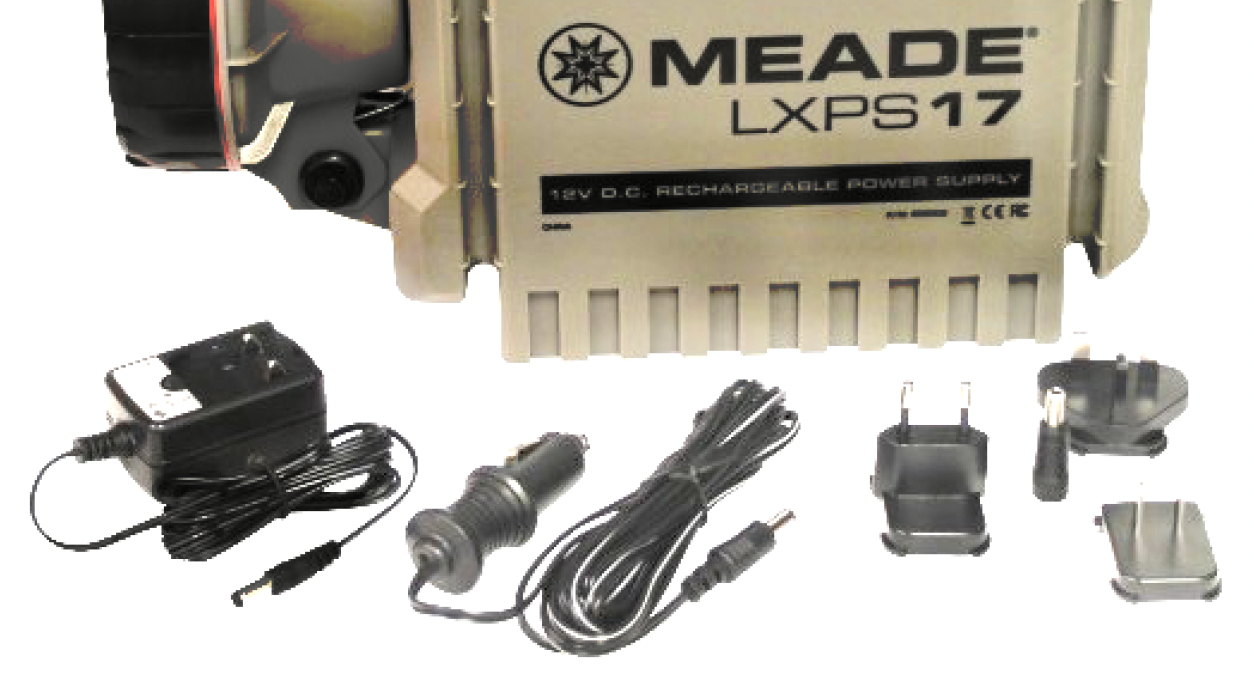
About the Meade Battery LXPS7 
Manufacturer part number: 606001. Meade Power Supply, 12V, 7 amp hour capacity. For field operation of a 12V telescope. The battery can manage the telescope and USB devices requiring power.

With Meade’s new LXPS 17 Rechargeable Portable Power Supply you can easily power your telescope and electronic devices in the field. 12V, with a massive 17 amp-hour capacity. Connect your equipment using the two included 12V cigarette lighter ports, two USB ports, or through the positive/negative terminals on the back. The LXPS includes a built-in circuit breaker and fused circuit to protect your valuable equipment. Includes both USA and international type AC adapter plugs so you’ll be able to recharge the LXPS anywhere you travel. The Meade LXPS also includes an adjustable super bright 30 LED spotlight and white flashlight with red filter attachment, perfect for setting up and tearing down in the dark. Additionally, the LXPS 17 includes an AM/FM radio, siren, and tethered detachable light. The LXPS can also be used for emergency situations like jump starting your car battery. With 17-amp hours, the LXPS 17 is the must-have accessory for star parties, long observing sessions and the dedicated astronomer.

Features a rechargeable lead acid 7AH battery and includes wall charger, LED charge level indicator, two 12V cigarette cord type outputs, power cord (cigarette plug type), hinged LED spotlight, hinged high output LED spotlight, flashlight with red lamp cover and strobe function, two USB outputs rated at 5V, built-in carry handle, shoulder carry strap, and one set of 12V output posts. Product is fuse protected with a replaceable fuse. Weight is 8.4 pounds. Size 11.3 x 9.3 x 5.2" / 28.7 x 23.6 x 13.2 cm.

Astroimaging Accessory - Compass for the Celestron Nexstar 6 SE Telescope


Astroimaging Accessory - Observatory Telescope Compass for the Celestron Nextstar 6 SE
This section of the Astroimaging website will examine accessories for the new Celestron Nexstar 6 SE. When designing an open measured sky view for local environments, a manual non-electronic compass is a very important accessory. The compass chosen serves telescopes, the marine industry, Boy Scouts, campers and the professional military.


The Eyeskey Optics Company model EK4076 handheld compass is of compact size and lightweight, easy to handle and carry. For night use, luminous dial and luminous magnet arrow, rotary 50mm dial with 360° scale. Accuracy is +- 0.5 degree. Made of high strength engineering metal, glass, and covered by enamel paint, which is capable of working under extreme weather conditions. The compass has a reading lens, aiming line, cover, graduated metric and imperial scales, cover, distance measuring notches, inclinometer, hinged, glass viewing portal, level bubble, threaded for tripod, wind rose, central support, 360-degree pivoting dial, reading adjustable eyepiece, north line with north arrow, metal hanging/holding ring, and case. Convex lens makes reading dial scale more clear. It has a lengthened proportion scale straightedge, and the cover can be flipped up and down 180-degrees to double the measuring range.

— a compass to vastly improve directional knowhow —

Fast and accurate homing/positioning time is 5 seconds. Waterproof and shakeproof, suitable for motoring, boating, camping, mountaineering, exploring, hunting and other outdoor activities Foldable metal lid. Floating compass dial with 360°scale. Luminous magnet arrow. Adjustable prism lens. Fine workmanship, attractive appearance, durability. With CM and INCH ruler on each side of the compass. Measures slope. To measure direction, longitude and latitude, horizontal and so on. Weight is 287 grams and size is 95x66x28 mm. Cost is approximately $25 shipped from China.

The astronomical compass was used to survey and determine the directions and dimensions of the open sky view from the observatory deck and is useful for the manual location of the Moon and planets from the directions of various environmental obstructions and to develop a mercator projection for the availability of clear viewing areas for future observations and studies. It can provide detailed and accurate data, determine the positioning of rising and setting of celestial objects, monitor times version cardinal directions, but only when not in the vicinity of cell phones, magnetic devices, magnetized metal, and other electronics.

The compass updates the Celestron Nexstar 6 SE telescope leveler and can provide a fast survey of the celestial night sky before observing. With this compass, directions will be known even if obscured by tall skyscrapers, mountains and other obstructions.