Showing posts with label LOG. Show all posts

Friday, May 27, 2022

Log Saturday May 28 2022


Log Saturday May 28 2022

Weather

The weather is day and night non stop rain and in a new cycle of Monsoons. However, for exactly 5-seconds today, the sun popped through a sucker hole in a patch of overcast that formed a broken cloud. There was not enough time to use the telescopes on the Sun and then it went back to raining. It's my fault as I bought two new telescopes and this is the double whammy of the curse - new telescopes equal clouds and rain.

The Curse of New Telescope = Clouds
https://otisastro.blogspot.com/2022/05/the-curse-of-new-telescope-clouds.html
Sticky Clouds
Lofted Fog
https://otisastro.blogspot.com/2022/05/lofted-fog-phenomenon.html

Left: weather update shows another two weeks of storms and rain. Buying two new telescopes increased the bad weather curse to the maximum.

No Occultation of Moon Venus
On Friday, it rained and the rare Venus being occulted by the Moon was not visible. Above is a computer planetarium simulation.

Observatory Platform
The required number of 40 recycled bottles is now saved up for completion of the telescope outdoor observatory platform but the deck is soaked from rain and the fitting will need to wait for dry conditions. An extra 3 bottles are available and this number may grow.

New Astro Imaging Section
The Astro Imaging web site has introduced a new section, "What's Behind the Clouds." A computer planetarium program will be used to see and study the simulation of celestial events that otherwise could not be seen.

Sun Baked Observatory
Sun Baked Observatory is continuing to do studies with past solar data collected by the telescopes and studies at the following links:

History of Solar Telescopes posting.
Sun Baked Observatory Explores Venus Atmosphere During Solar Transit
Sun Baked Observatory
Sun Baked Observatory Report

Examined a Cloud Hole
For the first time, I examined the contents of a cloud hole, and wow, it's full of stuff!

Looking inside an Atmospheric Hole

Ways to See Through Clouds
I'm working on ways to see through clouds, possibly for daytime solar and lunar observations.

Spectroscopic Clouds

Categorizing New Inventions
My new inventions for processing images are listed at this posting along with some standard ones.

Processing Techniques Invented for Small Telescopes
Artistic Creative Scientific Astro Processing
https://otisastro.blogspot.com/2022/05/artistic-creative-scientific-astro.html

Align Telescope without Polar Alignment or Stars
Let's say you're on a balcony or deck of a tall skyscraper and behind you is North which is totally blocked. How to align the telescope? Probably the sky is blocked and you won't get the alignment stars from sky quadrant to sky quadrant. Now what? Here's a simple method.


Contents
Weather
No Occultation of Moon Venus
Observatory Platform
New Astro Imaging Section
Sun Baked Observatory
Examined a Cloud Hole
Ways to See Through Clouds
Categorizing New Inventions
Align Telescope without Polar Alignment or Stars

Tuesday, May 24, 2022

LOG Tuesday May 24 2022


LOG Tuesday May 24 2022

Weather
The weatherman has updated the weather forecast to rain every day for the next two weeks. This is undoubtedly the curse of new telescope = rain. And to think, I bought two new telescopes and all the accessories! I don't know when I will ever see clear skies again! Even the distant mountains are going invisible.

The Curse of New Telescope = Clouds
https://otisastro.blogspot.com/2022/05/the-curse-of-new-telescope-clouds.html


Left: The mountains are almost totally invisible. No solar imaging today and no imaging of the mountains or wildlife studies. Rain continued all day and into the evening. The weatherman claims the rainy season Monsoon has reared its ugly head.

Left: after 20 minutes, the mountains were gone due to the proverbial mix of rain, mist, fog, smoke, air pollution, smog, and 100% humidity.


Observatory Construction
Work on the outdoor observatory has stopped due to inclimate weather and rain. A total of 40 recycled water bottles, each at 1,000 psi strength, blanketing 40,000 psi for earthquake resilience, are now collected and waiting for clear weather and the fitting process to the telescope platform and to the elevation safety guard railing which is anchored in steel, cement, and granite on the side of the skyscraper. The telescope platform must conform to a small granite floor a mere 15-inches in depth. It will be advantageous to automate most of the telescope functions, limit load weight, and minimize exposure to the outdoor elements. This can include bites from deadly bugs in this subtropical/tropical zone.

Sun Baked Observatory Study
Studies begin with successful data obtained from previous/past historical imaging sessions. I'm working with several software packages and testing the results on the sun. Developing new techniques and inventions will be a high priority. Several posts detail the telescopes used for solar studies that began in 1965 through the present day. https://otisastro.blogspot.com/2022/05/sun-baked-observatory-explores-venus.html

Orders
All remaining orders are on temporary hold due to mitigating and extenuating circumstances.

Indoor Work
Indoor work, such as organizational, is proceeding with indoor observatory areas.

Telescope Lifting
After heart surgery and the long recovery process, in order to ever lift the most heavy telescopes and their mountings again in the future, I have taken up weightlifting. Today I worked arms and legs on a split routine with multiple sets of repetitions. It's hoped the sum total of all this work will lead to greater longevity, increased health and well being, and a possible life span to 2066 - the quoted life of some of the heart related machine components.  https://humanoidolabs.blogspot.com/


Lofted Fog Phenomenon
Under an Overcast Sky: Just when we thought one small patch of Lofted Fog was interesting, a short time later 20 appeared. These are big and spread across the ten mile span. Locals claim that weather patterns have changed from the traditional seasons and predicting when the current Monsoon rainy period will end is anyone's guess.

Contents
Weather
The Curse of New Telescope = Clouds
Observatory Construction
Sun Baked Observatory Study
Orders
Indoor Work
Telescope Lifting
Lofted Fog Phenomenon

Wednesday, May 18, 2022

Log Wednesday May 18 2022


Otis AstroImaging Log Wednesday May 18 2022

Weather
After I bought the new sun telescope, the local weatherman announced the return of the Monsoon season (rainy season) which is highly unusual for this time of year. I can expect another month of rain every day. This is what happens when you buy a telescope.

Solar Telescope
The Solar Telescope is prepared, filterized, and ready to go when the sky clears. Several times in the late afternoon, the sun briefly appears through haze and in between openings in the clouds. The opening are short lived and the direction of the evening sun is on the opposite side of the observatory - blocked by a tall skyscraper. The roof, thousands of feet high, is a less safe option at this time as high winds often accompany the Monsoon. The higher you go, the stronger the wind. At ground level, there is no wind, but at the upper atmosphere level the clouds can move 1,000 mph. When the cycle of weather rotates, it will flip flop to some brief cloud openings in the morning sky when the sun is properly positioned for solar study.

Observatory Platform
The Observatory Platform needs only 3 more empty water bottles and construction can resume. It takes a total of 40 bottles to complete the backing spacer. Each water bottle base can handle up to 1,000 PSI. The add-on backing is required because the outdoor steel rail has a raised floor foot that prevents the original platform configuration from butting up against the railing. With the added backing, the platform will reach the railing and have a firm strong area for connection. The platform is now made dual purpose, and will have full functionality both indoors and outdoors depending on long term seasonal environmental conditions.

Earthquakes
When installed outdoors, the observatory platform will be anchored to the steel railing with a backing of 40 extra strong 1,000 PSI empty recycled water bottles with a blanket 40,000 PSI strength. The connection is to withstand a category 5 to 5.5 earthquake force jolt. As earthquakes are frequent and common, there's no telling when the next one will occur. Therefore, the platform may remain firmly anchored on the outside observatory and have a covering in place to resist the weathering for at least a season. Earthquakes are another topic regarding the telescopes and will be handled as a separate challenge.

This Pacific area is active geologically, formed on a complex convergent boundary between the Yangtze Subplate of the Eurasian Plate to the west and north, the Okinawa Plate on the north-east, the Philippine Sea Plate on the east and south, and the Sunda Plate to the southwest. Subduction changes direction at this location. The upper part of the crust is primarily made up of a series of terranes, mostly old island arcs which have been forced together by the collision of the forerunners of the Eurasian Plate and the Philippine Sea Plate, which is moving to the northwest. These have been further uplifted as a result of the detachment of a portion of the Eurasian Plate as it was subducted beneath remnants of the Philippine Sea Plate, a process which left the crust underneath this Pacific area more buoyant.

Earthquake-Proof Telescope
One of the best ways to handle the outdoor observatory platform earthquake forces on the telescopes will be to bring in the telescopes to a safer prepared haven indoors after a night of use. For this reason, telescopes are kept lightweight on purpose and are relatively easy to move. Earthquakes shake up and down, left and right, and in contorted directions and can last a full minute, more or less. The force of an earthquake can vary during the earthquake and rapid buzzing and vibration is not uncommon. Telescopes which have a higher center of mass are easy and dangerous targets for quakes to topple. The higher the center of mass, the more the moment of inertia will result. Many small earthquakes are happening all the time, many of which are not detected by human body, or, a feeling of motion sickness may result. There are many ways to detect these - one way is observing things in a residence that will appear to slip, slide and fall without reason. 

Ordering is a Three Step Process
Step one is complete. The sun telescope arrived with the purchased solar filter accessory. Step two remains to obtain solar filter number two and a solar telescope interface to a new mount. Step three remains, to order a number of mixed astro parts necessary to complete intricate operations at Sun Baked Observatory.

Contents
Weather
Solar Telescope
Observatory Platform
Earthquakes
Earthquake-Proof Telescope
Ordering is a Three Step Process

Friday, May 13, 2022

Log Friday May 13 2022


Log Friday May 13 2022

Acuter Maksy 60 EPs
Every eyepiece tested with this f13.5 telescope worked admirably - short FL, long FL, aspherics, plossls, orthoscopics, from 6mm to 55mm. Even the zoom lens was working.

Zoom Eyepiece Usage
The challenge with the zoom lens is it requires holding the EP and turning the barrel which introduces vibration. It also has a substantial amount of weight offsetting the Acuter Maksy 60 telescope balance when using the small stock tripod.

Moon, Sun & Land
The 60mm Maksutov-Cassegrain catadioptric introduced by Acuter is primarily a Moon, Sun and daytime objects telescope. As the useful magnification ranges from about 48 to 72x with 120 being the theoretical maximum, the image scale remains small. 

Maksy Planet Imaging
It might be possible to image planets with the Acuter Maksy 60 but the image scale would be very small. A mobile phone has a zoom function which may help. It would be best to take a video with thousands of embedded images and use software to stack, enhance and edit the results.

Maksy Mounting
To steady the image, attaching the telescope to another with a sturdy tripod is a good idea. This is a good solution for planets because the supplied tiny tripod is not stable enough for high resolution planetary imaging.

55mm Eyepiece
The massive Televue 55mm EP, weighting more than the telescope OTA, was attached to the minuscule Mak in a highly successful experiment. This gave 14.75x instead of the (37.5x with the supplied 20mm EP).

Observatory Platform
Construction continues, now waiting for the final 8 empty water bottles for recycling into the platform. It's noted the platform will perform dual, with two telescopes either indoors or outdoors.

Astro Drawing/Sketching
Mike Otis added electronic digital astro drawings to his repertoire using electronic paint and draw software on the Apple iMac with Catalina. Recent experimental renditions include the Sun, Jupiter, Ganymede, Io, Europa, Venus, Mars, Saturn, and the current planetary conjunction. In 1955 I used a pencil and art paper to draw the Moon. In 2022, I use a computer and sketching & drawing software.

Scaling Inference
When drawing celestial images at minuscule image scale, Mike Otis creates a drawing/painting that undergoes a visionary scaling inference, making it much bigger and retaining the original's detail or no detail. A person remembers or notes the details at the small image scale and paints the images into a much larger scale.

Astro Painting Scale Inference
When the telescope's image scale is too small for planetary astro imaging, try direct observing to paint the object using the mind's eye scaling inference.

Contents
Acuter Maksy 60 EPs
Zoom Eyepiece Usage
Moon, Sun & Land
Maksy Planet Imaging
Maksy Mounting
55mm EP
Observatory Platform
Astro Drawing/Sketching
Scaling Inference
Astro Painting Scale Inference

Sunday, May 8, 2022

LOG Sunday May 8 2022


LOG Sunday May 8 2022

Nexstar Observatory

We have now collected a total of 29 recycled distilled water bottles to be used for making the back side extension of the indoor/outdoor platform extension. The distilled water bottle is ten times the strength of a regular water bottle. Further design indicates ten per row are needed with 4 rows for a total of 40 bottles required to complete the project. The cache increases at one per day and we will have enough by the end of eleven days. "You will be in the green world."


Orion CT80
House of telescopes! After a period of about 2 years, the Orion CT80 was stored in the shipping box, and was a situation of basically not knowing how to mount it. Today, I've become so familiar with mountings, it was a piece of cake establishing how to mount the OTA onto a tripod and also how to attach a finderscope. The CT80 comes without the finderscope, without the mount, and with no accessories like EPs or focal extensions so added eyepieces will come into focus.

Left: the Orion CT80 came with only the OTA tube. This weekend, a finderscope, finderscope ring mount, dovetail shoe, and HF-3110 tripod were added for standalone functionality. A future order will include a 90-degree diagonal with 99% transmission.

Tripod HF-3110
Free tripod! There's an interesting story around this tripod. About six years ago I had the need to mount my camera on a tripod and visited the night market to find one. I chose the best and largest available at that time. A local friend bartered with the merchants to get the price down so it was a very good deal. The tripod has four long extensions so it can raise a camera or telescope a good distance off the ground, and the best features are low cost, small size and ultra lightweight. It has its own bag and is ideal for portability. So this tripod is excellent for initial use with the small Orion CT80 OTA and the upcoming Acuter Maksutov.

Acuter Maksutov Telescope
The minuscule mak! Monday is the big day! Coming soon is a new Acuter Maksutov 60mm small light blue telescope (Maksy), tentatively to be ordered on Monday, May 8, 2022.

Left: the minuscule maksutov will be ordered without the matching blue finderscope. It will however, contain the very high quality sun filter,  sun finder, and AMICI prism in the 90-degree diagonal for upright and correct orientation views.

While the Orion CT80 OTA white metal tube is 14.7-inches long and 3.25 lbs, the Acuter Maksy is only a third of that weight and its plastic tube is only 8-inches long. It should work better with the HF-3110 tripod due to lighter weight and it also will mount alongside the Celestron main observatory telescope OTA, putting less stress on the mount and motors in the Nexstar 6SE. The popularity of the small high resolution Maksy with exceptional optics is spreading like wildfire and is now sold out at most places. One key feature is the accessory roster, which lists a solar filter claimed to be comprised of high quality Baader film and mounted with its own solar finder. With the right techniques and accessories (CMOS astro imaging camera, processing computers), computer processing software power, additional h-alpha and spectroscopic filters, solar results could be spectacular for the minuscule Mak. Plus, when attached to the main observatory telescope, the telescopes will share guiding, tracking and all the advanced resources provided by the Celestron Nexstar GOTO mount.

New Observatory Naming
It does seem that Nexstar Observatory has caught on for a new name. The previous name of NTO Nexstar Telescope Observatory is retained but not being used in its entirety at this time. The nice thing about NO or NTO is it can be reconfigured for many additional applications, indoor, outdoor, through glass, no glass (lunar, planetary, deep sky, solar, nature & conservation).

Green Gem Laser Finder
The green gem laser finder on the Nexstar was removed and decommissioned for safety and legal issues.

INDEX
* Nexstar Observatory
* Orion CT80
* Tripod HF-3110
* Acuter Maksutov
* New Observatory Naming
* Green Gem Laserfinder

Thursday, May 5, 2022

LOG Friday May 6 2022


LOG Friday May 6 2022

Largest Telescope
I was asked about the location of the very large telescope which is amped up to a diameter of 140-inches. It's true, the telescope is a behemoth that takes up an enormous amount of space with its massive counterweight and equatorial mount. The OTA alone is too heavy to lift so random assembly and take down is out of the question. It's also incapable of being lifted or moved by a single person after its assembled. The current idea is to maximize the deck door opening and do observing the same as we did here:
https://space1usa.blogspot.com/2019/03/space1-singularity-observatory_20.html
This requires freeing up an entire room and verifying the deck doors are wide enough. The alternative is to relocate the telescope to the top of the skyscraper inside one of the buildings made into an observatory. We'll need to observe precautions with potential wind at that level - thousands of feet in the air.

Nexstar Observatory
This observatory is still under construction. A total of twenty seven empty water bottles are now collected, however at least 40 will be needed to construct the platform backing (tentatively four rows of ten per row). The rate of collection continues at one per day on the average. It's noted the platform will work both indoors or outdoors, bringing the telescopes at both locations above the outside metal guard rail level for non obstructed views. The Nexstar Observatory is now intended to use a battery of telescopes that take advantage of various efficient reconfigurations for multiple applications.

Solar Observatory Upgrade
The solar observatory is getting an upgrade with an additional sun telescope. The second telescope will serve to rapidly test various filter combinations, quick check the solar disk sunspot status, and perform various testsand experiments in varying spectroscopic ranges. Other upgrades to the newly founded solar observatory will include a variety of image processing software designed for solar enhancements.

Weather Station Monitoring
We continue to observe the weather conditions at our weather station, noting the seasonal changes and short term variations. We are currently in a random varying stretch of overcast skies but this is breaking up and is beginning to have openings for observing. The locals specify clear skies being more prevalent during the summer.

Left: 101 by Mike Otis using iPhone to analyze weather conditions

Laser Status
Even safe low power pointing lasers used in businesses and schools are getting a bad rap these days. The police are calling these weapons and making arrests for possession. The attorney said the police cannot show intent to use as a weapon or all kitchen butter knives will become weapons of intent. Hence the controversy. Are cars also weapons of intent to kill? Pilots of aircraft are very paranoid as a few bad war players with high powered lasers are in the picture and causing a mess. There's an airport located not too far away from the observatory and as noted there are some dwellings on the mountains. Being in a high populous region, there's bound to be at least a few misunderstanding individuals who see the star pointer laser light and form a misinterpretation. Therefore we have canceled orders for all future lasers, removed the telescope low power star pointing laser, and now the laser to the Moon project is on hold or cancelled as are all other outdoor laser experiments. The laser usage will not be resumed until the laws become more clear in favor of low power pointing lasers used for telescope astronomy.

One Shot Camera
The ZWO ASI224MC is a one shot color camera. With one exposure, it captures color, made up of three constituent colors added together. There's no need to use a collection of four filters, red, green, blue and IR subtract, and take four images just to create one color photo.

INDEX
* Largest Telescope
* Nexstar Observatory
* Solar Observatory Upgrade
* Weather Station Monitoring
* Laser Status
* One Shot Camera

Saturday, April 30, 2022

LOG Saturday April 30 2022


LOG Saturday April 30 2022


Updates
* Situation with B&H is resolved
* Water bottles collected are now up to 22 for the new observatory platform. We are looking at adding another resource to increase the supply of empty water bottles so the project can be completed sooner.
* The orders from the observatory are reestablished with B&H. This will allow the solar observatory to continue.
* Work is continuing on the solar observatory and a new solar telescope will be added to the array of telescopes. It will include a special solar filter and have ultra light weight of only 1-pound so it can be mounted on the main Nexstar 6SE and take advantage of its mount's solar and sidereal guiding and tracking. As this is a Chinese telescope, work is proceeding to translate the web sites and look for appropriate reputable companies to order from. The telescope is not yet available in the USA at the sources we reviewed.
* A new project is opened to contact astro imagers in the same city as they are dealing with many of the same issues. It will be interesting to see a new perspective of how they resolve the biggest challenges. Making first contact is difficult as everyone so far does not use or provide an email address.
* Weather reverted back to a total sheen overcast with no clouds or cloud breaks and the visibility of the Jupiter Venus Moon etc. conjunctions is now blocked from view. This will allow time to revert to a focus on ordering and product selection challenges. Of course weather can change in a 20-minute period and monitoring the environment will be helpful.
* Work is continuing on the eyepiece list to calculate focal lengths. It's expanded to include Barlow lenses and Focal Reducers. One thought is to create a list of values for each telescope combination.
* The updated observatory list is completed and published.
* A new telescope list of all telescopes purchased, designed, constructed, built and used by Otis is being prepared although the work is daunting given so many telescopes from day one to historically analyze.
* A file folder is opened up for solar R&D, including resource sites and image processing details regarding solar imaging. A large number of video sources are being reviewed on YouTube.

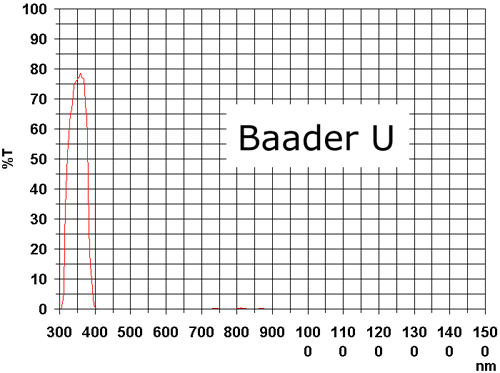
* Solar information was found on the potential result of solar observing in violet light. This is something we want to try at the solar observatory however see the note. Work continues to find an extreme violet filter that will function well within the limits of the ZWO ASI224MC camera's spectroscopic range.

Note: The U-Filter is not a visual filter since the human eye can not resolve images clearly in these portions of the spectrum transmitted by this filter. And particularly if attempting to see the Sun with these filters there are health issues involved. The U-Filter is not a visual filter since most telescopes and eyepieces can not pass light in the UV. According to the spectra chart
from ZWO, the camera is cut off at 400 nm on the chart where it has 0.4 relative response. It functions down to 300 nm. Note: give the telescope has a solid glass corrector plate and glass EPs, and the filter itself is glass, doing any kind of extreme ultraviolet work is most likely inadvisable, especially since glass absorbs and takes out he UV, the UV filters are so expensive and usually unavailable. Now there is some discussion as to the validity of the actual filter.

Thursday, April 28, 2022

Log Wednesday April 28 2022


Log Wednesday April 28 2022

Observatory Construction
Time moves quickly and the Nexstar Observatory project now has collected a total of 20 empty water bottles. This will cover approximately two of four rows in the back of the telescope platform for mounting directly onto the steel railing.

Mounting the Telescope
The Nexstar 6SE telescope was moved onto the top of the platform to see if it would easily slide off and if so, how should it be mounted. The telescope has several strong gripping rubber pads on the bottom and this creates tremendous gripping force on the top of the platform. If any mounting attachment is used for the telescope, it will be minor with perhaps a few short bungee cords.

Cleaning the Optics
The single pane of white optical window glass at the indoor observatory was cleaned on the inside with window cleaner and tested.

Lightweight Guider
A project was opened to locally acquire a very light weight one pound OTA guiding telescope for mounting on the main Nexstar 6SE telescope. A search began for various mounting hotshoes that would fit the main telescope.

Solar Observatory
Work continued on the Solar Observatory and a new telescope with a custom solar filter is being examined for purchase. This would satisfy the criteria previously established for the solar observatory and make solar observing much more convenient. The results could enable higher resolution with the chosen mounting tracking and the accuracy it can provide.

Laser Through Glass
The lasering project and test was a success and lasers can now be used as object finders and pointers when indoors and observing through a pane of optical window glass.

Tuesday, April 26, 2022

Log Tuesday April 26 2022


Otis Astroimaging Log Tuesday April 26 2022

The Night Sky

Arose at 2:30 am to a spectacular view of the crescent Moon and flanking Venus. The other less bright objects and stars were obscured by haze so the alignment conjunction will need to wait for another night.

Nexstar Observatory (NTO)
Work is proceeding perfectly on the Celestron Nexstar 6SE Observatory at the rate of one empty water bottle per day. The total is now up to 17. The tape ordered was 50/50. Half was the correct clear 3M tape. The other was an undesired tan other brand which was tested and will not work. I think the 6 rolls of 3M tape will be enough. Tools will not be needed - no need to purchase an electric drill, saw, etc. The assembly uses off-the-shelf tape, motorcycle cover, book shelf unit, bungee cords and empty recycled thick water bottles. The telescope was removed from the tripod and sized on top of the observatory platform, check stability, clearances and usage.

Accessory Orders
The accessory orders are going good. Decisions were finalized on solar filters for the new solar observatory. (This will allow astro imaging of solar sunspots, granulation, eclipses, transits, and limb effects.) Other items include a much larger level for the Nexstar telescope mount, a possible new planetary guide telescope (Maksutov Cassegrain) with an OTA that's only 8-inches long. It can attach with a camera hot screw mount. Batteries for those devices that take a button power source. Rolls of DIY hose clamps for attaching the Orion CT 80mm refracting telescope, a finderscope mount and dovetail base with screws, a new tri device mount, ultrawide angle EP, several Barlows for lunar and planetary imaging (the new barlows merely thread into oculars much like colored filters), more plastic & resin finder scopes, etc.

Vendor Selection
A tip for vendor selection now involves checking out a number of reputable sources and looking for specific telescopes, accessories and astronomical items. Shopping around can save money with the item, postage and shipping, tax, and fees associated with customs clearance. For example, China sources sell a smartphone to telescope adapter for $2 while Amazon sells the same item for $37.95. PChome is now selling telescopes. There are numerous USA companies which now have inventory but the shipping may be costly.

Diagonal Note
The replacement diagonals with high quality 99% reflectivity dielectric coated optics were much too large and would interfere with the telescope OTA and base when viewing near the zenith, therefore the stock diagonal will not be replaced.

R&D
Research and development continues for the Celestron Nexstar 6SE telescope and the invention of new techniques to make it more powerful and more capable. Thus far, techniques include the comforts of indoor observing through a pane of optical white glass, telescope amping to increase a telescope's diameter, Transdigilog (transitioning digital and analog), and TransAs (transitioning art and science).

Saturday, April 23, 2022

Log Saturday April 23 2022


Otis AstroImaging Log Saturday April 23 2022

NTO Nexstar Telescope Observatory
NTO is in operation. The refinement of the telescope platform is in progress. All parts and components for the platform are ready and waiting for assembly except the empty water bottles. Currently we have 15 bottles on hand. An order was placed for more water/bottles. The rate of collection is about 1 empty bottle per day. Some experimenting will determine the exact number needed. The bottle bases with the ability to withstand 1000 PSI each need to be placed in proper positioning on the back of the platform to conform with the steel rail.

Enhancements
TRANSDIGILOG - Transitional Digital & Analog
AMPING - Amplification of Telescope Diameter
TRANSAS - Transitioning Art and Science
NTO is fully operational with image processing and enhancements to include the new invented TransDigiLog. Combining a special transition of digital with analog, coined TransDigiLog, the process takes the best of both worlds - modern digital imaging and the foundations of spectroscopic emulsion based film. In this case, the spectroscopic film is transitioned to digital color, which never existed or was not popular during the original historical era of common astronomical spectroscopic usage in the early 1970s.  Also included with the newly added repertoire of power techniques for the Celestron Nexstar 6SE, invented by the author, is Amping. Amping takes a given telescope diameter and qualitatively gives it the appearance of an aperture 10 or 100 times larger. The third technique uses a combination of transitioning art and science, TransAS, to bring out highly specific features and renditions. The science side is highly quantitative while the artistic side is very qualitative in representations.

First Image Processing Result!
The first webpage with the first image processed and enhanced result, from the Celestron Nexstar 6SE telescope, was posted yesterday Friday April 22 2022. The invented technique by the author takes both digital and analog to create a new advanced and enhanced representation of the COSMOS that vastly outstrips the original in many technical aspects of imaging. This employs more than one method techniques application and of image processing. Additional processing is designed to remove light pollution, air pollution and upper atmospheric haze. The image is taken with a Celestron Nexstar 6SE telescope in the famous nebulosity area of the constellation Orion where stars are born and vasts wisps of bright red hydrogen atoms form clouds of interstellar gas filling the vastness of this region of space and time.

Thursday, April 21, 2022

Observatory Log Update Celestron Nexstar 6SE Thursday April 21 2022

Observatory Log Update Celestron Nexstar 6SE Thursday April 21 2022
Update for the construction of a new Nexstar Outdoor Observatory using only simple available parts, materials and no tools

WATER BOTTLES
I now have 12 water bottles - one extra today. I don't know the liter capacity of a bottle but it appears I can down one bottle per day. So this is the data rate of expansion of the water bottle quantity per unit time. The greatest use of water is coffee, tea, drink mixes like potato and protein, other than pure water consumption. The number of empty bottles occurring per day will be monitored and increased if possible. If 50 bottles really are needed (the design may vary), that leaves another 38 required. At one per day accumulated, 38 more days are needed, or just under 6 weeks. If the rate can increase to two per day, that will take 19 days to collect the remainder of the bottles needed, just under 3 weeks in half the time.

BUNGEE CORDS
Bungee cords were ordered from two new companies and are not yet delivered to the door. However, one package will be small and small packages are held at the administration office. Since the admin has new workers, the bungees may not be delivered to the door. The Internet shows at least one package being delivered to the admin. Delivery of the first package is expected today and if it does not arrive, phone calls will be made.

Bungee Update 5:00 pm - After the phone call was made to the building administration, two packages were delivered to the door. One package has eight cords all the same size (19-inches). The 2nd package had only 2 cords (37-inches) and (48-inches). The old cord on hand is (57-inches) and appears to have lost some stretch. It can still be used by supplanting one or two 19-inch cords in the stream. I originally wanted five of each, however by connecting various lengths together, the existing cach of cords may be sufficient to fully complete the project.

WRAPPING
A simple method of wrapping and covering the observatory platform is needed to ward off intense solar radiation, pollution, wind, mist, rain, bugs, birds, dust, and the onslaught damp humidity. The platform will be bungee'd to the metal railing. A technique to insert the wrap tarp under the bungees will be needed. It's likely the solution will encompass keeping the wrap intact on the back under the bungee cords and inserting the protective flaps across the top and front.

ORDERS
Work is proceeding on solidifying the orders for the observatory telescope's accessories from a multitude of vendors. Orders are being handled one at a time. Currently the wait is for two orders for bungee cords. When this arrives in two packages, the next frame of order will include the solar observatory.

WEATHER
Weather is highly changeable as usual and has turned from cold, overcast and raining to a clear blue sunny sky with some patches of upper haze, entirely worthy of solar observations. Weather has completed defied the 10-day predictions and completely baffled the meteorologists to the happiness of local astronomers on the island.

HIGH RESOLUTION SOLAR OBSERVATORY
It has become imperative that we soon complete a new solar observatory, given the increasing number of clear sky days. The decision is not yet made in the purchase of a solar filter accessory. The problems are vendors not providing full information and not having access to full information. In lew of buying a fully equipped expensive solar telescope, a decision will be made soon to select an appropriate safe solar filter. The solar observatory is described in other postings and will be at level 1. Observations will be primarily under the classification of astro imaging with targets being the limb, granulation, sunspots, determination of solar flares and storms, transits and occultation of planets and satellites the ISS International Space Station. Additional studies may measure the variable changing size and shape of the sun, and the distances to the Earth. The telescope employed will be the new upgraded Celestron Nexstar 6 SE in potential amping modes for apertures of at least 6, 60 and 600 inches in diameter.

New Solar Observatory with the Celestron Nexstar 6-inch SE

Log Update Celestron Nexstar 6SE Thursday April 21 2022

Celestron Nexstar 6SE Log Thursday April 7 2022 - Solar Observatory

Astro Log for Monday April 11 2022

Monster Astro Projects - Observing the Sun

My Observatory Summary
Taiwan Skyscraper Rooftop Observatory - Venus Transit Across the Sun

StarryNight Solar Eclipse

Sunday, April 10, 2022

Astro Log for Monday April 11 2022


Above photo: During a recent inspection - not a speck of dust and no imperfections in this pristine new Celestron Nexstar 6SE corrector plate and optics, flawless optics, bright clear images, remarkable true color viewed in objects, no visible aberrations, and the latest improved StarBright XLT coatings. This performs like a serious baby EdgeHD when compared to its big family: the 9.25" and 14" with clear sharp images across the FOV clear to the edge. No visible coma or achromatic aberrations. No astigmatism or spherical defects.

Astro Log for Monday April 11 2022
The logs will contain log diary astro entries for things happening, various thoughts and ideas, projects being cultivated, suggestions, ponderings, and the addition of notes at the end with with various resolved discoveries made.

* I will think twice before observing with an open window after a visitation by a very large beetle bug. It's conjectured that it hitched a ride or flew in from the mountains into the city.  (Blister beetles, sometimes called acid flies, belongs to the Meloidae family of beetles that secretes toxic Cantharidin, which is harmful to humans and livestock. Others reported beetles landing on their shoulders and it took a wild scuff to get rid of their tenacity presence.)

* A number of people are envious that I have access to a great view of the mountains and trees. Location can be an advantage when living in the concrete jungle.

* The bucket list is long, but some simple things are aligning the finderscope, repositioning the telescope closer to the window for a larger sky view, testing the Apple iPad for compass function, washing the windows and deck area, and moving the accessories & astro imaging lab table.

* With the iPhone XS not having a working compass, the automatic sky positioning and calibrations will be delegated to the older Apple iPhone 5. Does this have something to do with app software versions? Check this.

* Now waiting for delivery of an IKEA bookshelf unit that will serve as an outdoor mount, by replacing the tripod. The telescope will set on top and there may be some sort of anchoring devised.

* Recent purchase of a remote camera shutter from the Night Market has tested perfect for the iPhone XS Max, and will stop camera vibrations from spoiling the images. The older remote shutter works with the older iPhone 5 and it currently needs a 3v lithium ion battery.

* There are two items on the USA purchase list, both manufactured by Celestron - the passive dew shield and the updated solar filter. A heated solar filter would assuredly destroy lunar/planetary images with the bubbling and instability of mixing different temperature air.

* The new solar filter will fit the larger 6-inch telescope for the solar observing program and is more safe in the way it attaches. The prime solar telescope will change from the Orion 4.5-inch RFT f/4 StarBlast to the Celestron Nexstar. The 6-inch has a larger image scale at f/10 for better sunspot data.

* Some people talk the talk and don't do the walk. Their teeny unrequited lens sets idle on the shelf. Here at HSO we are making progress rapidly by putting new systems into place, developing new programs, exploring the realms of science, and making new discoveries.

* The Chinese astro order is almost ready - it will include a negative projection lens set to gain the largest lunar and planetary image scale at 300x. At a 5x multiplier and 60" FL, it reaches 5x60=300. Years ago I used a simplistic variable optics train with spectacular results and I expect this simple device will perform equally well. Tests with $700 optics are no better than $7.95 optics for all things considered.

* One thing to try is the workability of a negative projection lens with the smartphone and camera mount. So far, positive EP projection is working fine.

* On the bucket list is also to try out all the EPs with the 6SE. The other RFT telescopes at f/4 have some eyepieces that do not work well as they show the shadow of the diagonal obstruction towards the center. This effect was seen both visually and photographically. However, at f/10 on the Schmidt-Cassegrain that problem should not exist.

Notes: Celestron Nexstar 6SE  Power Jack
It's discovered that the power jack on the Celestron Nexstar 6SE is not meant to be threaded. The power plug just plugs into it without any way of permanent connection, therefore it can pull out if yanked hard enough. The extra power amp AC to 12 volt DC supply accessory is threaded but just ignore the threads. Use a cable loop around the mount base to secure the cable. As the telescope is not rotating in circles, the changing cord position is not a concern (due to the one cardinal direction sky viewing window).

Thursday, April 7, 2022

Celestron Nexstar 6SE Log Thursday April 7 2022


Reflections off and through the Celestron Nexstar 6SE corrector plate

Celestron Nexstar 6SE Log Thursday April 7 2022


Flying Saucers
This we have not seen. All sky activities appear normal from the new location. Through haze, one brighter star and a very bright satellite were viewed to nights ago. The mountain contains some homes and temples and one place of worship had an open smoke fire during the day to burn money to send it to Heaven for the benefit of deceased loved ones.

Weather Trend
The weather trend is good. After several relatively clear nights, last night pocket clouds moved in until the sky was obliterated. No rain is in the forecast. As seasonal temperatures rise, more sky conditions will change to clearing. Currently in the daytime there is a mix of smoke, fog, haze, mist, air pollution, and smog. This can rapidly clear out due to changing oceanic tradewinds.

The following morning the sky had all clouds and it took 2 to 3 hours for a small space in between clouds to occur. It happened exactly at the position of Venus around 4 am and lasted for 20 minutes. During this time period, good observations of Venus were possible.

Solar Observatory
Singularity Observatory is working towards setting up the new Celestron Nexstar 6SE with a Celestron Solar Filter. The order needs to go in to the optics company. The larger aperture and focal length supersedes the 4.5-inch RFT used previously to show more solar detail. Solar cartography of sunspots will be expanded and researched. Solar observing opens up more observing time on the telescope during the day when the sky clears. The solar observatory will use the same sky area to the East in the morning.

Telescope Diagonal
Work continues upgrading the Celestron Nexstar 6SE telescope. Research shows that although the reflectivity of the diagonal may not be at 99%, its size is perfect for the telescope and it permits better viewing closer to the zenith. So called replacement star diagonals are very large and would obstruct observing even remotely close to the zenith. Therefore a large replacement diagonal will not be forthcoming.

Diagonal Solution
The solution perhaps is to use a flip mirror and divert the optical stream back and forth from the eyepiece to the camera, therefore no diagonal is used and the full amount of light reaches the camera (but not the eyepiece). It needs a determination to see if the flip mirror size fits the back of the telescope for minimal obstruction and to see if focus is dynamically kept in range.

Accessories Reviewed
The vote is in to keep accessories in the review section. Numerous more accessories are on the review list.

Astroimaging Web Presence
Ever since the purchase of the Celestron Nexstar 6SE telescope, the astroimaging Web Presence Popularity has shot up wildly like a rocket. https://otisastro.blogspot.com/

Friday, November 12, 2021

Atmospheric Study - Spectacular Captured Weather Subsystems


Atmospheric Study - Spectacular Captured Weather Subsystems for Extended Observations
It was discovered that spectacular weather subsystems exist in and around regional active volcanic mountains where it can be clear in one area and obscured and raining in another. How is this useful to astronomical imaging? Can the telescope view sky objects during rain? Do these weather subsystems divide and what are their rates of changeability?


PHOTO
In a general example, entire mountain ranges can disappear while others remain visible, depending on weather conditions. In other specific examples, clouds are seen in front of some clear area mountains and not others.

WEATHER POSITION These weather systems move inside, over top side, surrounding the sides, and extending to the base of volcanic mountains.

VOLCANIC MOUNTAINS
There are five main surrounding active volcanic mountain regions, each at varying sizes, distances and elevations. 

LOCATION
The volcanic mountains border on the Pacific ocean where a weather front can spill over into the mountainous formed depressive bowl and weather is thus held captive. Weather inside the bowl is shown to move around, affording clear views in one location and not in another. Sometimes these systems are static more or less, or can be in a high rate of motion and change.

RATE OF CHANGE - SIZE - CONTENT
Weather can change in 20 minutes and one weather cell may have a different rate of change compared to another. Cells can vary in size and content. Some cover entire mountains while others are seen as small prevailing cloud systems obscuring a small mountainous fraction.

CONCLUSION
During daytime, subsystems are visually spotted and the telescope is directed to open areas of the sky for astro imaging or to specific mountains for conservation study. At night, weather subsystems are found with imaging cameras that see in the dark.

Wednesday, November 10, 2021

Monster Astro Projects

New Orion brand telescopes wait as skies begin clearing

Monster Astro Projects & Updates
The largest projects are described as of Wednesday, November 10, 2021

Numerous ongoing projects make use of the telescopes for astro imaging, conservation, weather, and technical studies. Never a moment lost - if the day is clear, the telescopes are pointed to the mountains to study and statistically categorize the ecology to include plants and animals, large insects and terrain. This area is surrounded by mountains, some 100 miles away, and the telescopes provide exceptionally clear magnified views for visual studies and photographic imaging.

If the night is mostly clear but with sections that may have upper atmosphere haze, or smog, fog, air pollution, heavy humidity, or breaks in the clouds, various inventions are deployed to penetrate the hood to resume astronomical observations.

Main divisions include:
* Singularity Observatory
* Solar Observatory
* Astro Imaging Laboratory
      Equipment, telescopes, accessories purchases
* Conservation
      Forestry study of mountains, plants, animals, birds and resources for
      conservation
* Cartography
      Moon mapping & atlas creation for lunar colonists
* Atmospheric Studies
      Invented methods to penetrate clouds, haze, air pollution, water vapor and haze

Main Sections
* Outdoor Pacific Ocean Astronomy
* Indoor Astronomy
* Armchair Astronomy

Perfect Weather & Clear Skies
The month of November is going exceptionally well. The weather has cooled to the perfect temperature of around 70 degrees and the skies are mostly clear and transparent, providing outstanding views of the mountains for conservation studies and the sky for planetary observations and weather studies. Mother nature has given five months of clear nights after two years of rain and overcast conditions.

Accessories, Inventions
This year has see the purchase of accessories and inventions to penetrate clouds, haze, air pollution, water vapor and haze. 

Telescope Trends
The trend of telescopes: at age 20, the goal was to make the largest telescopes possible. The progression went from 4.25" to 8 and then 12.5. At age 30s, weightlifting helped with strength to build and hoist the world's largest amateur telescope with a plate glass objective at the time - 40 inches in diameter. This was followed by two 50-inch telescopes around age 40s. At age 50s, the telescopes progressed into new inventions - giant power telescopes and then super large space telescopes using recycled nasa parts in space worth trillions of dollars. By age 60s, methods were invented to amplify the power of smaller telescopes into 925 and 1,400 inches aperture. By age 70, the telescope continued to shrink so they could become more manageable, easier to carry and set up.

Digital eVscope Not for this Region
It was finally discovered that, among other problems, Unistellar eVscopes in this region fail due to the combination of severe light pollution combined with haze that occludes and obstructs swaths of stars preventing the telescope from properly calibrating and plate solving.

Busy Making the Lunar Atlas
With renewed interest in the Moon, new private industry moon landings, scientific lunar outposts in the making, upcoming vacation tours to the Moon and potential off-planet colonization, a lunar atlas is in the works. It uses actual raw and processed lunar imaging from our best and most powerful telescopes at Singularity Observatory.

Observing the Sun
Recent telescope upgrades now include a solar observatory, complete with solar filters, abilities to view and image and count solar sunspots to determine sub periods of min and max, transits, eclipses, specula, and other phenomena. Tests will be made on prominences and the solar corona, and correlations with the aurora borealis and aurora australis.

Wednesday, August 18, 2021

AMPING UP THE NEW ASTRO IMAGING LABORATORY

Today is a good day for revamping the entire astro imaging laboratory, taking advantage of a rare good health day and some remarkable weather inside one of the 20M slots.


We are deploying three telescopes simultaneously for departmentalized work. Mountains 25 miles away are crystal clear and it's now possible to collimate our new lasers by beaming directly into the mountain.

When MB Mountain Beaming is complete, the Moon is next. Apollo astronauts left a moon reflector plate on the moon for laser experiments, to our benefit. Current work is on a new sequential tunneling penetratory imaging project.

In regard to multi-purposing, work progresses on  ground penetrating electrodynamic imaging for moons and planets as the precursor to our colonization and the search for underground resources or the penetration of lunar and planetary atmospheres.

Thursday, August 12, 2021

Unboxing the Orion StarBlast II EQ 4.5"

Unboxing the Orion StarBlast II EQ
Orion makes two different StarBlast f/4  4.5-inch diameter telescopes, the StarBlast and the StarBlast II EQ. The first sets on a modified Dobsonian mount, and the latter has an Equatorial mount and motor drive. Let's take a look at unboxing the the StarBlast Equatorial version, with the AstroTrack Drive.

The telescope is shopped in one box which is protected by another full size box. The assembled weight of the telescope is listed as 20.7 lbs. Inside are a series of smaller boxes fitting together like a jigsaw puzzle, each holding parts except one box which is an empty space holder. The parts and components were adequately protected for international shipping.

The telescope parts were set out on a round table and then sorted. Everything was present except for the printed manual - it was for another telescope. So I had no assembly instructions but assembly is so simple and easy that no instructions are needed. If instructions are needed, the pdf file can be downloaded at the Orion website or several videos from Orion are available on YouTube. 


In the Box
Orion 4.5" f/4.0 reflector telescope optical tube assembly
Orion AstroTrack Motor Drive
25mm Orion Sirius Plossl telescope eyepiece (1.25")
10mm Orion Sirius Plossl telescope eyepiece (1.25")
Tripod legs
EQ-1 equatorial telescope mount
EZ Finder II reflex sight aiming device
Collimation cap
Tube rings
Counterweight
Counterweight shaft
Tripod accessory tray
Slow-motion control cables
Latitude adjustment T-bolt
Orion MoonMap 260

Friday, July 16, 2021

Orion StarBlast Color

Orion StarBlast Color
The color of the new Orion StarBlast Dobsonian telescope is a remarkable story to behold

Many white OTA telescopes had flooded the market in the past and white became so common that many telescope makers began using alternate black color.

After a number of years of stumbling over and into black telescopes in the darkness of night, black was deemed no longer creative and Orion began looking for new colors of originality for the lineup.

Signature red was of course taken up by Edmunds red Astroscan telescope and Celestron made a popular line of orange Schmidt-cassegrain telescopes.

The most creative and unusual esteemed and royal colors were sought after and reviewed. Teal was a new web color formulated in 1987.

In the 1990's Teal was a cyan-green fad color for sports and it was adopted by many teams for the color of their uniforms. The color is believed to originate from the common Teal, a member of the duck family whose eyes are surrounded by this color.

Teal green is a darker shade of teal with more green and is a variable color averaging a dark bluish green that is green, darker, and stronger than invisible green or pine tree. Teal green is most closely related to the Crayola crayon color Deep Space Sparkle. Air New Zealand picked Teal green as their signature airline color.

In 2003, the California-based Orion Telescopes and Binoculars introduced the StarBlast, a 4.5-inch Newtonian reflector grab and go telescope with a Dobsonian mount. The telescope became popular with both kids and adults and even libraries have some for checkout. When Orion Telescope Company formulated the signature StarBlast OTA color, they went a step further than white or black and formulated metal teal pearl color. The tube finishes were embedded with scintillating sparkles of a metal appearance (a borrowed technique of creating finer car finishes).  Under certain lighting it looked like tiny pinpoint stars making up the tube finish, a fantastic and very original sight to behold.

Wednesday, July 14, 2021

Laser Calibrating the Orion StarBlast Telescope

Laser Calibrating the Orion StarBlast Telescope using the Svbony Next Generation Adjustable Deluxe Laser Collimator

First make a mount to hold, test and calibrate the laser collimator using some everyday common household items. Supplies and tools include a bag of aquarium gravel, peanut butter jar, extra peanut butter jar lid, duct tape, scissors, wire cutters, emory stick, and the wrench for the laser collimator. 

Left: the laser collimator is set on top of the homemade mount as shown. Turn on the laser and point it to the opposing wall about 3 meters or 12-feet away. Slowly rotate the collimator and observe the red dot. If it stays in the same position, the collimator is ready for use.

Fill the peanut butter jar with aquarium gravel to give it weight. Cut two opposing V notches in the extra jar lid. Sand smooth with the emory stick. Duct tape the lids together as shown. On the collimator, remove the threaded collar to expose the adjustment set screw. Turn on the collimator and point to the opposing wall about 9 meters or 12 feet away. Rotate the collimator and observe the red dot. If the dot remains in the same location, the laser is collimated. If not, use the allen wrench and adjust the set screw until the dot remains centered. The laser collimator is now ready to adjust the StarBlast telescope and other Newtonian telescopes.

Left: the Svbony collimator includes the adjusting allen wrench, a 2-inch adapter, a preinstalled battery and
instruction manual.


Tuesday, July 13, 2021

Orion StarBlast Telescope Differences

Orion StarBlast Telescope Differences
The purchase was for two identical Orion StarBlast telescopes of 4.5-inch aperture at f/4. Only the mounts are different, so we thought. This page will describe the actual  differences between the two.

BIG BLUE
Nicknamed Big Blue because of its beautiful blue metal tube and larger footprint created by the mount style, this telescope is shown on the right in the photo. The Orion Starblast II EQ with motor drive has many obvious differences when compared to the Dobsonian mounted version. With a total weight of 20.7 lbs it comes with a German Equatorial mount and requires some assembly. A motorized clock drive moves the telescope in right ascension using one motion control knob and a single 9-volt battery. It also has manual slow motion controls for right ascension and declination. Setting circles are provided. Differences also include the primary mirror  - Orion specifications say it's made of soda lime plate glass. Also different are the two eyepieces, both Plossl design at 10mm and 25mm focus. The telescope comes with a Moon map. The product manual must be downloaded. Assembly instructions are in the manual or found on Youtube with Orion's video.

LITTLE GREEN
Nicknamed Little Green because of its beautiful green metal tube and small footprint compared to its sibling, this Orion StarBlast is Dobsonian mounted and is a true grab and go tabletop telescope. Weighing only 13 lbs., no assembly is needed. It sets inside the shipping box fully assembled. There is no motor drive. The primary mirror is made from low expansion borosilicate glass and the includes Ramsden eyepieces 6mm and 17mm focus. The entire telescope weighs only 20.7 lbs. and can be lifted with one hand. This is a grab and go tabletop telescope, setup and ready for action. It comes with a product manual, and Starry Night SE software.

ADDED DIFFERENCES
As of the date on this posting, Little Green gets a replacement Celestron 5x24 lightweight resin lensed finderscope to do star hopping. Big Blue gets a cell phone holder, Apple iPhone Max X, and Celestron software to do push go goto to find sky objects.