Nexstar Observatory Tests
(Indoor observatory testing) The Celestron Nexstar 6SE was set up for the first time on the new platform and tested for stability. The telescope has large rubber pads that are very grippy and once set in position, there was no movement (even when shaking the platform). There was no noticed ability to topple. The telescope is extremely well balanced and stable. The platform is by far the strongest in lateral positioning. For the greatest depth stability, it will be anchored to the steel railing with the heap of bungee cords seen at the right. The window was cleaned internally and is being tested for optical glass variances of white window glass from one indoor observatory to another. The OTA will be transformable depending on the application due to the limit to carry weight. Therefore more plastic accessories will be used on the OTA to lighten up the load and increase the efficiency of the driving motors. One techniques will be to swap or remove the accessories that won't be needed for a particular observation/ astro imaging mission. A number of tests were performed to simulate earthquakes. The system handled those tests well and the OTA remain in excellent collimation. The telescope is currently connected to a power source and is fully functional. Skies have reverted to overcast so tests may resume on a clear day/night.
Showing posts with label nexstar 6se. Show all posts
Thursday, April 28, 2022
Friday, April 22, 2022
Astroimage Processsing with the Nexstar 6SE

Advanced AstroImage Processsing with the Nexstar 6SE by Mike Otis at the New NTO Nexstar Telescope Observatory
Friday, April 15, 2022
Change Finderscope Position
Decide the stance relative to the telescope, either from the back, left side or right side. This will determine which finderscope goes where.
Left: the challenge in this photo shows how the scopes are mounted without attention to observational positioning. Once the scopes are mounted, the positions can be decided. Using dovetail bases can allow for quick interchange. Currently the plastic finder is not interchangeable.
The most frequently used finderscope will be located in the most convenient location. Generally, even a back centered stance will favor the left or the right position. The photo shows three different finder scopes. At right, the Svbony has the ability to show the deepest magnitude. The laser can quickly point to objects at night without looking through it. The middle finder is very lightweight and and shows less magnitude - less confusing during heavily light polluted skies.
Sunday, April 10, 2022
Celestron NexYZ Smartphone Adapter
Accessory for the Celestron Nexstar 6SE
$80.95, Eyepiece Clamp Range: 35mm - 60mm (1.37" - 2.36")
Phone Clamp Style: Easy load with internal spring
Phone Clamp Range: 65mm - 90mm (2.55" - 3.54")
Dimensions: 165.1mm x 139.7mm x 107.95mm (6.50" x 5.50" x 4.25")
Weight: 10 oz ( 283 g)
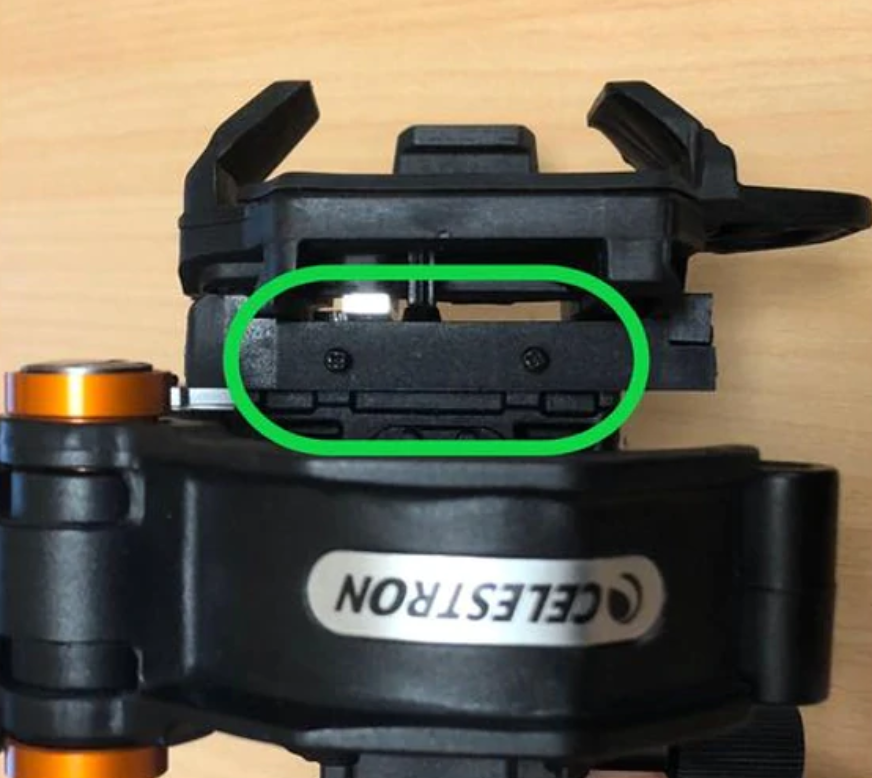
The advertising claimed to adjust the cell phone in all three directions and the reviews were good so this accessory was purchased. However, the unit is not adjusted and had slop out of the box. It was unknown if this is the way it worked or if it had adjustment points. A bit of experimenting discovered sets of tiny phillips screws that could calibrate the tension and take up any play in the axes.

To accomplish this, look for a matching set of two screws that may not be screwed in all the way, at each axis. Tighten the screws using a very small #1 precision Chinese phillips screwdriver from a set sold in China to get the proper depth screwdriver. Then test by turning the adjustment knobs. The knob should turn firm but not too tight or too loose. This will take up the play along the gear rack and the overall smartphone adapter will become firm and tight as it holds and adjusts the phone.
The adapter is a bit heavy but considering what it can do along three axes where others are made of lightweight plastic and can only adjust along two axes, it appears to be an excellent investment.
The tension of each axis can be easily adjusted using a small Phillips screwdriver. Use the images below to locate the adjusting screws. For each axis, only make small adjustments to the set screws. Tightening them too much can make it difficult to use the motion knobs. In between the platform and adapter, there will be screws for tension adjustment in the X axis.
(NOTE: For NexYZ, make sure to adjust the Z axis until the phone platform is as far away from the adapter as possible). Y Axis – On the side of the phone bed holder platform, there will be screws for tension adjustment in the Y axis.
Underneath the handle will be two set screws for tension adjustment in the Y axis. Z Axis – (NexYZ only) Directly on the opposite side of the Z axis motion knob are the set screws for tension adjustment in the Z Axis. This adjustment is very useful for heavy smartphones.
NexYZ connects your smartphone to your telescope, spotting scope, binocular, monocular, and microscope so you can capture images and video through the eyepiece. Works with a wide range of mobile phone models, including all the latest devices from Samsung, Google, and Apple.
Unlike other adapters, NexYZ features 3 directional knobs (X, Y, and Z axis) that perfectly align your phone’s camera with
the eyepiece in seconds so you are ready to snap the perfect image; In addition, you can make tension adjustments to keep the phone firmly in place. NexYZ stands up to rigorous field use thanks to its robust, durable construction with a metal frame and polymer body.
NexYZ fits any eyepiece from 35 millimeter to 60 millimeter in diameter including telescopes with 1.25 inch and 2 inch eyepieces.
Another good accessory to have is a battery powered Bluetooth Remote Shutter to automatically take the exposures without touching the camera and preventing the introduction of vibrations.
These are usually keychain size devices that operate on a 3 volt button battery. Go to settings on the iPhone and select Bluetooth, then find the device and connect. Thereafter, use the pushbutton switch on the device to activate the camera's shutter and take the photo.
Saturday, April 9, 2022
Celestron Nexstar 6SE Mountain Observing
A HUNDRED MILES AWAY!
The first results are in from the new telescope and new location and they're spectacular!
Left: using the same eyepiece and camera, there is no doubt as to the quality of the optics looking through window glass and the high level of detail in the tower.
As previously described, in the north of the island where HSO Singularity is now located, the low mountains near the Taipei basin contain several of the island's endemic species or rare subspecies, including the seldom seen emerald tree frog and Taipei green tree frog. These amphibians are at the top of the rarest observation list. Also on this list are the habits of the great rare migratory birds that make Taiwan mountains their unique home during their long oceanic journeys.
These mountains are an especially good habitat for amphibians, since the northeast winter monsoon wind lifts moisture laden air from over the warm Japan sea current and blows it up the mountainsides, where it cools and condenses, releasing precipitation over the subtropical forest.
Eventually the telescopes will be used to photo and classify the endemic species, record their living space, numbers, and habits, and potentially report findings and population/ distribution trends to the Taiwan Government Conservation & Wildlife.
Equipment
Above Left: photo taken with a handheld smartphone, slightly zoomed, frames the mountains being studied. The towers are invisible.
Left: through the telescope at low power (60x) using eyepiece projection and the Celestron stock 25mm Plossl eyepiece. A smartphone was held above the eyepiece. The resolution of vegetation and the towers is incredible. By adjusting the color, different plant species are identifiable.
After the move to a new observatory complex location and setting up the new telescope, the first results of conservation studies for Taiwan Conservation Management are in for analysis. I used the stock supplied Celestron 25mm Plossl eyepiece for iPhone 10 Max handheld projection. The telescope was set up indoors and looked through a muddy glass window during a hazy high percentage air pollution day. Frankly, good results were not expected, but due to the very high optical quality of Celestron's Nexstar 6SE, the images were spectacular!
Left: using the same eyepiece and camera, there is no doubt as to the quality of the optics looking through window glass and the high level of detail in the tower.
The image is sharp and clear during the first historic mountain indoor observatory session. The colors are bold and distinct without aberrations. There are no achromatic or chromatic defects, coma or astigmatism and the image is sharp and clear to the edge.
As previously described, in the north of the island where HSO Singularity is now located, the low mountains near the Taipei basin contain several of the island's endemic species or rare subspecies, including the seldom seen emerald tree frog and Taipei green tree frog. These amphibians are at the top of the rarest observation list. Also on this list are the habits of the great rare migratory birds that make Taiwan mountains their unique home during their long oceanic journeys.
These mountains are an especially good habitat for amphibians, since the northeast winter monsoon wind lifts moisture laden air from over the warm Japan sea current and blows it up the mountainsides, where it cools and condenses, releasing precipitation over the subtropical forest.
Eventually the telescopes will be used to photo and classify the endemic species, record their living space, numbers, and habits, and potentially report findings and population/ distribution trends to the Taiwan Government Conservation & Wildlife.
Other projects include bird & large insect watching and mountain exploring/ mapping by remote. Mapping the mountains and their elevations relative to the horizon will benefit telescope astro imaging during night time, for ascertaining various lunar and planetary rise times and for operating predictive planetarium programs before telescope observations and astro imaging. Such photos could be used as long or short term spatial references for volcanic and seismic studies.
Elephant Mountain is about 20 miles away from Singularity observatory. It includes in the background a larger and more distant mountain range. The closest mountain is flanked by two massive office skyscrapers, a black and an orange, that have roads leading into the mountain for easy access. At the top of the mountain range are a series of power towers ideal for aligning finderscopes. To the left, when facing East, two large and four smaller towers are visible during average conditions. More rare are occasional building structures seen in two locations.
Equipment
To observe the mountains, Singularity Observatory is now focusing on the Celestron Nexstar 6SE due to its high resolution optics and ability to observe directly through optical Taiwan window glass. The equipment also includes Celestron Power Binoculars, low power binoculars and various filters, lenses and cameras (iPhone 5, iPhone 10, ZWO CMOS ASI224MC, Canon).
Links
Singularity Observatory Weather Trends
https://otisastro.blogspot.com/2022/04/singularity-observatory-weather-trends.html
Telescope Mountain Conservation Management at Singularity Observatory
https://otisastro.blogspot.com/2022/04/telescope-mountain-conservation.html
Links
Singularity Observatory Weather Trends
https://otisastro.blogspot.com/2022/04/singularity-observatory-weather-trends.html
Telescope Mountain Conservation Management at Singularity Observatory
https://otisastro.blogspot.com/2022/04/telescope-mountain-conservation.html
Biblical
Deuteronomy 2:7, 14
For the LORD your God has blessed you in all that he has done in your hands. You walk in this great wilderness, he knows all about it. The LORD your God has always been with you these forty years, so you lacked nothing.
Deuteronomy 2:7, 14
For the LORD your God has blessed you in all that he has done in your hands. You walk in this great wilderness, he knows all about it. The LORD your God has always been with you these forty years, so you lacked nothing.
Thursday, April 7, 2022
Looking for Bright Stars for Celestron Nexstar 6SE Alignment
![]() |
| Brightest star in the Northern Hemisphere - Sirius |
Looking for Bright Stars
for Celestron Nexstar 6SE Alignment
As a reminder, the following Messier lists are available on pages of Astroimaging. If you get a clear night, seven stars may become visible in and around the Orion Nebula, enough for Celestron's Two star Alignment. Run an experiment to see what happens.
Why are we looking for bright stars? Urban astronomy typically has severe light pollution. The largest cities also deal with air pollution and particulate matter suspension. This is conducive to the forming of upper atmospheric haze. Two nights ago, Venus was bright and visible. However, dimmer Mars and Saturn were not obvious and almost not visible. Blame it on several factors, air pollution, light pollution, haze, and planets that are far from opposition. This applies to large cities with populations of 3 million or more.
Main Messier List
https://otisastro.blogspot.com/2020/08/messier-object-list.html
Messier List by Constellation
https://otisastro.blogspot.com/2020/08/messier-objects-by-constellation.html
Messier Objects by Type
https://otisastro.blogspot.com/2020/08/messier-objects-by-type.html
Messier List by Magnitude
https://otisastro.blogspot.com/2020/08/messier-objects-by-magnitude.html
List of Supernova
https://otisastro.blogspot.com/2020/08/find-supernova.html
List of Bright Stars
https://otisastro.blogspot.com/2020/08/bright-stars.html
Other Interest
Top Ten Brightest Messier Objects
"Deep Sky for light polluted skies"
Object Catalogs - The Constellations
Map of the constellations
List of the constellations
Constellations in order of size
The Deep Sky
The Messier objects
Browse object catalogs
List of the 200 brightest open clusters
List of the 200 brightest globular clusters
List of the 200 brightest galaxies
Stars
List of the 200 brightest stars
List of the 200 closest stars
Your Sky - Solar System Objects
Planets
Comets
Asteroids
The Deep Sky
Visibility of the Constellations
Deep Sky Objects
Sky Diagrams
Diagram of objects in your sky
Rising and setting times
Altitude/time charts
------------
Find Messier Objects by Type
List of Other Objects
Messier Objects by Constellation
Supernovae in Messier Catalog Galaxies
Messier in Photos
Main Messier Object List
Messier Objects by Magnitude
Best Non-Messier Objects
Subscribe to:
Posts (Atom)