Showing posts with label review. Show all posts

Sunday, April 10, 2022

Remote Shutter

Remote Shutter Stops Camera Image Motion

This accessory is needed when shooting images through the Celestron Nexstar 6SE using a smartphone.  A small slide switch on the side of the keychain sized unit turns the unit on and off. A blue LED power light monitors the on/off status. When turned on, the iPhone in settings and bluetooth will show the pairing which is nearly instantaneous. Then go to the camera application and use the "remote" shutter to take the photo by pressing its button. The camera will automatically take a photo and keep it. The unit will connect as AB Shutter3. The device will also activate other camera settings like video.

Touching the cell phone to take a photo introduces massive vibrations that blur the image. A remote shutter for iPhone operates on bluetooth, pairs with the phone, and a touch of the remote takes the photo.

This accessory is mandatory for shooting with smartphones. It was purchased at the Night Market for about $3, however the CR2032 battery was not included. A button battery was removed from other electronic equipment to get the remote shutter to work with the iPhone 10 Max XS.

The remote shutter will be an important accessory when shooting images with all observatory smartphones, inclusive of lunar and planetary, solar, and mountain conservation. This newer shutter did not work on the old iPhone 5. For that phone, an older remote shutter is operable. It's also unknown if the wireless remote shutter will work on the Mini iPad which was upgraded to a mini computer. More testing will occur.

Celestron NexYZ Smartphone Adapter


Celestron NexYZ Smartphone Adapter
Accessory for the Celestron Nexstar 6SE

$80.95, Eyepiece Clamp Range: 35mm - 60mm (1.37" - 2.36")
Phone Clamp Style: Easy load with internal spring
Phone Clamp Range: 65mm - 90mm (2.55" - 3.54")
Dimensions: 165.1mm x 139.7mm x 107.95mm (6.50" x 5.50" x 4.25")
Weight: 10 oz ( 283 g)

The advertising claimed to adjust the cell phone in all three directions and the reviews were good so this accessory was purchased. However, the unit is not adjusted and had slop out of the box. It was unknown if this is the way it worked or if it had adjustment points. A bit of experimenting discovered sets of tiny phillips screws that could calibrate the tension and take up any play in the axes.


To accomplish this, look for a matching set of two screws that may not be screwed in all the way, at each axis. Tighten the screws using a very small #1 precision Chinese phillips screwdriver from a set sold in China to get the proper depth screwdriver. Then test by turning the adjustment knobs. The knob should turn firm but not too tight or too loose. This will take up the play along the gear rack and the overall smartphone adapter will become firm and tight as it holds and adjusts the phone.


The adapter is a bit heavy but considering what it can do along three axes where others are made of lightweight plastic and can only adjust along two axes, it appears to be an excellent investment.


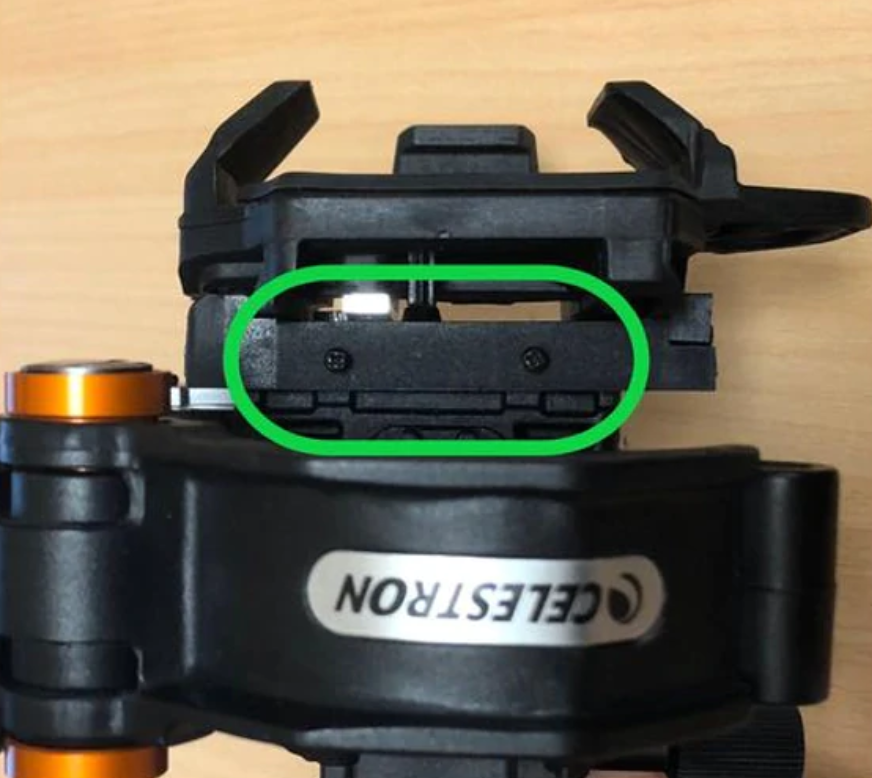
The tension of each axis can be easily adjusted using a small Phillips screwdriver. Use the images below to locate the adjusting screws. For each axis, only make small adjustments to the set screws. Tightening them too much can make it difficult to use the motion knobs. In between the platform and adapter, there will be screws for tension adjustment in the X axis.

(NOTE: For NexYZ, make sure to adjust the Z axis until the phone platform is as far away from the adapter as possible). Y Axis – On the side of the phone bed holder platform, there will be screws for tension adjustment in the Y axis. 

Underneath the handle will be two set screws for tension adjustment in the Y axis. Z Axis – (NexYZ only) Directly on the opposite side of the Z axis motion knob are the set screws for tension adjustment in the Z Axis. This adjustment is very useful for heavy smartphones.
NexYZ connects your smartphone to your telescope, spotting scope, binocular, monocular, and microscope so you can capture images and video through the eyepiece. Works with a wide range of mobile phone models, including all the latest devices from Samsung, Google, and Apple. 


Unlike other adapters, NexYZ features 3 directional knobs (X, Y, and Z axis) that perfectly align your phone’s camera with
the eyepiece in seconds so you are ready to snap the perfect image; In addition, you can make tension adjustments to keep the phone firmly in place. NexYZ stands up to rigorous field use thanks to its robust, durable construction with a metal frame and polymer body. 

NexYZ fits any eyepiece from 35 millimeter to 60 millimeter in diameter including telescopes with 1.25 inch and 2 inch eyepieces.


Another good accessory to have is a battery powered Bluetooth Remote Shutter to automatically take the exposures without touching the camera and preventing the introduction of vibrations.

These are usually keychain size devices that operate on a 3 volt button battery. Go to settings on the iPhone and select Bluetooth, then find the device and connect. Thereafter, use the pushbutton switch on the device to activate the camera's shutter and take the photo.


Friday, July 9, 2021

Orion StarBlast II Telescope Wins Red Ribbon Award

Orion StarBlast II Telescope Wins the Coveted Red Ribbon Award at Singularity Observatory
Ten telescopes were analyzed in twenty different categories and the Orion StarBlast winner took the coveted Red Ribbon Award


Telescopes reviewed were the (1) Celestron CGX/L 14-inch edge HD, (2) Celestron CGX/L 9.25-inch Edge HD, (3) Orion StarBlast Dobsonian, (4) Orion CT80 Refractor, (5) Celestron FirstScope Dobsonian, (6) Orion StarBlast II EQ, (7) Unistellar eVscope digital telescope, (8) Meade 60AT Refractor, (9) Celestron 9x50 refractor, 10) Meade ETX/90

It's agreed that analyzing a telescope may in part be directly dependent on a person's goal. For example, will the telescope go into a permanent observatory or is it designed as a lightweight grab and go scope? This contest is an overall average and an overview of the most likely and desirable key points.

The telescopes were rated in twenty categories, with ratings from 0 to 10 with 10 best. Points were added up and the telescope with the highest number of points is the winner.

1) Weight: easy to lift, carry
2) Size: ability to move through door, assembled
3) Portability
4) Setup time
5) Takedown time
6) Learning curve
7) Ease of use
8) Ability & ease of calibration
9) Number of defects: does it work?
0) Amount of time used
12)  Diameter: light gathering ability
13) Optical Quality
14) Rich Field Ability or Planets
15) Tracking ability
16) Grab and go
17) Convenience: power, computer, usb, cables
18) Cost
19) Availability
20) Support

Telescopes Analyzed
Celestron CGX/L 14-inch Edge HD
Celestron CGX/L 9.25-inch Edge HD
Orion StarBlast Dobsonian
Orion CT80 Refractor
Celestron FirstScope Dobsonian
Orion StarBlast II EQ
Unistellar eVscope digital telescope
Meade 60AT Refractor
Celestron 9x50 refractor
Meade ETX/90

The Winner: Orion StarBlast II EQ with Motor Drive
In summary, key award winning points and amazing features of the Orion StarBlast II EQ were ease of use, portability, light weight, easy to lift and carry, and with a very small learning curve. The telescope is easy to initially assemble, has a small footprint, fits through doors and inside cars when fully setup, and sports parabolic quality optics at f/4.

It's fast and large enough optics to show deep sky objects, setup and takedown time is either none or very fast and easy, no computer or AC electricity needed, it has good slow motion controls, and is good for astrophotography with a cell phone camera and camera mount. It can be used for lucky imaging with a CMOS camera, the scope and mount have a fast setup time of about 2 minutes or none at all.

The StarBlast telescope is low cost, has a one button motor clock drive, has calibration ability and is very easy to calibrate, it's supported by Orion, However availability is at high demand: I waited 2.5 years for new stock to arrive. The number of defects is 1 (locked on toe stopper). The PTA has rich field wide angle ability and is outstanding for the Moon, deep sky objects, and moons around planets, it's an excellent star hopper - it can upgrade to the lens-based Celestron finderscope with matching mounting bolts.

Orion has fast shipping, the telescope by choice is used very frequently, features include grab and go, German Equatorial with rapid takedown time, sets up in seconds with a compass, and this telescope has extra powers - the aperture is ideal for more seeing days due to its size, the primary has glass conducive to rapid cool down thermal, it sees better through window glass, and has adjustable secondary diagonal).

Included eyepieces are excellent. Focuser is tight and smooth. Upgrades with with a Bahtinov mask for achieving good focus, a front end full diameter specialty solar filter for studying the sun, and an iPhone for making a push to goto DIY finder. The telescope has many uses for many projects.

Thursday, September 3, 2020

Celestron 4mm Eyepiece

Celestron 6mm 1.25" Eyepiece Review

Conclusion: Stay clear of this dog

We bought the Celestron 6mm focus low profile eyepiece to use in a set of oculars for our small limited budget Celestron FirstScope and other telescopes.

I thought the small profile would weigh less and be ideal for small preset telescopes that are affixed to their mounts. Unfortunately I was wrong.

The heavy 6mm Celestron eyepiece is a dog. It has added weight and contributes to offsetting the fine balance of the telescope. It has one tiny itty bitty coated lens with a tiny diameter of a mere 4mm - it does not let enough light through to see much of anything. The exit pupil of 1mm is almost nonexistent! You're sure to see nothing through this useless accessory.

The worst problem happens with either visual observing or photo imaging because the limited FOV is severely restricted . On top of that, it does not produce good images. The color is off and the objects are dim. The worst problem is the exit pupil. It's only 1mm with the Celestron FirstScope, and much too small. A human eye cannot get close enough to the tiny opening to see anything, either with or without glasses.

The interior is coated flat black and the housing is threaded for filters. You'd definitely want to use a filter to help clean up the achromatic and chromatic color aberrations with fringing around the FOV.

Advertising has no specs and no information about the one tiny lens design. It's probably just a spherical mass produced uncorrected lens. It has a ring of color aberrations and fringing. The only redeeming features are the lens is made from glass and the housing is metal so it won't melt like the other two plastic Celestron eyepieces that were included with the Celestron FirstScope. It's hard to believe a company would put out such trash with a high cost. Caveat Emptor - let the buyer beware!

Recommendations: do not buy this eyepiece, it's a real dog

Advantages
* threaded for filters
* glass lens won't melt
* metal barrel is durable
* interior coated flat black
* anti-reflection coated lens
* low profile
* screen printed with type and focal length

Disadvantages
* Too Heavy
* too expensive for poor performance
* Bad exit pupil barely 1mm
* Difficult to use, results are bad
* eye cannot get close enough to see anything
* lens diameter is too small
* achromatic aberrations are severe
* Bad chromatic abberations
* images are soft and not sharp
* images are dim
* the FOV is too restricted
* bad single lens poor design
* lens is likely uncorrected
* introduces image distortion
* Optically poor
* Barrel threads jammed and won't disassemble for cleaning
* old discontinued product

Tip: To calculate the exit pupil of a telescope, divide the focal length of the eyepiece in millimeters by the focal ratio of the scope. For example, a 25mm eyepiece used in an f/5 scope delivers an exit pupil of 25/5=5mm, while a 35mm eyepiece in the same scope delivers an exit pupil of 35/5=7mm.

Wednesday, August 26, 2020

Celestron FirstScope My Review

My personal review of the Celestron FirstScope, a tiny 3-inch f/4 Dobsonian mounted reflector telescope

This is one of the first tabletop telescopes

Introduction
The tiny telescope is so cute, just keeping it on the shelf may be enough for a conversation starter. The 3 inch f/4 spherical mirror of lesser optical quality won't win any awards and in fact you will need to process the Hell out if any astrophotos taken with it to get acceptable images. The included plastic eyepieces are best thrown in the garbage asap and replaced with new glass lens aspheric oculars from Svbony that work outstanding with this scope.

The rack & pinion has excellent tension and
outstanding smooth mechanical action, perfect
for EPs and cameras. Plus, the rack tension is
adjustable with two screws. However, when
the rack and pinion achieves focus with the EP,
the tube extends too far down and causes a very
large secondary mirror obstruction that severely
degrades the image.
Worth & Value
What good is the scope, you may ask... The scope, in spite of optical shortcomings, is a real gem. It costs about $60

Dob Mount
 The minuscule scope comes with the smoothest and easiest to use Dobsonian mount. Even the spirit of the great John Dobson would be pleased with its ease of its use. Objects are found by manual GOTO; a process of sight and point, then slosh around the scope in the general vicinity until the object is found in a low power eyepiece.

It works! Simple Analog
Actually, this is the only working telescope that I have now, amidst a plethora of larger and more costly telescopes, with some rigs priced around 20 grand! Those set idle, too complicated to use, too heavy to set up or take down, or with high tech failures. There is something to say about the reliability of a simple analog telescope with hands-on ability.

Small aperture telescopes seem to do better
with big city light pollution because they

collect less of it.  Only one planet is seen in
this light polluted central urban sky.
Known for Cuteness
Speaking of hands-on, this scope is known as the cat's pajamas for the cuteness factor alone. It comes bare bones, no finder scope, and no calibration screws for the primary mirror, but it's not really a problem - sight down the tube to find Heavenly objects, and the secondary mirror has 3 screws for collimation.

Lightweight Tabletop Telescope
The minuscule telescope can be handled with one hand, as its combined weight is only 4.3 pounds! Set it on a table. It sets up in 3 seconds. My other telescopes are too big and heavy to set up and take down.

Focuser & Lightweight
The focuser works flawless and can hold each of the entire line of lightweight 1.25-inch eyepieces and computer USB astro cams for astro imaging - or simply hold an iphone or android above the eyepiece to capture the Moon. The goal here is to find lightweight accessories so as not to upset fixed tube balance. For example, there is a lightweight accessory plastic finderscope that weighs only a fractional ounce that screws onto the tube.

No matter how the "too small" diagonal
mirror is positioned, the larger primary
mirror will not fit into full view. Plus, the
diagonal is is not properly elliptical
shaped so when it tilts at 45 degrees, the
mirror looks  irregular and is ill fitting.
When new, the diagonal mirror came
with fine scratches and a marred surface.
Optical Quality
It's not a perfect world and small cuteness comes with a price. The optics leave something to be desired. The primary mirror is F/4 but spherical. The secondary elliptical flat mirror is too small and geometrically misshapen, therefore does not show the entire primary mirror for calibration. Due to this, only certain aspheric eyepieces will give performance.

Secondary Mirror
Further inspection last night when I started to collimate it revealed a disappointing secondary mirror far too small (it won't show the entire primary mirror, about 30% is missing) and it has the wrong ellipse shape! - when tilted 45-degrees, it's not a circle! In dealing with these anomalies, it's a wonder we can get any image at all.

The Telescope that Could
But maybe, just maybe, this is the little telescope that could. The story of the Little Engine that Could In the tale, a long train must be pulled over a high mountain after its engine breaks down. Larger engines, treated anthropomorphically, are asked to pull the train; for various reasons they refuse. The request is sent to a small engine, who agrees to try. The engine succeeds in pulling the train over the mountain while repeating its motto: "I-think-I-can". The story of the little engine has been told and retold many times. The underlying theme is the same — a stranded train is unable to find an engine willing to take it on over difficult terrain to its destination. Only the little blue engine is willing to try and, while repeating the mantra "I think I can, I think I can", overcomes a seemingly impossible task.
https://en.wikipedia.org/wiki/The_Little_Engine_That_Could

Stock Eyepieces
These eyepieces came with the telescope and are made of plastic lens and plastic upper barrels. The cheap plastic lenses melted on a hot summer day. While other quality eyepieces are engraved, these have a cheap paper sticker on the top. Throw these away asap. If you look through these, the view will be disappointing, fuzzy, and dim without focus.

Image Processing
Given the spherical optics and subsize misshapen secondary, you will need to try and make up for any defects somewhere. This is where image processing comes into play. By transferring the digital image to a computer, the system OS will usually have a photo app that can offer image sharpening, noise reduction,  color adjustment, gamma correction, with rotation and cropping. Also feel free to make corrections to the image with more than one level or iteration of processing, as needed.

Endearing Telescope
As both an amateur and professional astronomer for a half century, I have many uses for the Celestron FirstScope, doing experiments, testing lenses and optical configurations, use as a fast grab & go telescope that needs practically no setup time, plus running wild experiments and doing super fun projects. I've collected many telescopes and this one is a favorite.

Celestron FirstScope - Index
https://otisastro.blogspot.com/2020/08/celestron-firstscope-index.html