Showing posts with label astroimaging. Show all posts

Sunday, May 1, 2022

Magic Astro Imaging Tips & Methods

Magic Astro Imaging Tips & Methods
Using the ZWO ASI224MC Color Camera, work the magic by subtracting heavy light pollution, penetrate and improve less than ideal seeing conditions, change the color camera into a black and white camera, make your own special Venus filter,  and convert the color camera into a spectacular high resolution Mars camera to see the surface!

Make a Regular Color Camera
Zwo 1.25" UV/IR Cut
Use the above filter for a regular color camera.

Make a B&W Camera
Zwo IR 850nm Pass 1.25"
Use this filter as a near IR b&w camera.

Take Out Heavy Light Pollution
Zwo HA 7nm & 656 nm 1.25"

Make a Mars Camera
Astronomik Planet IR Pro 742 1.25", pass IR after 742nm
This filter penetrates down beneath the Martian clouds and has the potential to show spectacular surface features.

Improve Seeing Conditions
Svbony 1.25" IR-Pass Filter 685 nm, SV183
Reduce the effects of seeing for planetary photography, enhance contrast, pass infrared only, block wavelengths below 670nm to enhance contrast and surface detail and reduce the effects of seeing when used in IR-LRGB imaging of the
moon and planets.

Method to Cut Through Atmospheric Haze
Svbony 1.25" CPL circular polarizer/linear
1-40% light xmission, F9147A, cut atmospheric haze,
reduce reflections in the atmosphere, shoot through glass

DIY Cheap U-Venus filter
Have you seen the incredible cost of u-venus filters lately - plus there's no guarantee the new ones on the market have any quality. Why not make your own? Those expensive filters ask for an IR block, but when added, the UV transmission will be blocked almost completely.  Therefore the UV-pass filter must have no IR leak and this will be even more expensive. In summary an inexpensive UV filter can be made for Venus using a W47 filter combined with an IR blocking filter. At the time of this writing, W47 filters are all sold out.

Make a Better Venus Filter
Zwo 1.25" LRGB
The above filter set contains the special B filter which is IR cut only. Use the B filter with UV or V filter on Venus. B cuts off at 700nm.

Saturday, April 23, 2022

Log Saturday April 23 2022


Otis AstroImaging Log Saturday April 23 2022

NTO Nexstar Telescope Observatory
NTO is in operation. The refinement of the telescope platform is in progress. All parts and components for the platform are ready and waiting for assembly except the empty water bottles. Currently we have 15 bottles on hand. An order was placed for more water/bottles. The rate of collection is about 1 empty bottle per day. Some experimenting will determine the exact number needed. The bottle bases with the ability to withstand 1000 PSI each need to be placed in proper positioning on the back of the platform to conform with the steel rail.

Enhancements
TRANSDIGILOG - Transitional Digital & Analog
AMPING - Amplification of Telescope Diameter
TRANSAS - Transitioning Art and Science
NTO is fully operational with image processing and enhancements to include the new invented TransDigiLog. Combining a special transition of digital with analog, coined TransDigiLog, the process takes the best of both worlds - modern digital imaging and the foundations of spectroscopic emulsion based film. In this case, the spectroscopic film is transitioned to digital color, which never existed or was not popular during the original historical era of common astronomical spectroscopic usage in the early 1970s.  Also included with the newly added repertoire of power techniques for the Celestron Nexstar 6SE, invented by the author, is Amping. Amping takes a given telescope diameter and qualitatively gives it the appearance of an aperture 10 or 100 times larger. The third technique uses a combination of transitioning art and science, TransAS, to bring out highly specific features and renditions. The science side is highly quantitative while the artistic side is very qualitative in representations.

First Image Processing Result!
The first webpage with the first image processed and enhanced result, from the Celestron Nexstar 6SE telescope, was posted yesterday Friday April 22 2022. The invented technique by the author takes both digital and analog to create a new advanced and enhanced representation of the COSMOS that vastly outstrips the original in many technical aspects of imaging. This employs more than one method techniques application and of image processing. Additional processing is designed to remove light pollution, air pollution and upper atmospheric haze. The image is taken with a Celestron Nexstar 6SE telescope in the famous nebulosity area of the constellation Orion where stars are born and vasts wisps of bright red hydrogen atoms form clouds of interstellar gas filling the vastness of this region of space and time.

Friday, April 22, 2022

Astroimage Processsing with the Nexstar 6SE


Advanced AstroImage Processsing with the Nexstar 6SE by Mike Otis at the New NTO Nexstar Telescope Observatory


One invented technique by the author takes both digital and analog to create a new advanced and enhanced representation of the COSMOS that vastly outstrips the original in many technical aspects of imaging. This employs more than one method of image processing. The image shown above is taken with a Celestron Nexstar 6SE telescope in the nebulosity area of the constellation Orion where stars are born and vasts wisps of red hydrogen fill the vastness of space and time.

Techniques used are amping, a method to amplify the overall diameter of the telescope by a factor 10x and 100x, and the technique that takes the digital and combines it with the analog reminiscent of old school spectroscopic film only with the added enhancement of color. This first acquired image was shot in the throes of light pollution, upper atmospheric haze, and air pollution. These elements are subtracted out from the image to restore the clarity of the Universe with stunning success. This special occasion marks first light for the depths of deep sky Universe with the Celestron Nexstar 6SE telescope. The image is toying with the first result of additional amping to convert 6-inch diameter into 60-inch diameter, and some enhancements took it all the way up to 600-inch diameter for mind boggling incredible results.

Thursday, April 7, 2022

Astroimaging Through Cloud Cracks & Holes

Twenty minutes later, compared to the photo below, these additional clouds formed. These clouds are timed to indicate they move at 1,000 mph.

This is an extreme example of clouds with holes and cracks in the early morning - a time when observing the Sun is often ideal. Unfortunately this morning, the clouds remained in front of the Sun and it took another hour for the clouds to move. Taipei 101 at left. Captured through a closed window with iPhone 10. A haze covers everything due to air pollution and smog.


Astroimaging Through Cloud Cracks & Holes
When the weather's so quickly changeable, all efforts must be made to utilize every available opportunity to see the sky and observe the Sun, Moon or planets.

There's a spring season when the overcast and rain break up into clouds with cracks and spaces in between. This is the interim period before the skies briefly clear for a week or two and telescope fever sets in.

These fast changing clouds offer rich observing opportunities for the vigil and patient. Given the speed of cloud movement, there is usually a 20 minute opening. Even so, upper atmospheric haze is nearly always a contention and sky filtration with moisture and haze penetration is highly useful.

Update: Seasonal Variations
By the time Saturday morning, April 9th rolled around, the sky was totally clear and remained until 9:30 am when a few straggler clouds began moving in. It was a period of several hours to observe the planets, Venus, Saturn, Mars and then the Sun was in perfect position.

Wednesday, April 6, 2022

Celestron Nexstar 6 SE Remounting

Celestron Nexstar 6 SE Tripod Replace-ment

The deck observatory floor is too narrow with elevational step levels to accommodate Celestron's tripod for the Nexstar 6 SE telescope. 

The solution is found with an IKEA item of the proper diameter, thickness, shape and stability.

In one possible solution under consideration, the tripod is removed and the telescope GOTO mount sets on top of  a bar stool. The bar stool feet fit on the largest clear floor area so the telescope can operate remote and outdoors. The Celestron tripod for the Nexstar 6SE is a paramount of rock solid stability. It's unfortunate the wide stance of the extended tripod legs are not conducive to fitting on all deck and balcony floor space. However, the solid bar stool makes a good substitute. Unfortunately the bar stool is not high enough to peer over the deck railing and the idea must be discarded.

Deck 2 has a 16-inch width floor with a railing 49.5" high. The telescope is 16" from the base bottom to the top of the tube when pointed horizontal. The circular base is about 6.5" in diameter.

904.621.24 Ikea 2 is 15.4" wide and 29.2" tall. 

                   (16+29.2=45.2", 49.5-45.2=4")  
                   The legs will fit on the floor.
                   The height with telescope is 4-inches below the rail.
                   The bar stool is not tall enough.

Is there another solution using the tripod only?  Open the window door and insert one leg of the tripod through onto the far end of the deck floor butted up against the limit, while the remaining two legs are inside the room. The height is full tripod adjustable.

This laundry shelf unit is 37" tall and 14" wide, wire mesh, 3 shelves. The telescope will set (37+16=53" to the top of horizontal tube)
https://www.ikea.com/my/en/p/omar-1-shelf-section-grey-green-bamboo-s29401554/#content
This also is not tall enough. Aim for a 45" tall shelf unit (114 cm), the Ikea table is 30" high and 77 cm is 30". This is not tall enough.

Look for a shelf unit ideally from 44 to 46" tall. (112 - 117 cm)

Bookcase one may be too narrow and tip over too easily. This IKEA book unit 003.515.78


This is only 15.75-inches wide. Is wider available? The height is good at 41.75".


*** Purchased Sat. Apr. 9, 2022 online *** Bookcase two: Nine in stock. $66, this is 41.75" tall and a better more stable 31.5" wide. It's 11" deep and will fit the 16" deck floor. IKEA #403.515.81
Package is 19.4 kg or 43 lbs. The unit will be delivered and assembled.


Max load per shelf is 30 kg (66 lbs). The telescope OTA and the GOTO mount are about 22 lbs. at one third shelf load capacity. The surface is made from natural wood veneer. 

It has 2 adjustable shelves (adaptable space in between shelves). The base material is particle board, ash veneer, stain, clear acrylic lacquer. The back is fiberboard, foil. It sets on four plastic feet. 


You could slide this onto the deck for use and return indoors when finished or try bungi roping to the railing to prevent tipping (through the two openings at the top of the unit and then cover the unit with a motorcycle covering). 

Add non-slip rubber cut to fit the top and duct tape on so wind or earthquake does not take it. Put the large Meade battery on the adjusted bottom shelf to add weight stability. Operate with the deck door slightly ajar to access the PC computer to control the CMOS camera initially. 

Manage the camera with the USB cable. The app SkyPortal on the iPhone 10 is not working because the compass does not work. However, the compass and app are working on an iPhone 5 smartphone. To remote the computer, use the iPhone 5 and app or a USB cable feed.

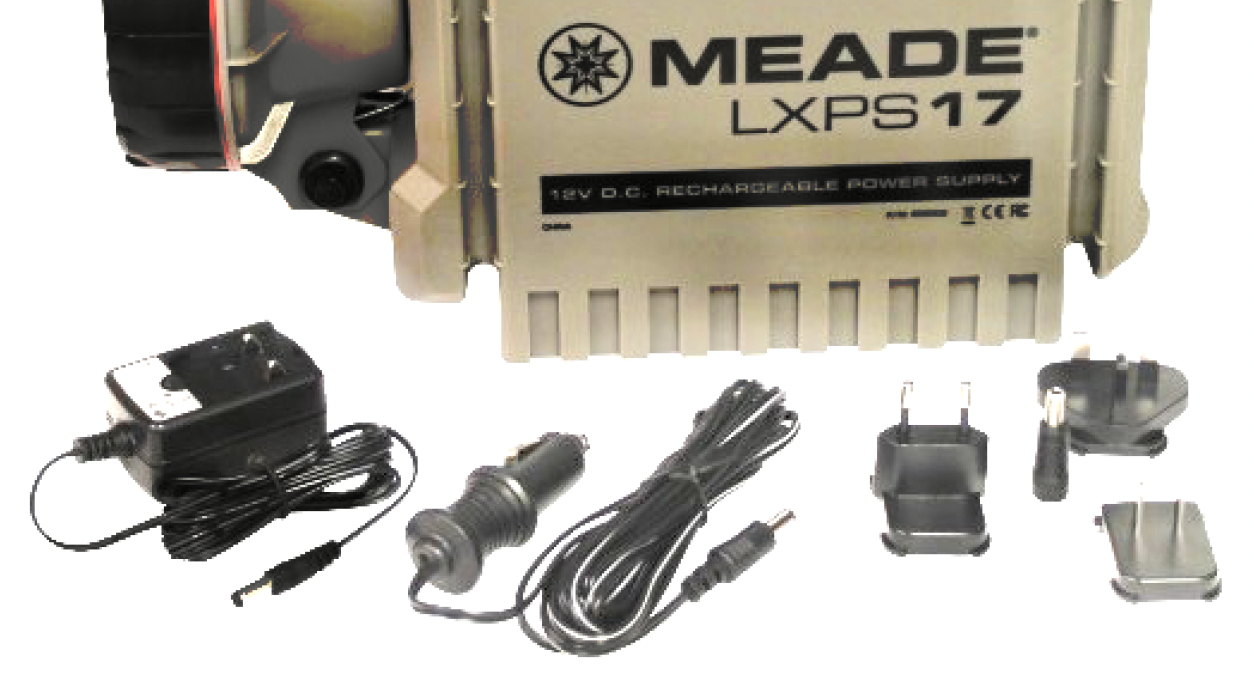
About the Meade Battery LXPS7 
Manufacturer part number: 606001. Meade Power Supply, 12V, 7 amp hour capacity. For field operation of a 12V telescope. The battery can manage the telescope and USB devices requiring power.

With Meade’s new LXPS 17 Rechargeable Portable Power Supply you can easily power your telescope and electronic devices in the field. 12V, with a massive 17 amp-hour capacity. Connect your equipment using the two included 12V cigarette lighter ports, two USB ports, or through the positive/negative terminals on the back. The LXPS includes a built-in circuit breaker and fused circuit to protect your valuable equipment. Includes both USA and international type AC adapter plugs so you’ll be able to recharge the LXPS anywhere you travel. The Meade LXPS also includes an adjustable super bright 30 LED spotlight and white flashlight with red filter attachment, perfect for setting up and tearing down in the dark. Additionally, the LXPS 17 includes an AM/FM radio, siren, and tethered detachable light. The LXPS can also be used for emergency situations like jump starting your car battery. With 17-amp hours, the LXPS 17 is the must-have accessory for star parties, long observing sessions and the dedicated astronomer.

Features a rechargeable lead acid 7AH battery and includes wall charger, LED charge level indicator, two 12V cigarette cord type outputs, power cord (cigarette plug type), hinged LED spotlight, hinged high output LED spotlight, flashlight with red lamp cover and strobe function, two USB outputs rated at 5V, built-in carry handle, shoulder carry strap, and one set of 12V output posts. Product is fuse protected with a replaceable fuse. Weight is 8.4 pounds. Size 11.3 x 9.3 x 5.2" / 28.7 x 23.6 x 13.2 cm.

Friday, November 12, 2021

Atmospheric Study - Spectacular Captured Weather Subsystems


Atmospheric Study - Spectacular Captured Weather Subsystems for Extended Observations
It was discovered that spectacular weather subsystems exist in and around regional active volcanic mountains where it can be clear in one area and obscured and raining in another. How is this useful to astronomical imaging? Can the telescope view sky objects during rain? Do these weather subsystems divide and what are their rates of changeability?


PHOTO
In a general example, entire mountain ranges can disappear while others remain visible, depending on weather conditions. In other specific examples, clouds are seen in front of some clear area mountains and not others.

WEATHER POSITION These weather systems move inside, over top side, surrounding the sides, and extending to the base of volcanic mountains.

VOLCANIC MOUNTAINS
There are five main surrounding active volcanic mountain regions, each at varying sizes, distances and elevations. 

LOCATION
The volcanic mountains border on the Pacific ocean where a weather front can spill over into the mountainous formed depressive bowl and weather is thus held captive. Weather inside the bowl is shown to move around, affording clear views in one location and not in another. Sometimes these systems are static more or less, or can be in a high rate of motion and change.

RATE OF CHANGE - SIZE - CONTENT
Weather can change in 20 minutes and one weather cell may have a different rate of change compared to another. Cells can vary in size and content. Some cover entire mountains while others are seen as small prevailing cloud systems obscuring a small mountainous fraction.

CONCLUSION
During daytime, subsystems are visually spotted and the telescope is directed to open areas of the sky for astro imaging or to specific mountains for conservation study. At night, weather subsystems are found with imaging cameras that see in the dark.

Wednesday, November 10, 2021

Monster Astro Projects

New Orion brand telescopes wait as skies begin clearing

Monster Astro Projects & Updates
The largest projects are described as of Wednesday, November 10, 2021

Numerous ongoing projects make use of the telescopes for astro imaging, conservation, weather, and technical studies. Never a moment lost - if the day is clear, the telescopes are pointed to the mountains to study and statistically categorize the ecology to include plants and animals, large insects and terrain. This area is surrounded by mountains, some 100 miles away, and the telescopes provide exceptionally clear magnified views for visual studies and photographic imaging.

If the night is mostly clear but with sections that may have upper atmosphere haze, or smog, fog, air pollution, heavy humidity, or breaks in the clouds, various inventions are deployed to penetrate the hood to resume astronomical observations.

Main divisions include:
* Singularity Observatory
* Solar Observatory
* Astro Imaging Laboratory
      Equipment, telescopes, accessories purchases
* Conservation
      Forestry study of mountains, plants, animals, birds and resources for
      conservation
* Cartography
      Moon mapping & atlas creation for lunar colonists
* Atmospheric Studies
      Invented methods to penetrate clouds, haze, air pollution, water vapor and haze

Main Sections
* Outdoor Pacific Ocean Astronomy
* Indoor Astronomy
* Armchair Astronomy

Perfect Weather & Clear Skies
The month of November is going exceptionally well. The weather has cooled to the perfect temperature of around 70 degrees and the skies are mostly clear and transparent, providing outstanding views of the mountains for conservation studies and the sky for planetary observations and weather studies. Mother nature has given five months of clear nights after two years of rain and overcast conditions.

Accessories, Inventions
This year has see the purchase of accessories and inventions to penetrate clouds, haze, air pollution, water vapor and haze. 

Telescope Trends
The trend of telescopes: at age 20, the goal was to make the largest telescopes possible. The progression went from 4.25" to 8 and then 12.5. At age 30s, weightlifting helped with strength to build and hoist the world's largest amateur telescope with a plate glass objective at the time - 40 inches in diameter. This was followed by two 50-inch telescopes around age 40s. At age 50s, the telescopes progressed into new inventions - giant power telescopes and then super large space telescopes using recycled nasa parts in space worth trillions of dollars. By age 60s, methods were invented to amplify the power of smaller telescopes into 925 and 1,400 inches aperture. By age 70, the telescope continued to shrink so they could become more manageable, easier to carry and set up.

Digital eVscope Not for this Region
It was finally discovered that, among other problems, Unistellar eVscopes in this region fail due to the combination of severe light pollution combined with haze that occludes and obstructs swaths of stars preventing the telescope from properly calibrating and plate solving.

Busy Making the Lunar Atlas
With renewed interest in the Moon, new private industry moon landings, scientific lunar outposts in the making, upcoming vacation tours to the Moon and potential off-planet colonization, a lunar atlas is in the works. It uses actual raw and processed lunar imaging from our best and most powerful telescopes at Singularity Observatory.

Observing the Sun
Recent telescope upgrades now include a solar observatory, complete with solar filters, abilities to view and image and count solar sunspots to determine sub periods of min and max, transits, eclipses, specula, and other phenomena. Tests will be made on prominences and the solar corona, and correlations with the aurora borealis and aurora australis.

Wednesday, August 18, 2021

AMPING UP THE NEW ASTRO IMAGING LABORATORY

Today is a good day for revamping the entire astro imaging laboratory, taking advantage of a rare good health day and some remarkable weather inside one of the 20M slots.


We are deploying three telescopes simultaneously for departmentalized work. Mountains 25 miles away are crystal clear and it's now possible to collimate our new lasers by beaming directly into the mountain.

When MB Mountain Beaming is complete, the Moon is next. Apollo astronauts left a moon reflector plate on the moon for laser experiments, to our benefit. Current work is on a new sequential tunneling penetratory imaging project.

In regard to multi-purposing, work progresses on  ground penetrating electrodynamic imaging for moons and planets as the precursor to our colonization and the search for underground resources or the penetration of lunar and planetary atmospheres.

Thursday, August 12, 2021

Unboxing the Orion StarBlast II EQ 4.5"

Unboxing the Orion StarBlast II EQ
Orion makes two different StarBlast f/4  4.5-inch diameter telescopes, the StarBlast and the StarBlast II EQ. The first sets on a modified Dobsonian mount, and the latter has an Equatorial mount and motor drive. Let's take a look at unboxing the the StarBlast Equatorial version, with the AstroTrack Drive.

The telescope is shopped in one box which is protected by another full size box. The assembled weight of the telescope is listed as 20.7 lbs. Inside are a series of smaller boxes fitting together like a jigsaw puzzle, each holding parts except one box which is an empty space holder. The parts and components were adequately protected for international shipping.

The telescope parts were set out on a round table and then sorted. Everything was present except for the printed manual - it was for another telescope. So I had no assembly instructions but assembly is so simple and easy that no instructions are needed. If instructions are needed, the pdf file can be downloaded at the Orion website or several videos from Orion are available on YouTube. 


In the Box
Orion 4.5" f/4.0 reflector telescope optical tube assembly
Orion AstroTrack Motor Drive
25mm Orion Sirius Plossl telescope eyepiece (1.25")
10mm Orion Sirius Plossl telescope eyepiece (1.25")
Tripod legs
EQ-1 equatorial telescope mount
EZ Finder II reflex sight aiming device
Collimation cap
Tube rings
Counterweight
Counterweight shaft
Tripod accessory tray
Slow-motion control cables
Latitude adjustment T-bolt
Orion MoonMap 260

Friday, July 16, 2021

Orion StarBlast Color

Orion StarBlast Color
The color of the new Orion StarBlast Dobsonian telescope is a remarkable story to behold

Many white OTA telescopes had flooded the market in the past and white became so common that many telescope makers began using alternate black color.

After a number of years of stumbling over and into black telescopes in the darkness of night, black was deemed no longer creative and Orion began looking for new colors of originality for the lineup.

Signature red was of course taken up by Edmunds red Astroscan telescope and Celestron made a popular line of orange Schmidt-cassegrain telescopes.

The most creative and unusual esteemed and royal colors were sought after and reviewed. Teal was a new web color formulated in 1987.

In the 1990's Teal was a cyan-green fad color for sports and it was adopted by many teams for the color of their uniforms. The color is believed to originate from the common Teal, a member of the duck family whose eyes are surrounded by this color.

Teal green is a darker shade of teal with more green and is a variable color averaging a dark bluish green that is green, darker, and stronger than invisible green or pine tree. Teal green is most closely related to the Crayola crayon color Deep Space Sparkle. Air New Zealand picked Teal green as their signature airline color.

In 2003, the California-based Orion Telescopes and Binoculars introduced the StarBlast, a 4.5-inch Newtonian reflector grab and go telescope with a Dobsonian mount. The telescope became popular with both kids and adults and even libraries have some for checkout. When Orion Telescope Company formulated the signature StarBlast OTA color, they went a step further than white or black and formulated metal teal pearl color. The tube finishes were embedded with scintillating sparkles of a metal appearance (a borrowed technique of creating finer car finishes).  Under certain lighting it looked like tiny pinpoint stars making up the tube finish, a fantastic and very original sight to behold.

Wednesday, April 28, 2021

Plastic Telescope Takes the Cake!

The World's First All Plastic Commercial Telescope Takes the Cake!

Designed for the Celestron FirstScope as a finderscope

Leave it to Celestron partnered with Chinese constructionists to make perhaps the world's first commercial all plastic telescope and at the lowest pricing imaginable. As far as we know, everything from the tube, mount, ring, dust caps, eyepiece, and even the lenses are plastic!
The 5x24 telescope is originally designed for the Celestron FirstScope telescope and attaches to two bolts on the tube. With an aperture of 24mm or about one inch, and magnifying 5x, the scope is intentionally made of plastic to keep it extremely lightweight, an absolute requirement when attaching as an accessory to a small lightweight telescope without the means for adjusting balance.

What is the performance of an all plastic telescope? Surprisingly good. Who would have guessed? The photo at left was taken with a camera phone by holding it in front of the eyepiece end of the scope and shows crosshairs and a crisp colorful view of city buildings located far away. It was shot through a curving fence. The image through plastic lenses has very minimal distortion and any slight achromatic fringing is negligible. The photo shows any spherical aberration is also negligible and hardly noticeable. Plus the price is right - at only $8.69 and free shipping when purchased from Svbony Optics.


Cleaning Note
When cleaning a plastic optic, do not contact the surface with anything, especially a lens cloth, tissue or any other means of wiping the lens. Soft plastic will easily and permanently scratch. Clean by using gentle puffs of clean dry air.

Specs at a Glance
Function - Finderscope for Celestron FirstScope, Spotting Telescope
Aperture - 24mm
Magnification - 5x
Weight - A Few Ounces
Size - About 15cm Long
Dust Caps - Included
Construction - Plastic
Crosshair Reticle - Yes
Finish - Glossy Black
Mounting Bracket Type - Celestron FirstScope
Focus - Adjustable
Image - Inverted
Cost - $8.69

Saturday, April 24, 2021

Celestron Firstscope Experimenting Through Clouds

Celestron Firstscope: the Experiment, Can We Shoot Through Heavy Clouds?

Using a 2.99-inch Dobsonian to shoot the Moon through heavy clouds - is it possible?

by Mike Otis

THE VIEW at left shows the Moon totally obscured by heavy clouds on the night of Saturday, April 24th, 2021, captured with an iPhone Xs Max camera.

Photos are taken through the author's Celestron FirstScope with two Svbony Aspheric 62-degree eyepieces, using eyepiece projection, one at 10mm FL  at 30x and a 23mm FL at 13x. The experiment is to see if images can be obtained by shooting the Moon through very heavy  clouds without using filters.

At left, the first step is using the 23mm 13x ocular, holding the iPhone camera above the eyepiece and observe the effects at various exposures, noting the appearances across numerous images and seeing which images improve or degrade with various exposures. Low power seemed to accentuate the cloud haze across the front of the Moon and created less detail and surface features. It is also noted, focus will change based on the varying cloud density. It would be best to
place a lightweight plastic camera mount on the telescope rather than handhold the camera, thus allowing a greater ability to position the telescope, refocus as needed, and greatly minimize image motion without needing too many hands or bumping the telescope.

The final image shown above is through the 10mm eyepiece at 30x. The greater image scale is better at penetrating the clouds and showing lunar detail. The single prized image is software processed with PhotoScape X to remove cloud obstructions and water vapor haze. The image, towards the bottom right of the Moon shows some remaining water vapor, however it's not necessary to remove it as it does not appreciably cover the Moon. This experiment was far more successful than expected. Without the use of filters and only by adjusting image scale and exposure, a reasonable cloud penetration is possible with the Moon.

Wednesday, April 21, 2021

Small Telescope Fun

Having Fun with Small Telescopes
Not every image taken with a small telescope will reveal detail like the Hubble Space Telescope but you can do the next best thing by processing your photos in new, unique, and artistically creative ways. Left: original image. Below: Enhanced


Take for example this original image of the Moon (at top), captured with a small plastic telescope at 4-inch aperture. At first glance, there's not much useful information visible and the photo is overall dark and gloomy, but what if we could have some fun and extract more data from our favorite crater Ptolemaeus?

The crater Lyot is barely shown but what if image processing could enhance it and show more, introducing shadow depressions and more detail inside the giant crater? And to boot, let's add some pizazz with creativing lighting and color flares to make it interesting and fun. The second image shows those results. A lot of detail appears inside Ptolemaeus and the entire terminator is more pronounced with new features visible. Lyot crater is clearly visible along with more terminator details. To process the image, I first used Apple Mac OS system software Photos to base enhance the image. A second program Photoscape X was used for refinement and special effects, light flares, color, enhancements and framing.

CAPTURE THE ENTIRE MOON

At left is the original gibbous Moon image taken with the same telescope. The image is small and lacks the clarity of lunar features. In the next image, the Moon is having a bout of processing with Photoscape X to increase image scale and bring out the clarity of features.


So next time out, get creative and have a ton of fun with your small telescope!