Showing posts with label unboxing. Show all posts

Tuesday, May 10, 2022

Acuter Optics Telescope Arrival

Acuter Optics 60mm Telescope Arrival
The order for the Acuter 60mm Maksutov "Maksy" telescope was placed on Monday May 9th, 2022 and specified delivery was promised as soon as Wednesday May 11. Early Wednesday morning the the telescope arrived and a box appeared outside in front of the door, just as planned. A minuscule telescope has a minuscule box as can be seen in the photo in the unboxing sequence. Just as it always happens with a new telescope, the weather turned to overcast with heavy rain, predicted for the next two weeks!

Precision
The first thing noticed was the great attention to precision detail in the manufacturing process. There is not one blemish on this telescope and not one speck of dust on the optics.

Construction
There are no defects and everything works smoothly and perfectly. The eyepieces and 90-degree diagonal just drop into place and are held with adjustable screws. The inserted diagonal is turned to make it tight.

Eyepieces
The 20mm eyepiece supplied appears to be of high quality. A second supplied ocular is really a projection tube for use with the telescope at Prime Focus - an intentionally frosted flat glass for projection of brighter images, for group viewing. The focus will be different when switching from the projection tube to the eyepiece.

Cute Factor
The cute factor for this minuscule telescope is off the charts - this is truly the "cat's pajamas." The light blue color might be a bit deceiving as this is no toy - this is a precision instrument with a high level of manufacturing. Being cute may have something to do with the naming of the company - A Cute / Cuter.

No Finderscope Needed
The telescope kit includes the OTA - optical tube assembly, which has two molded tick marks for "down the tube sighting" and thus no finder telescope is needed. Using the scope on the Moon and brighter deep sky objects should be ideal for this method - "down the tube sighting" and thus no finder telescope is needed. Using the scope on the Moon and brighter day or deep sky objects should be ideal for this method.

Solar Filter
The sun filter is an extra purchase and comes with its own solar finder - a small projection screen that shows the sun when centered. The filter has a very tight fit and has an additional two locking screws. The solar filter is manufactured with the same attention to precision detail and the filter membrane is perfectly flat with no wrinkles, pinholes or defects in the film layer.

Mobile Phone Camera Mount
Included is a cell phone camera mount which very easily attaches with bands around the phone, and can be rotated alongside the OTA to adjust perfect balance and stability.

Table Top Tripod
The small tripod is amazing, steady and solid when placed on a stable surface like a table, counter top, window sill or flat surface. The solid steel legs add stability weight. After the telescope is attached, the motions are smooth with the ball gimbal and completely adjustable tension is set with the small handle directly under the tripod. I was able to set a smooth tracking motion with a little finesse and it can even compensate for the weight of a camera.

Finding a Table
I also immediately dedicated a round table at just the right height to the initial testing and use of the telescope.

Lens Cap
The lens cap is remarkable. It's the first cover I've ever had that's easy to use. It's made from rubber and has a perfect fit. Other telescopes have strange plastic caps that might be interlocking in some scheme or simply fall off.

OTA Weight - Mounting On Other Telescopes
The telescope tube is so light, at around a pound weight, it can mount on other telescopes to act as a second telescope and a guide and tracking scope. This is exactly what's planned when the camera mount arrives for the Celestron Nexstar 6SE. The Acuter Maksutov telescope has standard photographic camera style threads to accept a 1/4" bolt. It can share the mounting resources of other telescopes. With the Nexstar it will suddenly have access to 40,000 goto objects. It can also be used with other tripods. However, I like the "grab n' go" ability, the ease at which it can be carried, the tiny form factor, and the fact that it takes only a few easy minutes to set up. By the time the owner of a computerized GOTO telescope punches in date, time, and location coordinates, the little Maksy is already observing celestial objects.

Overview
The Acuter Maksy 60 is a complete fully functional telescope set with the added benefit of a removable discovery panel which reveals the fascinating internal construction of an advanced Maksutov-Cassegrain optical system and to give an understanding of how it works. This compact and portable telescope is great for observing, learning & taking photos of the stars with your smartphone, to keep a record of your observations. The set includes a 60mm Diameter f=750 Maksutov-Cassegrain Telescope, a 37.5x Eyepiece, a Projection Eyepiece, an Erect-image Diagonal, a Smartphone Adaptor (smartphone not included) and a Table Top Tripod. Supplied in an attractive colour gift box with carrying handle for easy transportation and instructions for use.

Mobile Phone Camera Mount
Included is a cell phone camera mount which very easily attaches with bands around the phone, and can be rotated alongside the OTA to adjust perfect balance and stability.

Table Top Tripod
The small tripod is amazing, steady and solid when placed on a stable surface like a table, counter top, window sill or flat surface. The solid steel legs add stability weight. After the telescope is attached, the motions are smooth with the ball gimbal and completely adjustable tension is set with the small handle directly under the tripod. I was able to set a smooth tracking motion with a little finesse and it can even compensate for the weight of a camera.

Finding a Table
I also immediately dedicated a round table at just the right height to the initial testing and use of the telescope.

Lens Cap
The lens cap is remarkable. It's the first cover I've ever had that's easy to use and stays on the tube. It's made from rubber and has a perfect fit. Other telescopes have strange plastic caps that might be interlocking in some scheme or simply fall off.

OTA Weight - Mounting On Other Telescopes
The telescope tube is so light, at around a pound weight, it can mount on other telescopes to act as a second telescope and a guide and tracking scope. This is exactly what's planned when the camera mount arrives for the Celestron Nexstar 6SE. The Acuter Maksutov telescope has standard photographic camera style threads to accept a 1/4" bolt. It can share the mounting resources of other telescopes. With the Nexstar it will suddenly have access to 40,000 goto objects. It can also be used with other tripods. However, I like the "grab n' go" ability, the ease at which it can be carried, the tiny form factor, and the fact that it takes only a few easy minutes to set up. By the time the owner of a computerized GOTO telescope punches in date, time, and location coordinates, the little Maksy is already observing celestial objects.

Overview
The Acuter Maksy 60 is a complete fully functional telescope set with the added benefit of a removable discovery panel which reveals the fascinating internal construction of an advanced Maksutov-Cassegrain optical system and to give an understanding of how it works. This compact and portable telescope is great for observing, learning & taking photos of the stars with your smartphone, to keep a record of your observations. The set includes a 60mm Diameter f=750 Maksutov-Cassegrain Telescope, a 37.5x Eyepiece, a Projection Eyepiece, an Erect-image Diagonal, a Smartphone Adaptor (smartphone not included) and a Table Top Tripod. Supplied in an attractive colour gift box with carrying handle for easy transportation and instructions for use.

Copies
After being in production for a couple years, several copies of the telescope are being made. Some of these have major differences and may have compromising optical performances. For example, the high quality AMICI prism is replaced with a lesser light transmission flat mirror. The mount is cheapened. Some versions have completely different mounts, either a tripod or Dobsonian single arm mount. One version has a matching light blue finderscope and another has a large black finderscope. Some include an extra eyepiece 10mm without the frosted glass projection eyepiece.

Specifications
Taiwan Name - Mini Horse Multifunctional Life Telescope
Acuter Optics Telescope Name - Acuter Maksy 60
Design - Maksutov-Cassegrain Catadioptric
Diameter - 60mm (2.4")
Focal Ratio - f/12.5
Focal Length - 750mm (29.5")
Optical Coating: Multi Layer Film
Eyepiece 20mm - 37.5x
OTA Length - 25 cm (8.25"), 10" with 90-deg. Diagonal
OTA Outer Diameter - 82mm (3.2")
OTA Weight - 467 grams (1 lb)
Tripod Weight - 360 grams (.8 lb)
Tripod Height - 20 cm (7.9")
Light Gathering - 73.5 times the naked eye
Assembled Height - 30.5mm (12" To Diagonal Top)
Box Contents - OTA, Tabletop Tripod Mount, 20mm Eyepiece (37.5x), 90-deg. Diagonal, Lens Cap, Instruction Manual, Mobile Phone Adapter, Frosted Glass Projection Eyepiece


Eyepiece Magnification Guide
EP        Power    2x Barlow   Focal Reducer
6mm    125x       250x             62.5x
10mm  75x         150x             37.5
20mm  37.5x        75x             18.8
25mm  30x           60x             15
30mm  25x           50x             12.5
40mm  19x           38x               9.5
Prime Focus = 29.5x
2x Barlow Projection = 59x
1/2x Focal Reducer = f/12.5 (750mm FL) to f/6.25 (375mm FL)
2 Stacked Focal Reducers = f/3.1 (187.5mm)

Wednesday, March 30, 2022

Celestron Nexstar 6 SE Unboxing

Celestron Nexstar 6 SE Unboxing
On Tuesday March 29, 2022, the Celestron Nexstar 6 SE telescope arrived and was placed next to the door at about 11:45 am.

The approximately 45 lb box appeared set on its side to take up minimal space in the traffic hallway next to the owners home door. When moved, it made a frightening rattling and broken glass sound. As it was marked 2-people lift, it was carried in by two people and correctly set on its bottom.

The box itself had incurred some damage and had been carefully covered over with clear strapping tape. It had a couple puncture wounds on the top lid, also covered with tape. The box was opened once or twice from the time of its original sealing. All things considered it appeared in relatively nominal condition after traveling from the USA, to South Korea, to Hong Kong, and finally to Taiwan.


The side of the box had a rather large deep incursion which was mended with clear strapping tape. 


The box top had received two puncture wounds shown on the right side of the lid as shown in this photo.


With pure luck, these two puncture wounds did not penetrate the second sealed boxing layer. So far, the telescope and tripod were packed well in these two boxes and were protected from any visible damage at this stage in the unboxing.


Opening the inside large box revealed a series of smaller boxes. From left to right counterclockwise, the boxes contained the telescope mount, the optical tube assembly (OTA), a cardboard spacer, and the box holding the eyepiece, finder, and star diagonal.


When opened, the tube assembly was found connected to the mount, connected on the arm. Two pieces of protective foam encircled this part of the telescope.

The tripod was another story. As seen at the top in the photo, the pointy side of the legs had dug into the protective foam, gouging out a large area.

To the left in another box was the wrench and the tripod leg spacer plate.


The box aat left contained a 25mm Celestron Plossl eyepiece, a Celestron 1.25-inch diagonal mirror, and a red dot finder found to not fit onto the already installed slide mount on the OTA.

Now it was time to set the parts on the table and inspect in more detail.

In the next post, we'll learn more about the alarming broken glass sound.


Thursday, August 12, 2021

Unboxing the Orion StarBlast II EQ 4.5"

Unboxing the Orion StarBlast II EQ
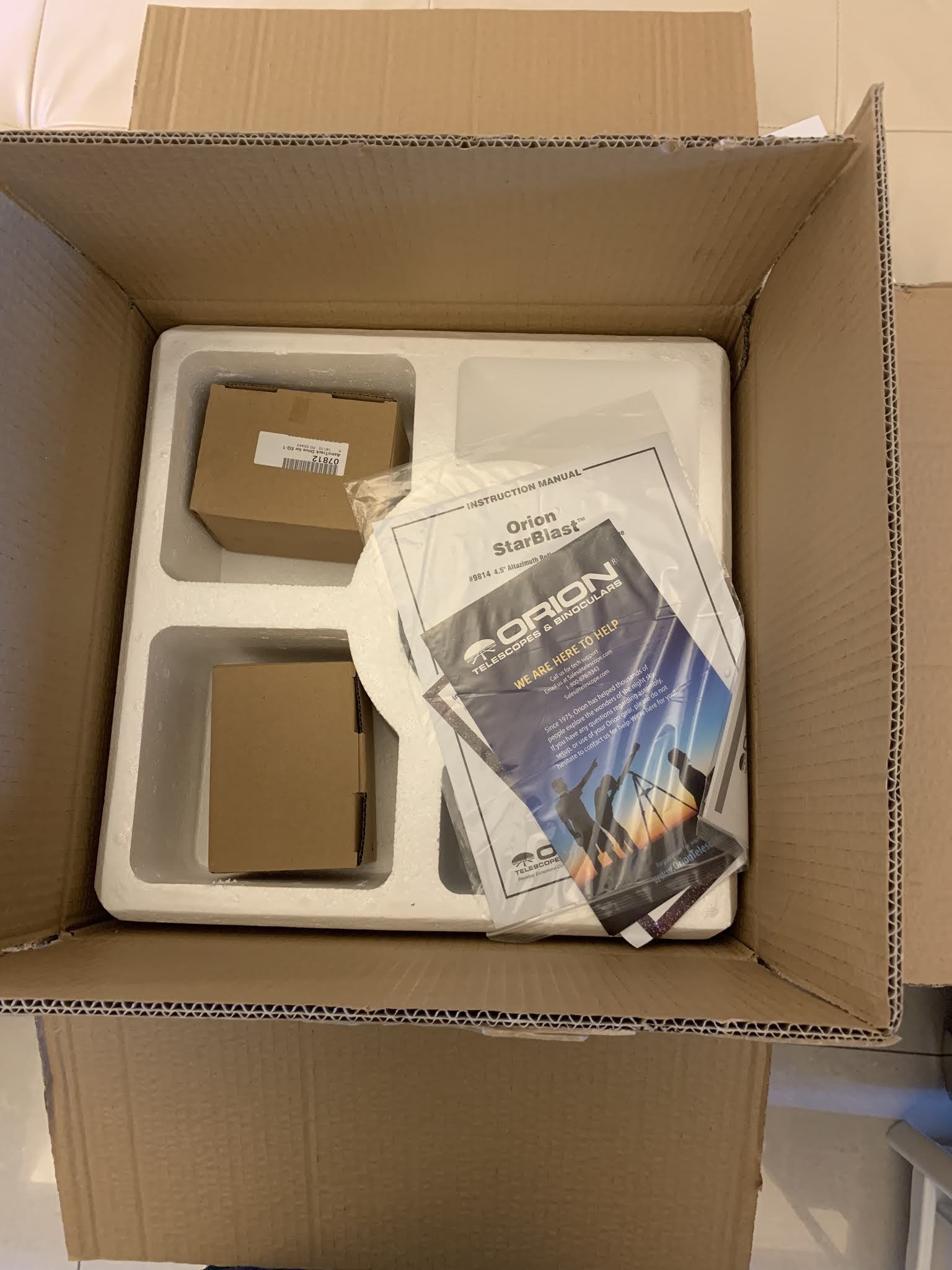
Orion makes two different StarBlast f/4  4.5-inch diameter telescopes, the StarBlast and the StarBlast II EQ. The first sets on a modified Dobsonian mount, and the latter has an Equatorial mount and motor drive. Let's take a look at unboxing the the StarBlast Equatorial version, with the AstroTrack Drive.

The telescope is shopped in one box which is protected by another full size box. The assembled weight of the telescope is listed as 20.7 lbs. Inside are a series of smaller boxes fitting together like a jigsaw puzzle, each holding parts except one box which is an empty space holder. The parts and components were adequately protected for international shipping.

The telescope parts were set out on a round table and then sorted. Everything was present except for the printed manual - it was for another telescope. So I had no assembly instructions but assembly is so simple and easy that no instructions are needed. If instructions are needed, the pdf file can be downloaded at the Orion website or several videos from Orion are available on YouTube. 


In the Box
Orion 4.5" f/4.0 reflector telescope optical tube assembly
Orion AstroTrack Motor Drive
25mm Orion Sirius Plossl telescope eyepiece (1.25")
10mm Orion Sirius Plossl telescope eyepiece (1.25")
Tripod legs
EQ-1 equatorial telescope mount
EZ Finder II reflex sight aiming device
Collimation cap
Tube rings
Counterweight
Counterweight shaft
Tripod accessory tray
Slow-motion control cables
Latitude adjustment T-bolt
Orion MoonMap 260

Saturday, July 10, 2021

Orion AstroBlast Telescope Unboxing

Orion AstroBlast Telescope Unboxing
On July 1st, 2021, these photos were uploaded to the Astroimaging server


Inside the box, the Orion 4.5-inch f/4 AstroBlast telescope comes fully assembled and connected to its Dobsonian mount. Remove the packing paper, screw on the red dot finder, and the telescope is ready for use.

Left: The fully assemble Orion StarBlast telescope was well protected with form fitting styrofoam panels. Separate items included the red dot finderscope, two eyepieces, a collimator, and the operating manual.

The one box package is actually a box inside a box for extra shipping protection, and arrived in about four days of shipping time. The prepayment included customs charges and tax, so the delivery was fast and no need to wait for money to be collected at the time of delivery.

Left: The OTA was fully assembled, however the optics, both primary and secondary (diagonal) mirrors needed collimating. To collimate, a telescope collimation PDF guide was downloaded from the Orion website. Also included with the telescope is a small plastic eyepiece collimation guide with a hole in the center.


Right: The plastic bag was carefully removed so it could be recycled as a telescope protective dust covering. The OTA was already mounted onto the Dobsonian mount with a large ring mount so the tube can rotate for balancing. One can simply reach into the box, grab the telescope, and lift it up and out.

Left: Orion's EZ Finder II is a zero magnification red dot finderscope designed to help find naked eye visible sky objects at a glance. It easily bolts onto the tube. It was removed and replaced with a practically zero weight resin-lens 5x24 finderscope by Celestron originally intended for the Celestron FirstScope.

Right: The diminutive size and low weight of the complete telescope make it a "grab and go" variety telescope. Pulled out of the box and directly placed in a chair, the small size becomes evident. Loosen the ring mount holding the OTA to remove the protective paper.

The Orion StarBlast Dobsonian has a total weight of 13 lbs. The removed OTA optical tube assembly weighs only 4 lbs. and the entire Dob mount weighs 9 lbs. The telescope has a handle on the mount and can be carried with one hand.
The telescope is known as a tabletop telescope. Here it sets on a small stable round table that will be used for observing both indoors and outdoors. The table, made in Taiwan and purchased at furniture street, folds up for transport and has a safety catch underneath.

The Orion StarBlast has a front end dust cap and a tight but smooth oving 1.25-inch rack & pinion to hold eyepieces and accessories like cameras. Both mirrors, primary and secondary are fully adjustable for precise collimation.

Left: The Orion StarBlast telescope, Dobsonian version, comes with 17mm and 6mm Kellner eyepieces. The telescope works well with added simple low cost aspheric design eyepieces. In this photo, the Orion EZ Finder II is replaced with a Celestron resin-lens 5x24 plastic finderscope which has performed well on other telescopes. Originally designed as an accessory for the Celestron FirstScope, it has practically no weight, yet offers magnification and light gathering ability to see more stars. The primary mirror is claimed to use low expansion borosilicate glass.

Manual push drive motions in azimuth are very smooth and the altitude has a locking knob which can set the tension on the motion. The ability to balance the telescope is an excellent feature when attaching accessories.

Sunday, August 16, 2020

Evscope Unboxing


Unboxing & Charging the eVscope
from Unistellar


Listed as 31 lbs. on the Bill of Lading, the eVscope came inside this wear & tear outer box. The telescope and tripod mount are around 20 lbs., ideal for portability. Already several trips are planned to the mountains where the sky is exceptionally dark for deep sky imaging.


As the bag is not airport regulation for air flights, I opted not to purchase it. However, the foam inside the box will nicely adapt to custom fitting luggage.

The package includes the optical tube assembly, the tripod mount, instructions, quick start guide, and a small box with a set of tools in a pouch and the charger. The charger has plugs to accommodate many countries.


Inside is the box that holds the scope and packaging styrofoam and with the logo "Prepare to be Amazed."


First the scope needs charging. The charger plugs into the small USB connector as shown. The larger USB port is for charging the phone. According to the LED color and the steady state, the telescope fully charged in 5 hours.