Showing posts with label acuter. Show all posts

Saturday, May 28, 2022

Acuter Maksy 60 Phone Mount

Acuter Maksy 60 Phone Mount

Don't waste a lot of time trying to find the correct band combination to hold your phone exactly over the eyepiece opening. If the band tension is not just right, or with too many bands, too tight or too loose, the phone camera will not stay over the opening above the eyepiece and won't have the ability to undergo fine positioning adjustments.


The photos show how to position one band (front and back connections) and allow the side positioned camera to reach the opening and maintain its position. One band was removed because two bands put too much tension on the phone and trying to position it resulted in the wrong position.

Left: the backside of the Acuter stock phone mount should look like this for positioning the camera with the proper tension. The use of only one band is needed.

The reason for this unusual design is there are no phone side grippers. I tried several different phone mounts with side grippers and they all interfered with the side buttons on the phone and could not be used.

This applies to the Apple iPhone 6 Plus and Xs Max.

The designers at Acuter Optics knew what they were doing when they designed this mobile phone holder. It does not pinch the sides of the phone and does not interfere with the side buttons or the operation of the iPhone. Read about bad phone mounts:

https://otisastro.blogspot.com/2022/05/bad-phone-camera-mounts.html

Trials & Tribulations Acuter Maksy 60 at Sun Baked Observatory


Above: Attempting high magnification at the Sun's limb produced this unusual appearance - the system needs additional tuning to clearly show sunspots and solar flares and edge prominences.

Exposed with the primary solar filter but no fine tuning engagement of H-Alpha filtering.

Left: at 20mm EP projection and hand holding the iPhone camera, the solar disk was overexposed and getting the iPhone to compensate was insufficient. However, overexposure has advantages and some prominence-appearing minute detail is beginning to appear at the solaredge as well as the graduations towards the photosphere.

Trials & Tribulations of the Acuter Maksy 60 at Sun Baked Observatory
The Acuter Maksy 60 is being tuned for solar work. A number of fixes are needed before this telescope will be fully up and running.

Here's a List of Numerous Anomalies Encountered on Sunday May 29 2022.

Small Stock Tripod Insufficient to Hold Weight
The small tripod mount is insufficient to hold the telescope and the weight of the iPhone.

Small Stock Tripod Cannot Reach Elevation
The small stock tripod must be rotated to a small gap opening at the top to get it to reach a higher elevation, otherwise it bumps into the mount which is very limited. It's inconvenient to stop and move the entire mount and telescope for a position that works better.

Small Stock Tripod Insufficient to Make Fine Motions
The small tripod mount is incapable of making the fine motions needed for adjustments to image positioning

Small Tripod does not fit the Observatory Platform
The small tripod did not fully fit the observatory platform

Stock Phone Mount Failure
The stock iPhone mount failed - mount number one with the stock bands was not fully adjustable and the phone camera would not stay over the eyepiece at the proper position

Phone Mount 2 Failed
The 2nd iPhone mount failed - it pressed on the side of the iPhone against the function buttons and locked p the phone

Phone Mount 3 Failed
The 3rd iPhone mount failed, the lock holding the phone was not able to have fine tuning.

Phone Mount 4 Failed
The 4th phone mount failed, it was too heavy.

Sun Blocked by Roof
Just as the project was getting started, the sun moved into a position blocked by the roof.

Clouds & Haze Obliterates Features
The sun features were relatively void due to viewing the sun through the clouds and haze.

iPhone Touchscreen Failure
The iPhone continued to fail as any touch to the screen activated some unwanted feature.

iPhone Screen Not Visible
The iPhone screen was invisible in the bright sun - a shield was fabricated but it too had too many reflections to see anything.

Two iPhones both Fail
Two different iPhones both had the same problems.

iPhone Goes into Undesired Modes
Just setting on the table, the iPhone goes into undesired modes not conducive to astro imaging. Anything near the screen or touching it randomly is a problem.

Observatory Platform Needs Moving
The observatory platform needs to be completed in construction and moved to an ideal location.

Thursday, May 12, 2022

Acuter Maksy 60 Specifications

Acuter Maksy 60 Specs


The Acuter 60mm (2.4-inch) diameter telescope has a Maksutov-Cassegrain catadioptric design and is precision made and optically a perfect as possible. 

Stars are perfect pinpoints and the diffraction rings both inside and outside of focus are picture perfect. The telescope is multi-purpose. With the stock tripod and stock eyepiece, it excels with Moon, daytime objects, and Jupiter Moons. With EPs of greater focal length, and a steady mount, Jupiter, Saturn, Venus and Mars come into view depending on their relative distance to the Earth and how close they are to opposition.

Specifications
Taiwan Name - Mini Horse Multifunctional Life Telescope
Acuter Optics Telescope Name - Acuter Maksy 60
Design - Maksutov-Cassegrain Catadioptric
Aperture/Diameter - 60mm (2.4")
Focal Ratio - f/12.5
Focal Length - 750mm (29.5")
Optical Coating: Multi Layer Film
Eyepiece 20mm - 37.5x
OTA Length - 25 cm (8.25"), 10" with 90-deg. Diagonal
OTA Outer Diameter - 82mm (3.2")
OTA Weight - 467 grams (1 lb)
Tripod Weight - 360 grams (.8 lb)
Tripod Height - 20 cm (7.9")
Light Gathering - 73.5 times the naked eye
Theoretical Power at 50x/aperture inch = 120x
Practical Power (20-30x/inch) - 48 to 72x
True Field of View - 1.8° (Pleiades fits into the field of view)
Exit Pupil - 1.6 mm
Theoretical Resolving Power - 1.93 arcseconds
Approximate Limiting Magnitude = +11.4 (dark, moonless sky)
Dawes Limit - 1.9 arcseconds
Raleigh Limit - 2.27 arcseconds
Assembled Height - 30.5mm (12" To Diagonal Top)
Finder - Two Line-of-Sight protrusions (protuberances) on OTA
Box Contents - OTA, Tabletop Tripod Mount, 20mm Eyepiece (37.5x), 90-deg. Diagonal, Lens Cap, Instruction Manual, Mobile Phone Adapter, Frosted Glass Projection Eyepiece
Purchased Accessories: Sun Filter with Sun Finder
Best Use - Moon, Jupiter Moons, Sun with Filter

Eyepiece Magnification Guide
EP      Power   2x     Barlow Focal Reducer

6mm   125x    250x   62.5x
10mm 75x      150x   37.5
20mm 37.5x   75x     18.8
25mm 30x      60x     15
30mm 25x      50x     12.5
40mm 19x      38x       9.5
Focal Length = 750mm
8mm - 24mm ( 94x - 31x) Variable Zoom
Prime Focus = 29.5x
2x Barlow Projection = 59x
1/2x Focal Reducer = f/12.5 (750mm FL) to f/6.25 (375mm FL)
2 Stacked Focal Reducers = f/3.1 (187.5mm)

Baader Mark IV Hyperion 8mm-24mm (8,12,16,20,24)
Acuter Solar Telescope: 750mm (29.5-inch) FL, 60mm (2.4-inch) aperture

08mm - 93.75
12mm - 62.50x
16mm - 46.88x
20mm - 37.50x
24mm - 31.25x

Under prefect seeing, the maximum power per aperture inch is 50x.
2.4" x 50 = 120x. 6.25mm - 120x

The theoretical power of any telescopes is 50x per inch of aperture.  (2.4")(50)=120x However, under average sky conditions, the practical power recommended to be used is 20-30 x per inch of aperture. 48x - 72x

Definitions

Focal Length
The distance (usually expressed in millimeters) from a mirror or lens to the image that it forms. In most telescopes the focal length is roughly equal to the length of the tube. Some telescopes use extra lenses and/or mirrors to create a long effective focal length in a short tube.

Magnification
The amount that a telescope enlarges its subject. It’s equal to the telescope’s focal length divided by the eyepiece focal length. As a rule of thumb, a telescope’s maximum useful magnification is 50 times its aperture in inches (or twice its aperture in millimeters).

True Field of View
The circle of sky that you see when you look through a telescope or binoculars. Generally, the lower the magnification, the wider the field of view.

Exit Pupil
The size of the circle of light that hits your eye when you look through the eyepiece. If the exit pupil is larger than 7mm, it means your eye probably won't see all the light coming from the eyepiece. (That's because, for an average adult, the pupil of the dark-adapted human eye is only 7 mm wide.) So in that case you should switch to a higher magnification.

Theoretical Resolving Power
The angular size of the smallest detail you can see at high magnification. This tells you the closest double star you can expect to separate.

Approximate Limiting Magnitude of Telescope
A number denoting the faintest star you can expect to see. The higher the magnitude, the fainter the star. For example, a 1st-magnitude star is 100 times brighter than a 6th-magnitude star.

Dawes Limit
Dawes Limit = 4.56/D inches = 116/Dmm. Dawes Limit is the first point at which a double star is elongated enough to suspect the presence of two stars. Dawes limit for a 6" / 150mm telescope is 4.56/6 or 116/150 = 0.77 arcseconds. For the Acuter Maksy 2.4" = 4.56/2.4 = 1.9 arcseconds

Rayleigh Limit
Rayleigh Limit = 5.45/D inches = 138/Dmm. Rayleigh Limit is a measure defining the limit at which two components can be clearly identified as separate components. It defines the distance between the centers of two Airy disks where the maximum of one is placed over the minimum of the other. The Rayleigh limit of a 6"/150mm telescope is 5.45/6" or 138/150 = 0.91 arcseconds.

Maximum Useful Magnification
As a rule of thumb, a telescope's maximum useful magnification is 50 times its aperture in inches (or twice its aperture in millimeters).

Astro Links

Acuter Maksy 60 Sun Observatory


Acuter Maksy 60 Sun Observatory
Solar preliminaries began with the new Acuter Maksutov-Cassegrain telescope on Thursday May 12th 2022 when the daytime sky momentarily cleared forming cloud opening sucker holes for astro imaging and study. The Acuter telescope has already received the solar filter and sun finderscope.

Left: setting the exposure with the correct application of filters is an important step to setting up the Solar Observatory with the minuscule Maksutov 60mm telescope. 

Experiments began with image scale, formatting and processing. The first setup is from the indoor observatory viewing through window glass and imaging with processing to remove window glass. The stock 20mm shows the entire solar disk, albeit on the small side at 37.5x while other oculars and a barlow zoom in on the edge for prominences and solar flares. The Acuter 60mm Maksutov-Cassegrain telescope is very high resolution and a perfect candidate for serving as one of the primary solar telescopes at the solar observatory.

Acuter Mak 60mm Star Test

Acuter Mak 60mm Star Test

Star Test - when sweeping the sky to locate the planets, many stars passed through the FOV. This was surprising as usually the fog, mist, upper atmospheric haze, light and air pollution severely limit any number of stars seen. It was decided to do the star test, to look at the optical figure of the new Acuter 60mm Maksutov (Maksy) telescope. I was not expecting too much but the test was a real surprise, looking like the perfect depiction from a book showing symmetrical perfect concentric rings. How is that possible?

The telescope is definitely a keeper! If a telescope's collimation is perfect and the atmosphere is transparent and still enough, the focused image of a star will be very much like a circular dot of light. The star test was picture perfect! It's a good thing too - there are no adjustment calibration points visible on the telescope. The existing calibration at this level of precision will enable the Acuter Mak 60 telescope to have the potential to become an instrument of high resolution. On days and nights of steady seeing conditions, it will be interesting to run such tests of resolution on images of the Sun and Moon. In the future, the connection of a CMOS camera will show images of the optical alignment.


Wednesday, May 11, 2022

Acuter Mak 60 Planet Observations

Jupiter and Galilean Moons near Jupiter as observed by Mike Otis early morning May 12, 2022 with the new Acuter Maksy 60 telescope using a 20mm EP and table top mount. The drawing graphic depicts two of the three moons visible and the image scale is vastly increased from the raw visual. The moon closest to Jupiter is Io and farther to the left is Ganymede. Not shown at this image scale, located farther to the left is Europa.

Acuter Mak 60 Planet Observations
On the early morning of May 12, 2022, around 4 to 4:20 am, the Acuter Maksutov-Cassegrain telescope was used for the first time to observe all the main planets Venus, Jupiter, Mars and Saturn. A number of things were learned about the telescope.


Left: the smaller image scale is more like the visual at the telescope and depicts Io, Ganymede and Europa from right to left. The observations were made through window glass at around 4:20 am on the morning of May 12th. At a 30-degree altitude, Jupiter had the least effect from the atmosphere compared to Venus.

* The 20mm eyepiece with 37.5x is too low a magnification to show significant detail on planets. It is, however, good for showing all the Galilean moons of Jupiter. For detail on the globe, the telescope should be ramped up to around 120x but then tracking the planet will become a great challenge.

Venus was spectacular in brightness and showed a "moon-like" phase. The low altitude was affecting the image. This drawing rendition by Mike Otis shows the phase of Venus through the new Acuter Maksy 60 telescope and a 20mm eyepiece. The scale is greatly exaggerated.

Left: this depiction of Venus and its phase, with the 60mm telescope, is closer to the actual visual observation regarding image size. At the lower "bubbling atmospheric" altitude and with the brightness of Venus, the phase was a challenge

* The small table top tripod is insufficient for astro imaging of planets and fine detailed motions. Therefore, the first observations included here will be various visual drawings and representations. In the future, the Maksutov will mount onto the Celestron Nexstar 6SE and have total digital control and tracking.

Left: Mars was a tiny dot very pronounced in orange color and too small to see any detail

* The bumps on the side of the telescope are not sufficient for finding objects during the night. Even with some illumination near the telescope, the bumps are difficult to see and line up. For study other than the Moon, a finderscope is needed. The Mak could also be mounted on another telescope and use its finding resources.

Saturn and its ring systems were too small to show any detail and the image scale from a 37.5x ocular was not enough. When Saturn is closer to the Earth, 120x should show more. The visual depiction here is only a guide.


As the rich and successful observing night with the new Acuter Maksy 60 telescope concluded, a beautiful golden sunrise appeared in the East with noctilucent appearing clouds, flanked by the tallest skyscraper in Taiwan located nearby - Taipei 101 (with 101 stories) towering at a height of 1,667-feet and scientific antenna dishes for various satellite and weather studies. The skyscraper is so tall, it often can be seen rising up into the clouds with the top section completely obscured and the bottom visible. Three such skyscrapers placed end to end would reach a full mile into the sky. The spectacular skyscraper sports a tower at the peak which is lit according to aircraft and airport rules and regulations. This is ideal for use as an artificial star and for calibrating finderscopes and checking telescope parametrics.

About 101
Its design incorporates a number of features that enable the structure to withstand the Pacific Ring of Fire's earthquakes and the region's tropical storms. The tower houses offices, restaurants, and indoor and outdoor observatories. The tower is adjoined by a multilevel shopping mall that has the world's largest ruyi symbol as an exterior feature.

Going to the Top Observatory
After the construction of Taipei 101, I was given permission to go up to the top of the skyscraper at the tallest point of the tower. The last part to get there is by taking the steps. The extra steep steps did not conform to what I expected to be USA building code dimensions and in my exuberance and excitement, I stumbled on a step and nearly fell all the way down. A couple security agents probably almost had heart attacks! I finally made it up to the top where it was extremely windy, cold and dangerous, feeling that a strong gust of wind could pick me up and send me sailing out across the sky! But the risk was well worth it - the view was spectacular! Some time later, all people were prohibited from going outside to the top so I had a very lucky and exciting experience.

Acuter 60mm Maksutov Tips & Techniques

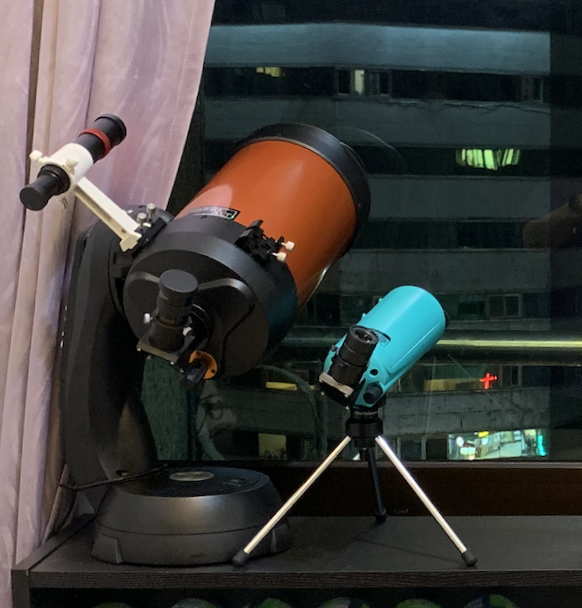
At left, the Celestron Nexstar 6SE. To the right, the new Acuter Maksy 60. Note: the light blue Maksutov does not have a conventional finderscope but rather uses two sighting bumps on the left side of the tube.

THE MINUSCULE MAK SERIES

Acuter 60mm Maksutov First Tips & Techniques

* Periodically check the tripod legs as they may need tightening.

* The frosted projection eyepiece will have a significantly different focus compared to the 20mm eyepiece.

* The frosted projection eyepiece shows the image in 1:1, i.e with no magnification as there are no magnifying lenses present, just a flat piece of glass. The projected image from the telescope is like prime focus, there is no extra magnification, i.e like a 1-inch FL eyepiece, the 750mm focal length will give approximately 29.5x.

* The telescope mount takes a standard 1/4th-inch camera mount/tripod screw

* At a pound weight, the lightweight telescope is perfect for attaching to other telescopes, to have a second powerful telescope, to use as a special finder telescope, to use with an autoguiding setup, to have a second telescope running at the same time but with different parameters (image scale, accessories, etc.).

* Use one of the three mounting holes and vary the position to help balance the telescope.

* The telescope does not need a finderscope, just use the two raised ticks to sight along the tube during the daytime. For nighttime use, dim illumination such as a nearby astro red light can provide just enough light to see it. You can get these on a headband, flashlight or as a nightlight. The red light will help keep the eyes dark adapted.

* When using the accessory solar sun filter, it normally goes on tight and then has an additional two screws to hold it as a safety feature.

* Try using lightweight aspheric EPs to maintain the telescopes lightweight.

* The minuscule 60mm aperture is ideal for viewing through a swath of window glass as it sees a smaller deviated angular wavefront thus making the image more sharp and clear.

* To better balance the telescope with a mobile phone and get greater tripod mount stability, move it back over and above the OTA Optical Tube Assembly.

* When using a mobile phone, use a remote bluetooth shutter. This will prevent the need to touch the phone screen when taking a photo and avoids vibration that degrades the image.

* Keep the side educational cover on to prevent dust from entering the inside.

Acuter Maksy 60 First Light

Acuter Maksy 60 Telescope
New First Light Celebration!
It didn't take long to set up the new Acuter 60mm Maksutov-Cassegrain telescope and commemorate First Light - about 5 minutes time in all. Wednesday, May 11, 2022, on the day of arrival, marks new First Light for the minuscule-in-size but massive-in-power telescope.

The flowers seen above, purchased online in Beijing China, commemorate the special event.

Left: setting together, the larger Celestron Nexstar 6SE at left and the cute Acuter 2.4-inch Maksutov. The powerful and ultimately cute Acuter 60mm Maksy is the "cat's pajamas and pulchritudinous."

The telescope was used with the supplied 20mm eyepiece and gave a spectacular high resolution view. Using the stock tripod and components, the scope was set on the new Observatory Platform indoors and looking through window glass, focused on a very distant building located by the mountains. The 60mm (2.4-inch diameter) aperture view resolution was incredible, showing no aberrations, excellent color, and detail on individual building bricks. For a comparison, the Celestron Nexstar 6SE, known also to be a high resolution telescope was set up with a high quality 25mm eyepiece and pointed on the same building. The views were practically identical with the 6SE showing an image that was ever-so-slightly brighter but not higher in resolution.

Tuesday, May 10, 2022

Acuter 60mm Maksutov Telescope

Acuter 60mm Maksutov Telescope

When are smaller and smaller telescopes desired over larger ones? When they are as cute as the cat's pajamas and created with high resolution precision optics for outstanding performance. Plus, they are true grab and go telescopes with an OTA weighting only 1lb. for ultimate portability and effortless fast setup.

Above: 60mm aperture Maksutov–Cassegrain telescope

Overview
The Maksutov, abbreviated "Mak" is a catadioptric telescope design that combines a spherical mirror with a mildly negative meniscus lens in a design that takes advantage of all the surfaces being nearly "spherically symmetrical". The negative lens is usually full diameter and placed at the entrance pupil of the telescope (commonly called a "corrector plate" or "meniscus corrector shell").

Corrects Aberrations
The design corrects the problems of off-axis aberrations such as coma found in reflecting telescopes while also correcting chromatic aberration.

The Invention
It was patented in 1941 by Russian optician Dmitri Dmitrievich Maksutov. He based his design on the idea behind the Schmidt camera of using the spherical errors of a negative lens to correct the opposite errors in a spherical primary mirror. The design is most commonly seen in a Cassegrain variation, with an integrated secondary, that can use all-spherical elements, thereby simplifying fabrication. Maksutov telescopes have been sold on the amateur market since the 1950s.

Sunday, May 8, 2022

LOG Sunday May 8 2022


LOG Sunday May 8 2022

Nexstar Observatory

We have now collected a total of 29 recycled distilled water bottles to be used for making the back side extension of the indoor/outdoor platform extension. The distilled water bottle is ten times the strength of a regular water bottle. Further design indicates ten per row are needed with 4 rows for a total of 40 bottles required to complete the project. The cache increases at one per day and we will have enough by the end of eleven days. "You will be in the green world."


Orion CT80
House of telescopes! After a period of about 2 years, the Orion CT80 was stored in the shipping box, and was a situation of basically not knowing how to mount it. Today, I've become so familiar with mountings, it was a piece of cake establishing how to mount the OTA onto a tripod and also how to attach a finderscope. The CT80 comes without the finderscope, without the mount, and with no accessories like EPs or focal extensions so added eyepieces will come into focus.

Left: the Orion CT80 came with only the OTA tube. This weekend, a finderscope, finderscope ring mount, dovetail shoe, and HF-3110 tripod were added for standalone functionality. A future order will include a 90-degree diagonal with 99% transmission.

Tripod HF-3110
Free tripod! There's an interesting story around this tripod. About six years ago I had the need to mount my camera on a tripod and visited the night market to find one. I chose the best and largest available at that time. A local friend bartered with the merchants to get the price down so it was a very good deal. The tripod has four long extensions so it can raise a camera or telescope a good distance off the ground, and the best features are low cost, small size and ultra lightweight. It has its own bag and is ideal for portability. So this tripod is excellent for initial use with the small Orion CT80 OTA and the upcoming Acuter Maksutov.

Acuter Maksutov Telescope
The minuscule mak! Monday is the big day! Coming soon is a new Acuter Maksutov 60mm small light blue telescope (Maksy), tentatively to be ordered on Monday, May 8, 2022.

Left: the minuscule maksutov will be ordered without the matching blue finderscope. It will however, contain the very high quality sun filter,  sun finder, and AMICI prism in the 90-degree diagonal for upright and correct orientation views.

While the Orion CT80 OTA white metal tube is 14.7-inches long and 3.25 lbs, the Acuter Maksy is only a third of that weight and its plastic tube is only 8-inches long. It should work better with the HF-3110 tripod due to lighter weight and it also will mount alongside the Celestron main observatory telescope OTA, putting less stress on the mount and motors in the Nexstar 6SE. The popularity of the small high resolution Maksy with exceptional optics is spreading like wildfire and is now sold out at most places. One key feature is the accessory roster, which lists a solar filter claimed to be comprised of high quality Baader film and mounted with its own solar finder. With the right techniques and accessories (CMOS astro imaging camera, processing computers), computer processing software power, additional h-alpha and spectroscopic filters, solar results could be spectacular for the minuscule Mak. Plus, when attached to the main observatory telescope, the telescopes will share guiding, tracking and all the advanced resources provided by the Celestron Nexstar GOTO mount.

New Observatory Naming
It does seem that Nexstar Observatory has caught on for a new name. The previous name of NTO Nexstar Telescope Observatory is retained but not being used in its entirety at this time. The nice thing about NO or NTO is it can be reconfigured for many additional applications, indoor, outdoor, through glass, no glass (lunar, planetary, deep sky, solar, nature & conservation).

Green Gem Laser Finder
The green gem laser finder on the Nexstar was removed and decommissioned for safety and legal issues.

INDEX
* Nexstar Observatory
* Orion CT80
* Tripod HF-3110
* Acuter Maksutov
* New Observatory Naming
* Green Gem Laserfinder