Monday, April 11, 2022

Smartphone Cell Phone Telescope Holder

Smartphone Cell Phone Telescope Holder
Cheap or Expensive Smartphone Holder? The choice is yours.

You may want to shop around and hold off purchasing that cell phone holder for the telescope when the price is listed around $30 to $85. 

China is selling the same exact holder for $2. Of course not everyone lives near China to take advantage of these bargains. Now you know the percent markup for this product. Does that seem right? Up to forty times markup more expensive? Plus it's named XZT. Does that sound a lot like the Celestron NexYZ? There are several versions, all slightly different but they are rock solid and rigid when holding the iPhone, and very easy to use. The lightweight and strong construction is ideal for telescope OTAs that have a weight load limit. A choice of metal or plastic is offered. Including the EP connector which can adjust up and down, the unit is fully adjustable in directions X, Y and Z. I bought two of these and may do a review later. At only a few pennies per mount, buy several and have each already mounted on your favorite EP for the night.

Sunday, April 10, 2022

Astro Log for Monday April 11 2022


Above photo: During a recent inspection - not a speck of dust and no imperfections in this pristine new Celestron Nexstar 6SE corrector plate and optics, flawless optics, bright clear images, remarkable true color viewed in objects, no visible aberrations, and the latest improved StarBright XLT coatings. This performs like a serious baby EdgeHD when compared to its big family: the 9.25" and 14" with clear sharp images across the FOV clear to the edge. No visible coma or achromatic aberrations. No astigmatism or spherical defects.

Astro Log for Monday April 11 2022
The logs will contain log diary astro entries for things happening, various thoughts and ideas, projects being cultivated, suggestions, ponderings, and the addition of notes at the end with with various resolved discoveries made.

* I will think twice before observing with an open window after a visitation by a very large beetle bug. It's conjectured that it hitched a ride or flew in from the mountains into the city.  (Blister beetles, sometimes called acid flies, belongs to the Meloidae family of beetles that secretes toxic Cantharidin, which is harmful to humans and livestock. Others reported beetles landing on their shoulders and it took a wild scuff to get rid of their tenacity presence.)

* A number of people are envious that I have access to a great view of the mountains and trees. Location can be an advantage when living in the concrete jungle.

* The bucket list is long, but some simple things are aligning the finderscope, repositioning the telescope closer to the window for a larger sky view, testing the Apple iPad for compass function, washing the windows and deck area, and moving the accessories & astro imaging lab table.

* With the iPhone XS not having a working compass, the automatic sky positioning and calibrations will be delegated to the older Apple iPhone 5. Does this have something to do with app software versions? Check this.

* Now waiting for delivery of an IKEA bookshelf unit that will serve as an outdoor mount, by replacing the tripod. The telescope will set on top and there may be some sort of anchoring devised.

* Recent purchase of a remote camera shutter from the Night Market has tested perfect for the iPhone XS Max, and will stop camera vibrations from spoiling the images. The older remote shutter works with the older iPhone 5 and it currently needs a 3v lithium ion battery.

* There are two items on the USA purchase list, both manufactured by Celestron - the passive dew shield and the updated solar filter. A heated solar filter would assuredly destroy lunar/planetary images with the bubbling and instability of mixing different temperature air.

* The new solar filter will fit the larger 6-inch telescope for the solar observing program and is more safe in the way it attaches. The prime solar telescope will change from the Orion 4.5-inch RFT f/4 StarBlast to the Celestron Nexstar. The 6-inch has a larger image scale at f/10 for better sunspot data.

* Some people talk the talk and don't do the walk. Their teeny unrequited lens sets idle on the shelf. Here at HSO we are making progress rapidly by putting new systems into place, developing new programs, exploring the realms of science, and making new discoveries.

* The Chinese astro order is almost ready - it will include a negative projection lens set to gain the largest lunar and planetary image scale at 300x. At a 5x multiplier and 60" FL, it reaches 5x60=300. Years ago I used a simplistic variable optics train with spectacular results and I expect this simple device will perform equally well. Tests with $700 optics are no better than $7.95 optics for all things considered.

* One thing to try is the workability of a negative projection lens with the smartphone and camera mount. So far, positive EP projection is working fine.

* On the bucket list is also to try out all the EPs with the 6SE. The other RFT telescopes at f/4 have some eyepieces that do not work well as they show the shadow of the diagonal obstruction towards the center. This effect was seen both visually and photographically. However, at f/10 on the Schmidt-Cassegrain that problem should not exist.

Notes: Celestron Nexstar 6SE  Power Jack
It's discovered that the power jack on the Celestron Nexstar 6SE is not meant to be threaded. The power plug just plugs into it without any way of permanent connection, therefore it can pull out if yanked hard enough. The extra power amp AC to 12 volt DC supply accessory is threaded but just ignore the threads. Use a cable loop around the mount base to secure the cable. As the telescope is not rotating in circles, the changing cord position is not a concern (due to the one cardinal direction sky viewing window).

Long Horn Beetle on Observatory Window


Long Horn Beetle on Observatory Window
It's unusual to see these critters migrating along in the concrete jungle, where most of its habitat is nonexistent. This appears to be some variety of the Taiwan Long Horn Beetle in obvious silhouette so its identification colors are not visible. But what is it doing here? On the observatory window!

Only one was seen. It made the sudden appearance just days after a rain spell splashed debri, dirt, and mud up on the window. This may be it's afternoon lunch at the highrise, thousands of feet in the air. It was a stubborn little critter, obstinate and not wanting to move, even when coaxed. Moral of the story is keep your windows clean on both sides, closed, and strange beetles will not be invited for a house brunch or privacy invasion peeking through your window or touring through the premises.

This may be an incentive to set up the telescope as a remote outdoor station so there is minimal risk going outside and getting bit by a creature of the day or night.

Remote Shutter

Remote Shutter Stops Camera Image Motion

This accessory is needed when shooting images through the Celestron Nexstar 6SE using a smartphone.  A small slide switch on the side of the keychain sized unit turns the unit on and off. A blue LED power light monitors the on/off status. When turned on, the iPhone in settings and bluetooth will show the pairing which is nearly instantaneous. Then go to the camera application and use the "remote" shutter to take the photo by pressing its button. The camera will automatically take a photo and keep it. The unit will connect as AB Shutter3. The device will also activate other camera settings like video.

Touching the cell phone to take a photo introduces massive vibrations that blur the image. A remote shutter for iPhone operates on bluetooth, pairs with the phone, and a touch of the remote takes the photo.

This accessory is mandatory for shooting with smartphones. It was purchased at the Night Market for about $3, however the CR2032 battery was not included. A button battery was removed from other electronic equipment to get the remote shutter to work with the iPhone 10 Max XS.

The remote shutter will be an important accessory when shooting images with all observatory smartphones, inclusive of lunar and planetary, solar, and mountain conservation. This newer shutter did not work on the old iPhone 5. For that phone, an older remote shutter is operable. It's also unknown if the wireless remote shutter will work on the Mini iPad which was upgraded to a mini computer. More testing will occur.

Celestron NexYZ Smartphone Adapter


Celestron NexYZ Smartphone Adapter
Accessory for the Celestron Nexstar 6SE

$80.95, Eyepiece Clamp Range: 35mm - 60mm (1.37" - 2.36")
Phone Clamp Style: Easy load with internal spring
Phone Clamp Range: 65mm - 90mm (2.55" - 3.54")
Dimensions: 165.1mm x 139.7mm x 107.95mm (6.50" x 5.50" x 4.25")
Weight: 10 oz ( 283 g)

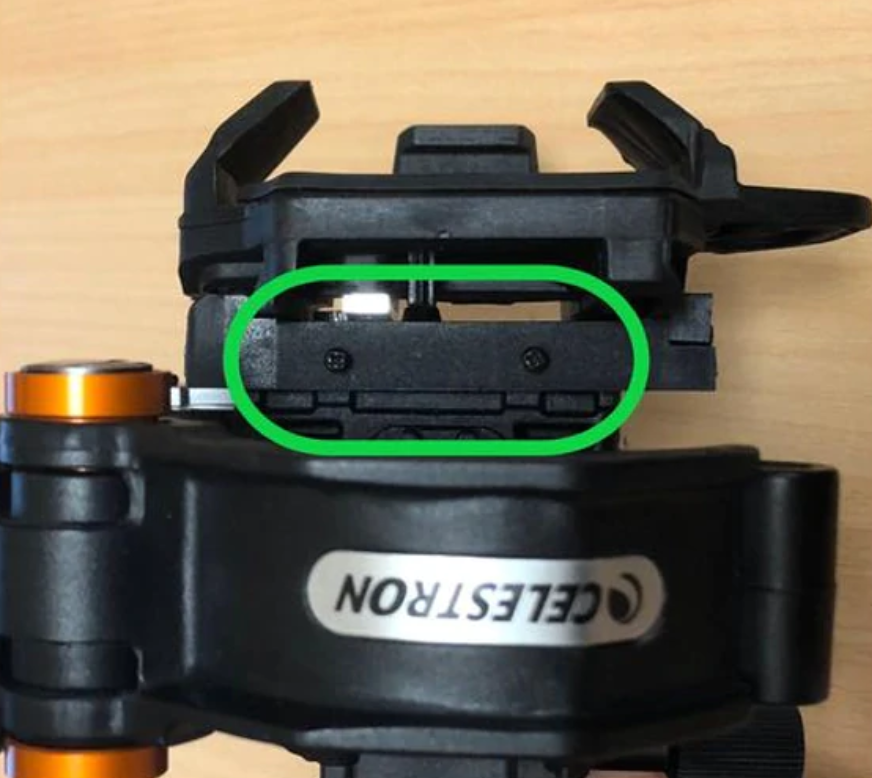
The advertising claimed to adjust the cell phone in all three directions and the reviews were good so this accessory was purchased. However, the unit is not adjusted and had slop out of the box. It was unknown if this is the way it worked or if it had adjustment points. A bit of experimenting discovered sets of tiny phillips screws that could calibrate the tension and take up any play in the axes.


To accomplish this, look for a matching set of two screws that may not be screwed in all the way, at each axis. Tighten the screws using a very small #1 precision Chinese phillips screwdriver from a set sold in China to get the proper depth screwdriver. Then test by turning the adjustment knobs. The knob should turn firm but not too tight or too loose. This will take up the play along the gear rack and the overall smartphone adapter will become firm and tight as it holds and adjusts the phone.


The adapter is a bit heavy but considering what it can do along three axes where others are made of lightweight plastic and can only adjust along two axes, it appears to be an excellent investment.


The tension of each axis can be easily adjusted using a small Phillips screwdriver. Use the images below to locate the adjusting screws. For each axis, only make small adjustments to the set screws. Tightening them too much can make it difficult to use the motion knobs. In between the platform and adapter, there will be screws for tension adjustment in the X axis.

(NOTE: For NexYZ, make sure to adjust the Z axis until the phone platform is as far away from the adapter as possible). Y Axis – On the side of the phone bed holder platform, there will be screws for tension adjustment in the Y axis. 

Underneath the handle will be two set screws for tension adjustment in the Y axis. Z Axis – (NexYZ only) Directly on the opposite side of the Z axis motion knob are the set screws for tension adjustment in the Z Axis. This adjustment is very useful for heavy smartphones.
NexYZ connects your smartphone to your telescope, spotting scope, binocular, monocular, and microscope so you can capture images and video through the eyepiece. Works with a wide range of mobile phone models, including all the latest devices from Samsung, Google, and Apple. 


Unlike other adapters, NexYZ features 3 directional knobs (X, Y, and Z axis) that perfectly align your phone’s camera with
the eyepiece in seconds so you are ready to snap the perfect image; In addition, you can make tension adjustments to keep the phone firmly in place. NexYZ stands up to rigorous field use thanks to its robust, durable construction with a metal frame and polymer body. 

NexYZ fits any eyepiece from 35 millimeter to 60 millimeter in diameter including telescopes with 1.25 inch and 2 inch eyepieces.


Another good accessory to have is a battery powered Bluetooth Remote Shutter to automatically take the exposures without touching the camera and preventing the introduction of vibrations.

These are usually keychain size devices that operate on a 3 volt button battery. Go to settings on the iPhone and select Bluetooth, then find the device and connect. Thereafter, use the pushbutton switch on the device to activate the camera's shutter and take the photo.


Saturday, April 9, 2022

Celestron Nexstar 6SE Mountain Observing

Celestron Nexstar 6SE Mountain Observing


A HUNDRED MILES AWAY!
The first results are in from the new telescope and new location and they're spectacular!


Above Left: photo taken with a handheld smartphone, slightly zoomed, frames the mountains being studied. The towers are invisible.

Left: through the telescope at low power (60x) using eyepiece projection and the Celestron stock 25mm Plossl eyepiece. A smartphone was held above the eyepiece. The resolution of vegetation and the towers is incredible. By adjusting the color, different plant species are identifiable.

After the move to a new observatory complex location and setting up the new telescope, the first results of conservation studies for Taiwan Conservation Management are in for analysis. I used the stock supplied Celestron 25mm Plossl eyepiece for iPhone 10 Max handheld projection. The telescope was set up indoors and looked through a muddy glass window during a hazy high percentage air pollution day. Frankly, good results were not expected, but due to the very high optical quality of Celestron's Nexstar 6SE, the images were spectacular!

Left: using the same eyepiece and camera, there is no doubt as to the quality of the optics looking through window glass and the high level of detail in the tower.
The image is sharp and clear during the first historic mountain indoor observatory session. The colors are bold and distinct without aberrations. There are no achromatic or chromatic defects, coma or astigmatism and the image is sharp and clear to the edge.

As previously described, in the north of the island where HSO Singularity is now located, the low mountains near the Taipei basin contain several of the island's endemic species or rare subspecies, including the seldom seen emerald tree frog and Taipei green tree frog. These amphibians are at the top of the rarest observation list. Also on this list are the habits of the great rare migratory birds that make Taiwan mountains their unique home during their long oceanic journeys.

These mountains are an especially good habitat for amphibians, since the northeast winter monsoon wind lifts moisture laden air from over the warm Japan sea current and blows it up the mountainsides, where it cools and condenses, releasing precipitation over the subtropical forest.

Eventually the telescopes will be used to photo and classify the endemic species, record their living space, numbers, and habits, and potentially report findings and population/ distribution trends to the Taiwan Government Conservation & Wildlife. 

Other projects include bird & large insect watching and mountain exploring/ mapping by remote. Mapping the mountains and their elevations relative to the horizon will benefit telescope astro imaging during night time, for ascertaining various lunar and planetary rise times and for operating predictive planetarium programs before telescope observations and astro imaging. Such photos could be used as long or short term spatial references for volcanic and seismic studies.

At 60x, a telescopic look into the dense forest region shows a surprising number of well defined plant, bush and tree species. Species are identified in part by their unique color, a testimony of Celestron's precision enhanced Starbright coated catadioptric optics. The photo show six unique species awaiting classification. The telescope is capable of 300x. The mountain has wind and the vegetation is in motion. Even though the exposures were fast, the movement of the leaves and tree branches may or may not create some image changes compared to a still day. The observatory took these images indoors through window glass, and is working on setting up an outdoor remote system that will provide a step up in high resolution.

Elephant Mountain is about 20 miles away from Singularity observatory. It includes in the background a larger and more distant mountain range. The closest mountain is flanked by two massive office skyscrapers, a black and an orange, that have roads leading into the mountain for easy access. At the top of the mountain range are a series of power towers ideal for aligning finderscopes. To the left, when facing East, two large and four smaller towers are visible during average conditions. More rare are occasional building structures seen in two locations.

Equipment
To observe the mountains, Singularity Observatory is now focusing on the Celestron Nexstar 6SE due to its high resolution optics and ability to observe directly through optical Taiwan window glass. The equipment also includes Celestron Power Binoculars, low power binoculars and various filters, lenses and cameras (iPhone 5, iPhone 10, ZWO CMOS ASI224MC, Canon).

Links
Singularity Observatory Weather Trends
https://otisastro.blogspot.com/2022/04/singularity-observatory-weather-trends.html

Telescope Mountain Conservation Management at Singularity Observatory
https://otisastro.blogspot.com/2022/04/telescope-mountain-conservation.html

Biblical
Deuteronomy 2:7, 14
For the LORD your God has blessed you in all that he has done in your hands. You walk in this great wilderness, he knows all about it. The LORD your God has always been with you these forty years, so you lacked nothing.

Singularity Observatory Weather Trends

Handheld Apple iPhone XS Max smartphone 6mm f/2.4 ISO16 1/905 second exposure 4032x3024. Zoomed and enlarged. No telescope. Taken through heavy air pollution at index 70%. Towers at the mountain top are almost invisible.

Singularity Observatory Weather Trends
Even with the sky clear and when the Sun is blocked on the other side of the skyscraper, the light pollution is not a contender and projects can divert to the mountains and conservation observations.

— the degree of blue and gray in the sky during the daytime determines the amount of air pollution and upper atmospheric haze —

Left: this Celestron Nexstar (new revised edition) has proved to be splendid optically and a fantastic performer, even through window glass.

The successful telescopic mountain conservation project at Singularity Observatory (HSO) has proven to be spectacular, showing the wide varieties of plant and animal life in the vicinity. The new Celestron Nexstar 6 SE telescope is a spectacular performer with extreme resolution, able to shoot excellent images from indoors through window glass for the ultimate observatory convenience.

Compare the camera view at the top of the page to the view taken through the telescope seen at left with a handheld iPhone shooting at f/10 with the supplied 25mm fl Celestron Plossl eyepiece and eyepiece projection. The image is so spectacular, shot from indoors through window glass, it even shows changes in FOV distances throughout the variable vegetation distances.

The wiring detail on the power pole is remarkable. The photo is taken with the iPhone 10 XS Max smartphone, handheld, 4.25mm ISO25, f/1.8 3024x4032 and a 1/279 second exposure focused on the projected telescope image at 25mm f/10 eyepiece projection. For additional resolution and 2x potentially up to 5x image scale, a negative lens barlow will become the primary optics train giving f20 through f50. This will likely pull in individual vegetation leaves and possible small animals, amphibians, reptiles and birds, provided the good weather trends hold up.

Friday, April 8, 2022

Planet Saturn Blasts into View - Celestron Nexstar 6-inch SE


Saturn from decades ago, had a different ring tilt - more edge on.

Planet Saturn Blasts into View - Celestron Nexstar 6-inch SE

As the story goes way back in the 1960s, I was taking classes in Jr. high school and a friend was pacing his new Criterion 6-inch reflector telescope that evening along with the Pastor's large refracting Unitron telescope. I was experimenting with the paramount invention of a new film developer, with the resolution of Acufine and the contrast of Metol. I asked to take a couple of photos of the planet Saturn through the telescope, not expecting much of anything, and he said, sure ok. When the negatives were developed, the results were mind blowing!

Seeing conditions were exceptional that night when I attached my Praktina FX camera with a roll of film, Kodak Tri-X emulsion,  and snapped very few Saturn photos which were later developed that night in the astro photographic darkroom. When the negatives were printed, I was stunned and completely blown away as they had the appearance of an observatory telescope photo taken with an aperture of a much larger size. The ringed planet was obviously at opposition, closest to the Earth and the view was crisp and clear with many divisions in the rings clearly visible.

Now, with Saturn and the rings in a different angle of tilt position, more open to face on, it begins its long journey towards another apposition, and the nostalgic telescopes comes to mind. This time, the telescope is a high resolution catadioptric Celestron f/10 Nexstar 6-inch SE on an altazimuth tracking mount with GOTO features.

New Solar Observatory with the Celestron Nexstar 6-inch SE

Current view of sunspots but without any solar flares - log on Saturday, April 9th, 2022. Enhanced to exhibit sunspot groupings and solar disk granulation.

New Solar Observatory with the Celestron Nexstar 6-inch SE

New Solar Observatory Forthcoming
The Celestron new solar filter #94243 EclipSmart $54.95 + $15.02 shipping for 15-day delivery time, is on the order list for the Celestron Nexstar f/10 6-inch SE. Made of a proprietary Mylar film, the filter is ISO 12312-2 compliant for safe solar viewing, blocking 99.999% of intense light across the entire visible spectrum and 100% of harmful ultraviolet (UV) and infrared (IR) radiation; resulting in high-contrast views of the sun in a neutral color. At just 2.6 ounces, the filter will provide the safety required to observe the sun and all phases of solar eclipses without adding significant weight to the front of the OTA. This replaces the smaller solar observatory with the 4.5-inch RFT f/4 telescope at 1.02 arc second resolution. The larger f/10 6-inch aperture of the Celestron Nexstar will pull in sunspots with a resolution up to 0.93 arcsec (Rayleigh); 0.77 arcsec (Dawes). The resolution is compliant with obtaining high res images showing limb darkening, sunspot groupings, and the extent of solar granulation.

Thursday, April 7, 2022

Astroimaging Through Cloud Cracks & Holes

Twenty minutes later, compared to the photo below, these additional clouds formed. These clouds are timed to indicate they move at 1,000 mph.

This is an extreme example of clouds with holes and cracks in the early morning - a time when observing the Sun is often ideal. Unfortunately this morning, the clouds remained in front of the Sun and it took another hour for the clouds to move. Taipei 101 at left. Captured through a closed window with iPhone 10. A haze covers everything due to air pollution and smog.


Astroimaging Through Cloud Cracks & Holes
When the weather's so quickly changeable, all efforts must be made to utilize every available opportunity to see the sky and observe the Sun, Moon or planets.

There's a spring season when the overcast and rain break up into clouds with cracks and spaces in between. This is the interim period before the skies briefly clear for a week or two and telescope fever sets in.

These fast changing clouds offer rich observing opportunities for the vigil and patient. Given the speed of cloud movement, there is usually a 20 minute opening. Even so, upper atmospheric haze is nearly always a contention and sky filtration with moisture and haze penetration is highly useful.

Update: Seasonal Variations
By the time Saturday morning, April 9th rolled around, the sky was totally clear and remained until 9:30 am when a few straggler clouds began moving in. It was a period of several hours to observe the planets, Venus, Saturn, Mars and then the Sun was in perfect position.

Looking for Bright Stars for Celestron Nexstar 6SE Alignment

Brightest star in the Northern Hemisphere - Sirius

Looking for Bright Stars
for Celestron Nexstar 6SE Alignment
As a reminder, the following Messier lists are available on pages of Astroimaging. If you get a clear night, seven stars may become visible in and around the Orion Nebula, enough for Celestron's Two star Alignment. Run an experiment to see what happens.

Why are we looking for bright stars? Urban astronomy typically has severe light pollution. The largest cities also deal with air pollution and particulate matter suspension. This is conducive to the forming of upper atmospheric haze. Two nights ago, Venus was bright and visible. However, dimmer Mars and Saturn were not obvious and almost not visible. Blame it on several factors, air pollution, light pollution, haze, and planets that are far from opposition. This applies to large cities with populations of 3 million or more.

Main Messier List
https://otisastro.blogspot.com/2020/08/messier-object-list.html

Messier List by Constellation
https://otisastro.blogspot.com/2020/08/messier-objects-by-constellation.html

Messier Objects by Type
https://otisastro.blogspot.com/2020/08/messier-objects-by-type.html

Messier List by Magnitude
https://otisastro.blogspot.com/2020/08/messier-objects-by-magnitude.html

List of Supernova
https://otisastro.blogspot.com/2020/08/find-supernova.html

List of Bright Stars
https://otisastro.blogspot.com/2020/08/bright-stars.html

Other Interest
Top Ten Brightest Messier Objects
"Deep Sky for light polluted skies"

Object Catalogs - The Constellations
Map of the constellations
List of the constellations
Constellations in order of size

The Deep Sky
The Messier objects
Browse object catalogs
List of the 200 brightest open clusters
List of the 200 brightest globular clusters
List of the 200 brightest galaxies

Stars
List of the 200 brightest stars
List of the 200 closest stars

Your Sky - Solar System Objects

Planets
Comets
Asteroids

The Deep Sky
Visibility of the Constellations
Deep Sky Objects

Sky Diagrams
Diagram of objects in your sky
Rising and setting times
Altitude/time charts
------------
Find Messier Objects by Type

List of Other Objects

Messier Objects by Constellation

Supernovae in Messier Catalog Galaxies

Messier in Photos

Main Messier Object List

Messier Objects by Magnitude

Best Non-Messier Objects

Celestron Nexstar 6SE Log Thursday April 7 2022


Reflections off and through the Celestron Nexstar 6SE corrector plate

Celestron Nexstar 6SE Log Thursday April 7 2022


Flying Saucers
This we have not seen. All sky activities appear normal from the new location. Through haze, one brighter star and a very bright satellite were viewed to nights ago. The mountain contains some homes and temples and one place of worship had an open smoke fire during the day to burn money to send it to Heaven for the benefit of deceased loved ones.

Weather Trend
The weather trend is good. After several relatively clear nights, last night pocket clouds moved in until the sky was obliterated. No rain is in the forecast. As seasonal temperatures rise, more sky conditions will change to clearing. Currently in the daytime there is a mix of smoke, fog, haze, mist, air pollution, and smog. This can rapidly clear out due to changing oceanic tradewinds.

The following morning the sky had all clouds and it took 2 to 3 hours for a small space in between clouds to occur. It happened exactly at the position of Venus around 4 am and lasted for 20 minutes. During this time period, good observations of Venus were possible.

Solar Observatory
Singularity Observatory is working towards setting up the new Celestron Nexstar 6SE with a Celestron Solar Filter. The order needs to go in to the optics company. The larger aperture and focal length supersedes the 4.5-inch RFT used previously to show more solar detail. Solar cartography of sunspots will be expanded and researched. Solar observing opens up more observing time on the telescope during the day when the sky clears. The solar observatory will use the same sky area to the East in the morning.

Telescope Diagonal
Work continues upgrading the Celestron Nexstar 6SE telescope. Research shows that although the reflectivity of the diagonal may not be at 99%, its size is perfect for the telescope and it permits better viewing closer to the zenith. So called replacement star diagonals are very large and would obstruct observing even remotely close to the zenith. Therefore a large replacement diagonal will not be forthcoming.

Diagonal Solution
The solution perhaps is to use a flip mirror and divert the optical stream back and forth from the eyepiece to the camera, therefore no diagonal is used and the full amount of light reaches the camera (but not the eyepiece). It needs a determination to see if the flip mirror size fits the back of the telescope for minimal obstruction and to see if focus is dynamically kept in range.

Accessories Reviewed
The vote is in to keep accessories in the review section. Numerous more accessories are on the review list.

Astroimaging Web Presence
Ever since the purchase of the Celestron Nexstar 6SE telescope, the astroimaging Web Presence Popularity has shot up wildly like a rocket. https://otisastro.blogspot.com/