Wednesday, May 11, 2022

Acuter Mak 60 Planet Observations

Jupiter and Galilean Moons near Jupiter as observed by Mike Otis early morning May 12, 2022 with the new Acuter Maksy 60 telescope using a 20mm EP and table top mount. The drawing graphic depicts two of the three moons visible and the image scale is vastly increased from the raw visual. The moon closest to Jupiter is Io and farther to the left is Ganymede. Not shown at this image scale, located farther to the left is Europa.

Acuter Mak 60 Planet Observations
On the early morning of May 12, 2022, around 4 to 4:20 am, the Acuter Maksutov-Cassegrain telescope was used for the first time to observe all the main planets Venus, Jupiter, Mars and Saturn. A number of things were learned about the telescope.


Left: the smaller image scale is more like the visual at the telescope and depicts Io, Ganymede and Europa from right to left. The observations were made through window glass at around 4:20 am on the morning of May 12th. At a 30-degree altitude, Jupiter had the least effect from the atmosphere compared to Venus.

* The 20mm eyepiece with 37.5x is too low a magnification to show significant detail on planets. It is, however, good for showing all the Galilean moons of Jupiter. For detail on the globe, the telescope should be ramped up to around 120x but then tracking the planet will become a great challenge.

Venus was spectacular in brightness and showed a "moon-like" phase. The low altitude was affecting the image. This drawing rendition by Mike Otis shows the phase of Venus through the new Acuter Maksy 60 telescope and a 20mm eyepiece. The scale is greatly exaggerated.

Left: this depiction of Venus and its phase, with the 60mm telescope, is closer to the actual visual observation regarding image size. At the lower "bubbling atmospheric" altitude and with the brightness of Venus, the phase was a challenge

* The small table top tripod is insufficient for astro imaging of planets and fine detailed motions. Therefore, the first observations included here will be various visual drawings and representations. In the future, the Maksutov will mount onto the Celestron Nexstar 6SE and have total digital control and tracking.

Left: Mars was a tiny dot very pronounced in orange color and too small to see any detail

* The bumps on the side of the telescope are not sufficient for finding objects during the night. Even with some illumination near the telescope, the bumps are difficult to see and line up. For study other than the Moon, a finderscope is needed. The Mak could also be mounted on another telescope and use its finding resources.

Saturn and its ring systems were too small to show any detail and the image scale from a 37.5x ocular was not enough. When Saturn is closer to the Earth, 120x should show more. The visual depiction here is only a guide.


As the rich and successful observing night with the new Acuter Maksy 60 telescope concluded, a beautiful golden sunrise appeared in the East with noctilucent appearing clouds, flanked by the tallest skyscraper in Taiwan located nearby - Taipei 101 (with 101 stories) towering at a height of 1,667-feet and scientific antenna dishes for various satellite and weather studies. The skyscraper is so tall, it often can be seen rising up into the clouds with the top section completely obscured and the bottom visible. Three such skyscrapers placed end to end would reach a full mile into the sky. The spectacular skyscraper sports a tower at the peak which is lit according to aircraft and airport rules and regulations. This is ideal for use as an artificial star and for calibrating finderscopes and checking telescope parametrics.

About 101
Its design incorporates a number of features that enable the structure to withstand the Pacific Ring of Fire's earthquakes and the region's tropical storms. The tower houses offices, restaurants, and indoor and outdoor observatories. The tower is adjoined by a multilevel shopping mall that has the world's largest ruyi symbol as an exterior feature.

Going to the Top Observatory
After the construction of Taipei 101, I was given permission to go up to the top of the skyscraper at the tallest point of the tower. The last part to get there is by taking the steps. The extra steep steps did not conform to what I expected to be USA building code dimensions and in my exuberance and excitement, I stumbled on a step and nearly fell all the way down. A couple security agents probably almost had heart attacks! I finally made it up to the top where it was extremely windy, cold and dangerous, feeling that a strong gust of wind could pick me up and send me sailing out across the sky! But the risk was well worth it - the view was spectacular! Some time later, all people were prohibited from going outside to the top so I had a very lucky and exciting experience.

Acuter 60mm Maksutov Tips & Techniques

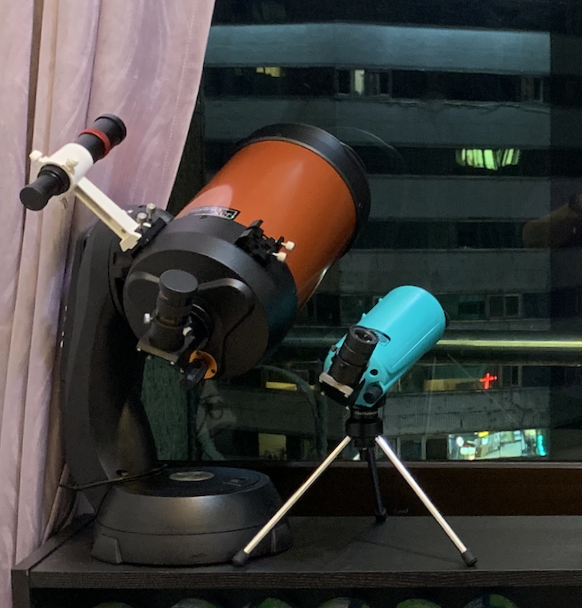
At left, the Celestron Nexstar 6SE. To the right, the new Acuter Maksy 60. Note: the light blue Maksutov does not have a conventional finderscope but rather uses two sighting bumps on the left side of the tube.

THE MINUSCULE MAK SERIES

Acuter 60mm Maksutov First Tips & Techniques

* Periodically check the tripod legs as they may need tightening.

* The frosted projection eyepiece will have a significantly different focus compared to the 20mm eyepiece.

* The frosted projection eyepiece shows the image in 1:1, i.e with no magnification as there are no magnifying lenses present, just a flat piece of glass. The projected image from the telescope is like prime focus, there is no extra magnification, i.e like a 1-inch FL eyepiece, the 750mm focal length will give approximately 29.5x.

* The telescope mount takes a standard 1/4th-inch camera mount/tripod screw

* At a pound weight, the lightweight telescope is perfect for attaching to other telescopes, to have a second powerful telescope, to use as a special finder telescope, to use with an autoguiding setup, to have a second telescope running at the same time but with different parameters (image scale, accessories, etc.).

* Use one of the three mounting holes and vary the position to help balance the telescope.

* The telescope does not need a finderscope, just use the two raised ticks to sight along the tube during the daytime. For nighttime use, dim illumination such as a nearby astro red light can provide just enough light to see it. You can get these on a headband, flashlight or as a nightlight. The red light will help keep the eyes dark adapted.

* When using the accessory solar sun filter, it normally goes on tight and then has an additional two screws to hold it as a safety feature.

* Try using lightweight aspheric EPs to maintain the telescopes lightweight.

* The minuscule 60mm aperture is ideal for viewing through a swath of window glass as it sees a smaller deviated angular wavefront thus making the image more sharp and clear.

* To better balance the telescope with a mobile phone and get greater tripod mount stability, move it back over and above the OTA Optical Tube Assembly.

* When using a mobile phone, use a remote bluetooth shutter. This will prevent the need to touch the phone screen when taking a photo and avoids vibration that degrades the image.

* Keep the side educational cover on to prevent dust from entering the inside.

Acuter Maksy 60 First Light

Acuter Maksy 60 Telescope
New First Light Celebration!
It didn't take long to set up the new Acuter 60mm Maksutov-Cassegrain telescope and commemorate First Light - about 5 minutes time in all. Wednesday, May 11, 2022, on the day of arrival, marks new First Light for the minuscule-in-size but massive-in-power telescope.

The flowers seen above, purchased online in Beijing China, commemorate the special event.

Left: setting together, the larger Celestron Nexstar 6SE at left and the cute Acuter 2.4-inch Maksutov. The powerful and ultimately cute Acuter 60mm Maksy is the "cat's pajamas and pulchritudinous."

The telescope was used with the supplied 20mm eyepiece and gave a spectacular high resolution view. Using the stock tripod and components, the scope was set on the new Observatory Platform indoors and looking through window glass, focused on a very distant building located by the mountains. The 60mm (2.4-inch diameter) aperture view resolution was incredible, showing no aberrations, excellent color, and detail on individual building bricks. For a comparison, the Celestron Nexstar 6SE, known also to be a high resolution telescope was set up with a high quality 25mm eyepiece and pointed on the same building. The views were practically identical with the 6SE showing an image that was ever-so-slightly brighter but not higher in resolution.

Tuesday, May 10, 2022

Acuter Optics Telescope Arrival

Acuter Optics 60mm Telescope Arrival
The order for the Acuter 60mm Maksutov "Maksy" telescope was placed on Monday May 9th, 2022 and specified delivery was promised as soon as Wednesday May 11. Early Wednesday morning the the telescope arrived and a box appeared outside in front of the door, just as planned. A minuscule telescope has a minuscule box as can be seen in the photo in the unboxing sequence. Just as it always happens with a new telescope, the weather turned to overcast with heavy rain, predicted for the next two weeks!

Precision
The first thing noticed was the great attention to precision detail in the manufacturing process. There is not one blemish on this telescope and not one speck of dust on the optics.

Construction
There are no defects and everything works smoothly and perfectly. The eyepieces and 90-degree diagonal just drop into place and are held with adjustable screws. The inserted diagonal is turned to make it tight.

Eyepieces
The 20mm eyepiece supplied appears to be of high quality. A second supplied ocular is really a projection tube for use with the telescope at Prime Focus - an intentionally frosted flat glass for projection of brighter images, for group viewing. The focus will be different when switching from the projection tube to the eyepiece.

Cute Factor
The cute factor for this minuscule telescope is off the charts - this is truly the "cat's pajamas." The light blue color might be a bit deceiving as this is no toy - this is a precision instrument with a high level of manufacturing. Being cute may have something to do with the naming of the company - A Cute / Cuter.

No Finderscope Needed
The telescope kit includes the OTA - optical tube assembly, which has two molded tick marks for "down the tube sighting" and thus no finder telescope is needed. Using the scope on the Moon and brighter deep sky objects should be ideal for this method - "down the tube sighting" and thus no finder telescope is needed. Using the scope on the Moon and brighter day or deep sky objects should be ideal for this method.

Solar Filter
The sun filter is an extra purchase and comes with its own solar finder - a small projection screen that shows the sun when centered. The filter has a very tight fit and has an additional two locking screws. The solar filter is manufactured with the same attention to precision detail and the filter membrane is perfectly flat with no wrinkles, pinholes or defects in the film layer.

Mobile Phone Camera Mount
Included is a cell phone camera mount which very easily attaches with bands around the phone, and can be rotated alongside the OTA to adjust perfect balance and stability.

Table Top Tripod
The small tripod is amazing, steady and solid when placed on a stable surface like a table, counter top, window sill or flat surface. The solid steel legs add stability weight. After the telescope is attached, the motions are smooth with the ball gimbal and completely adjustable tension is set with the small handle directly under the tripod. I was able to set a smooth tracking motion with a little finesse and it can even compensate for the weight of a camera.

Finding a Table
I also immediately dedicated a round table at just the right height to the initial testing and use of the telescope.

Lens Cap
The lens cap is remarkable. It's the first cover I've ever had that's easy to use. It's made from rubber and has a perfect fit. Other telescopes have strange plastic caps that might be interlocking in some scheme or simply fall off.

OTA Weight - Mounting On Other Telescopes
The telescope tube is so light, at around a pound weight, it can mount on other telescopes to act as a second telescope and a guide and tracking scope. This is exactly what's planned when the camera mount arrives for the Celestron Nexstar 6SE. The Acuter Maksutov telescope has standard photographic camera style threads to accept a 1/4" bolt. It can share the mounting resources of other telescopes. With the Nexstar it will suddenly have access to 40,000 goto objects. It can also be used with other tripods. However, I like the "grab n' go" ability, the ease at which it can be carried, the tiny form factor, and the fact that it takes only a few easy minutes to set up. By the time the owner of a computerized GOTO telescope punches in date, time, and location coordinates, the little Maksy is already observing celestial objects.

Overview
The Acuter Maksy 60 is a complete fully functional telescope set with the added benefit of a removable discovery panel which reveals the fascinating internal construction of an advanced Maksutov-Cassegrain optical system and to give an understanding of how it works. This compact and portable telescope is great for observing, learning & taking photos of the stars with your smartphone, to keep a record of your observations. The set includes a 60mm Diameter f=750 Maksutov-Cassegrain Telescope, a 37.5x Eyepiece, a Projection Eyepiece, an Erect-image Diagonal, a Smartphone Adaptor (smartphone not included) and a Table Top Tripod. Supplied in an attractive colour gift box with carrying handle for easy transportation and instructions for use.

Mobile Phone Camera Mount
Included is a cell phone camera mount which very easily attaches with bands around the phone, and can be rotated alongside the OTA to adjust perfect balance and stability.

Table Top Tripod
The small tripod is amazing, steady and solid when placed on a stable surface like a table, counter top, window sill or flat surface. The solid steel legs add stability weight. After the telescope is attached, the motions are smooth with the ball gimbal and completely adjustable tension is set with the small handle directly under the tripod. I was able to set a smooth tracking motion with a little finesse and it can even compensate for the weight of a camera.

Finding a Table
I also immediately dedicated a round table at just the right height to the initial testing and use of the telescope.

Lens Cap
The lens cap is remarkable. It's the first cover I've ever had that's easy to use and stays on the tube. It's made from rubber and has a perfect fit. Other telescopes have strange plastic caps that might be interlocking in some scheme or simply fall off.

OTA Weight - Mounting On Other Telescopes
The telescope tube is so light, at around a pound weight, it can mount on other telescopes to act as a second telescope and a guide and tracking scope. This is exactly what's planned when the camera mount arrives for the Celestron Nexstar 6SE. The Acuter Maksutov telescope has standard photographic camera style threads to accept a 1/4" bolt. It can share the mounting resources of other telescopes. With the Nexstar it will suddenly have access to 40,000 goto objects. It can also be used with other tripods. However, I like the "grab n' go" ability, the ease at which it can be carried, the tiny form factor, and the fact that it takes only a few easy minutes to set up. By the time the owner of a computerized GOTO telescope punches in date, time, and location coordinates, the little Maksy is already observing celestial objects.

Overview
The Acuter Maksy 60 is a complete fully functional telescope set with the added benefit of a removable discovery panel which reveals the fascinating internal construction of an advanced Maksutov-Cassegrain optical system and to give an understanding of how it works. This compact and portable telescope is great for observing, learning & taking photos of the stars with your smartphone, to keep a record of your observations. The set includes a 60mm Diameter f=750 Maksutov-Cassegrain Telescope, a 37.5x Eyepiece, a Projection Eyepiece, an Erect-image Diagonal, a Smartphone Adaptor (smartphone not included) and a Table Top Tripod. Supplied in an attractive colour gift box with carrying handle for easy transportation and instructions for use.

Copies
After being in production for a couple years, several copies of the telescope are being made. Some of these have major differences and may have compromising optical performances. For example, the high quality AMICI prism is replaced with a lesser light transmission flat mirror. The mount is cheapened. Some versions have completely different mounts, either a tripod or Dobsonian single arm mount. One version has a matching light blue finderscope and another has a large black finderscope. Some include an extra eyepiece 10mm without the frosted glass projection eyepiece.

Specifications
Taiwan Name - Mini Horse Multifunctional Life Telescope
Acuter Optics Telescope Name - Acuter Maksy 60
Design - Maksutov-Cassegrain Catadioptric
Diameter - 60mm (2.4")
Focal Ratio - f/12.5
Focal Length - 750mm (29.5")
Optical Coating: Multi Layer Film
Eyepiece 20mm - 37.5x
OTA Length - 25 cm (8.25"), 10" with 90-deg. Diagonal
OTA Outer Diameter - 82mm (3.2")
OTA Weight - 467 grams (1 lb)
Tripod Weight - 360 grams (.8 lb)
Tripod Height - 20 cm (7.9")
Light Gathering - 73.5 times the naked eye
Assembled Height - 30.5mm (12" To Diagonal Top)
Box Contents - OTA, Tabletop Tripod Mount, 20mm Eyepiece (37.5x), 90-deg. Diagonal, Lens Cap, Instruction Manual, Mobile Phone Adapter, Frosted Glass Projection Eyepiece


Eyepiece Magnification Guide
EP        Power    2x Barlow   Focal Reducer
6mm    125x       250x             62.5x
10mm  75x         150x             37.5
20mm  37.5x        75x             18.8
25mm  30x           60x             15
30mm  25x           50x             12.5
40mm  19x           38x               9.5
Prime Focus = 29.5x
2x Barlow Projection = 59x
1/2x Focal Reducer = f/12.5 (750mm FL) to f/6.25 (375mm FL)
2 Stacked Focal Reducers = f/3.1 (187.5mm)

Acuter 60mm Maksutov Telescope

Acuter 60mm Maksutov Telescope

When are smaller and smaller telescopes desired over larger ones? When they are as cute as the cat's pajamas and created with high resolution precision optics for outstanding performance. Plus, they are true grab and go telescopes with an OTA weighting only 1lb. for ultimate portability and effortless fast setup.

Above: 60mm aperture Maksutov–Cassegrain telescope

Overview
The Maksutov, abbreviated "Mak" is a catadioptric telescope design that combines a spherical mirror with a mildly negative meniscus lens in a design that takes advantage of all the surfaces being nearly "spherically symmetrical". The negative lens is usually full diameter and placed at the entrance pupil of the telescope (commonly called a "corrector plate" or "meniscus corrector shell").

Corrects Aberrations
The design corrects the problems of off-axis aberrations such as coma found in reflecting telescopes while also correcting chromatic aberration.

The Invention
It was patented in 1941 by Russian optician Dmitri Dmitrievich Maksutov. He based his design on the idea behind the Schmidt camera of using the spherical errors of a negative lens to correct the opposite errors in a spherical primary mirror. The design is most commonly seen in a Cassegrain variation, with an integrated secondary, that can use all-spherical elements, thereby simplifying fabrication. Maksutov telescopes have been sold on the amateur market since the 1950s.

A Lifetime of Telescopes


Inventive Creative Experimental Astronomy by Mike Otis
A Lifetime of Telescopes:
Telescopes so large they boggle the human mind


My Telescope Progression Regression
A Lifetime of Telescopes by Mike Otis

This list is being refined and made more accurate, and is therefore in progress. Basically Era can be categorized into historical year, age and the type of telescopes. The eras may overlap and can be complex and complicated. Therefore this is a generalized summary at best.

Above: Singularity Observatory 1,325-inch Telescope
https://space1usa.blogspot.com/2019/03/space1-singularity-observatory-1125.html

HSO Largest Ampled Telescope in the World
https://space1usa.blogspot.com/2018/06/hso-largest-telescope-in-world.html

Historical Year Versus Chrono Age*
1955 - 3
1965 - 13
1975 - 23
1985 - 33
1995 - 43
2005 - 53
2015 - 63
2020 - 68
2022 - 70

* Check the new page about what is more machine - the telescope or the telescope maker

Era the Beginning (1955-1990)
Location: USA
I had planned for some time to make a list of telescopes which I had under my ownership, either DIY, purchased, or as gifts. The plan was to plot the telescope diameters to show increasing size up to a point and then decreasing size. However, the list is not that simple. Beginning in 1955, my first 30mm Tasco telescope was a Birthday gift and it sparked a series of astronomical studies and observations. After that, the telescopes ramped upwards in time until reaching DIY 40-inch and 50-inch diameter telescopes.

Tasco 30mm
Edmund 4.25"
Homebuilt 4.25" Space Telescope
(2) Homebuilt 8"
Homebuilt Lensless Schmidt Camera 8"
Homebuilt 12.25"
Homebuilt 40"
(2) Homebuilt 50"

Era of Online Telescopes  (1980-1990)
Location Headquarters: USA
When the internet became fast enough, I designed, programmed and put into operation a remote cyber space telescope that could be controlled from anywhere in the world. It could image all Messier objects and selected objects like B33.

Remote Online Robotic Cyber Space Telescope (ETX70 70mm 2.75")

Era Age of Experimental Telescopes
Subtitle: Telescope Inventions (1991-2011)
Location: Beijing, Shanghai
Then I retired and moved to Asia where I had time to work on DIY telescopes and create new telescope inventions, running a large gamut of experiments.

Camera Telescope
CAM Telescope
Crater Telescope
Folding Mirror Telescope
Flexible Mirror Telescope
Galileo Lens Telescope
Granite Objective Telescope
Liquid Mirror Telescope
Massive Magnifying Glass Telescope
Micron Telescope
MLT Multiple Lens Telescope
Obsidian Mirror Telescope
Pinhole Solar Telescope
Resin Telescope
Spin Mirror Telescope
Water Reservoir Telescope
Waterdrop Telescope

Era Power Telescopes (Feb. 2012 - May 2014)
Subtitle: Extremely Powerful Telescopes, Power telescope Initiative
Location: Taiwan

During the PTI Power Telescope Initiative, sixteen powerful new telescopes were invented, constructed and put into operation above the Earth. How did these telescopes originate? Conventional telescope technology had reached an impasse. I was determined to make the world's largest and most powerful telescope. However, obstacles existed. It would take 10 years to build, it needed a million dollars in cost, there was no place to keep a massively large telescope, and rainy humid overcast weather with poor seeing conditions were unsuitable for a telescope. I sat down one evening and invented the Power Telescope. The PT was initially about a thousand inches in diameter, immediately became the world’s largest telescope, was built and assembled in a single evening, was parked in outer space with plenty of room available, was located high above the degrading effects of Earth’s atmospheric for perfect seeing conditions in the vacuum of space, and a trillions dollars of parts in space to make telescopes were free for the taking. After the first telescope, more inventions of space and time allowed for the creation of more Power Telescopes with compatible pipe mounted extreme machines fit to govern their abilities. These power telescopes mix art, science and extreme technology, with space adjuncts residing in space, and a ground supercomputer at the Earth Control Center. Each telescope has a special noted “super power” that specializes in new attributes conducive to exploring the Universe in new visionary ways and making new discoveries leading to a greater understanding of the Cosmos. The telescopes are designed to follow the Prime Directive, a space exploration guideline set by the Big Brain Initiative, an intelligent machine life form.

01) ULT - Ultra Large Telescope (945-inch), the 1st Power Telescope
02) NULT - New Ultra Large Telescope (945-inch)
03) GT - Genius Telescope (1.5-miles, 15-miles, 150-miles, 7000-miles)
04) PGT - Paradigmic Genius Telescope (7000-miles)
05) MGT - Molecular Genius Telescope (over 7000-miles)
06) PGT-ET - Paradigmic Genius Telescope - Enhanced Technology
(7.5-billion miles)
07) PDT - Power Dynamic Telescope (9-billion miles)
08) GGT - Gargantuan Gravatomic Telescope (Earth to Edge of Universe)
09) SRT - Space Recycler Telescope (exceeds largerst Earth telescope)
10) MMT - Molecular Mining Telescope (beyond Universe)
11) IET - Inference Engine Telescope (dimensional)
12) M3T - Massive Molecular Mining Telescope (Universe Penetrator)
13) ET - Extrapolation Telescope (mathematical, beyond dimension))
14) IT - Interpolation Telescope (mathematical, in between dimension)
15) OT - Over the Top Telescope (14 telescope apertures)
16) SST - Symbiotic Symbiosis Telescope (dimensional overlay)

Era of Hybrid Synthetics
Subtitle: Telescopes with New Multi Selective Dimensional Adjunctive Universe Penetrator Designs Completed


* ET Extreme Telescope 100X 9,450-inch 240-meter, this telescope is the first with multiple Adjuncts - a synthetic aperture of Multi Adjunctive design and heralds in a new era of telescopes, size is .15-mile diameter or 787-feet wide. This is equal to about twenty 40-foot wide skyscrapers placed end to end.

* HT Hercules Telescope 1,000X 94,500-inch 2,400-meter , this telescope has a synthetic aperture of 1.5 miles

* ST Super Telescope 10,000X 945,000-inch 24,000-meter, this telescope has a synthetic aperture of 15 miles

* CT Colossus Telescope 100,000X 9,450,000-inch 240,000-meter, this telescope is 150 miles wide

* NWT New World Telescope, estimating an extremely powerful synthetic aperture of 1,500-miles in diameter, linked in space to Earth, this new world telescope punctures holes through gravity, space, time, and dimension, with phase cutting through nebula and interstellar dust & matter like a hot butter knife, reaching the farthest places throughout the Universe. Along with new technology, this telescope is the next design building upon the 150-mile synthetic aperture telescope and previous technology.

Era of Telescope Amping - Earth Based (2018-2022)
Location: South Pacific Ocean
10x Telescope One 60" 1.6-meters
10x Telescope Two 92.5" 2.4-meters
10x Telescope Three 140" 3.6-meters
100x Telescope One 600" 15.3-meters
100x Telescope Two 925" 23.5-meters
100x Telescope Three 1,400" 36-meters

Era Progression Regression (2016-2022)
Meade 70AT 2.75" Goto
Meade 60AT 2.4" Goto
Celestron 2.99" FirstScope Dob
Celestron EdgeHD 14" CGX/L
Celestron EdgeHD 9.25"
Orion StarBlast 4.5" Dob
Orion StarBlast 4.5" Equatorial
Orion CT80 (3.25")
Celestron Nexstar 6SE
Acuter Maksutov 60mm (2.4")

Radio Telescope Era
I made a variety of radio telescopes in the USA, China, Taiwan, and in the South Pacific Ocean, conducted small SETI programs, and explored various intense radio sources in the Cosmos such as meteor storms, Jupiter, the Earth's ionosphere, and Cygnus X1.

* Detector with Galena Radio Telescope (1955)
* Modified Transistor Radio Telescope (1959)
* S9 Home Built Radio Telescope (1960)
* Modified Portable Transceiver Ham Radio Telescope (1960s)
* Knight Kit Star Roamer Radio Telescope (1970)
* Modified 6-Tube CB Radio Telescope (1970)
* Heathkit Radio Telescope (1980)
* China SWL Radio Telescope (2010)

Telescope Record Keeping Stats
Celestron 5x24 Finderscope for FirstScope (In Use)
Svbony 6x30 Finderscope 7.5 Deg. FOV .49lb FL=120mm (In Use)
Tasco 30x30mm Refractor (Stored)
(2) Celestron 9x 50mm 1.97" 180mm FL f3.6 Finderscope (In Use)
Meade ETX60AT 60mm Refractor (Stored)
Acuter 60mm Maksutov-Cassegrain (in use)
Celestron 2.9” FirstScope f/3.9 Dob Collector's Signature Edition (In Use)
Orion CT80 80mm f/5 (In Use)
Meade ETX90 (Sold)
Edmunds 4.25” f/11 Reflector (Stored)
Homebuilt 4.25” f/3 Space Telescope (Stored Optics)
Unistellar 4.5" f/4 Digital eVscope (Defective, Returned to Dealer)
Orion 4.5" StarBlast EQ with Motor Drive (In Use)
Orion 4.5" StarBlast Dobsonian (In Use)
Celestron Nexstar 6 SE f/10 Schmidt Cassegrain (In Use)
Homebuilt 8-inch f/6 reflector Equatorial (Sold)
Homebuilt 2nd 8-inch f/6 reflector (Sold)
Homebuilt 8” f/2 Lensless Schmidt Camera (Stored)
Celestron 9.25-inch EdgeHD Equatorial (In Use)
Homebuilt 12.5” f/6.3 Newtonian Reflector (Stored)
Celestron 14-inch EdgeHD Equatorial (In Use)
Homebuilt VLT 40-inch Reflector Dob (Vandalized)
Homebuilt 52-inch GT Giant Telescope Reflector Dob (Cracked When Moving)
Homebuilt 52-inch GTT Giant Twin Telescope Reflector Dob (Decommissioned)
ULT - Ultra Large Telescope 24 meters 925"
NULT - New Ultra Large Telescope 24 meters 925"
GT - Genius Telescope, Apertures 1.5-mile, 15-miles, 150-miles
GTU - Genius Telescope Upgraded to 7K*
PGT - Paradigmic Genius Telescope, Aperture 1.5-mile/15-m/150-m/7Km
MGT - Molecular Genius Telescope, Aperture Over 7K-miles
PGT-ET - Paradigmic Genius Telescope Enhanced Technology, Aperture
Width of the Solar System 7.5-billion miles
PDT - Power Dynamic Telescope Explorer Class, Aperture 9 billion miles
GGT - Gargantuan Gravatomic Telescope, Aperture from Earth to EOU
SRT - Space Recycler Telescope, Special Design
MMT - Molecular Mining Telescope, New Molecular Design
IET - Inference Engine Telescope, New Inference Engine Design
M3T - Massive Molecular Mining Telescope, with Supercomputer
ET - Extrapolation Telescope (See Book)
IT - Interpolation Telescope (See Book)
OT - Over The Top Telescope (Most Powerful)
SST - Symbiotic Symbiosis Telescope (Overlay Chameleonic States)

1-inch Refractor FT First Telescope
This was the first telescope, a 30mm used to observe the Moon and Saturn, plus solar projections, drawing lunarscape, first study was regarding red and blue fringing of achromatic aberration

70mm ETX-70 Computer controlled GOTO
(Sold) 

60mm ETX60AT  Computer controlled GOTO
Used for lunar and solar study, penetrating air pollution, the effect of filtering by atmospheric air pollution

3-inch Reflector F11
This reflector provided the first views of M42, M31, Saturn, and Titan

3-inch Reflector F3.95
Experiments in automation, robot control, machine brain interfacing

4.25-inch F11 PT Powerful Telescope
First studies of the Moon, Jupiter and Mars, Lunar Mapping. Imaged detail on Ganymede. Strong Jupiter studies and focus on Jupiter moons. Used for determining the speed of light and various astrophysics studies, film development and hypering

4.25-inch F2.9 Space Telescope
Used as the primary objective in creating an amateur space telescope for launching on the Shuttle's Getaway Special program

8-inch F3 Schmidt Camera
A Schmidt camera, study of spherical mirrors, curving film, wide FOV astrophotography, mounting, techniques

8-inch F6.3
Primary workhorse telescope leading to many studies (see the 10X 80-inch MT Massive Telescope), dry ice camera, super cooled imaging, planetary cartography, cometary studies

12.5-inch F6 OT Observatory Telescope
Entered the CCD era with imaging, automation and computer control, discovered a new star, worked with Hubble Space Telescope et. al., accomplished many studies

40-inch Diameter Very Large Telescope VLT
Designed with a COSMAC ELF 1802 Computer, 144 Servo Mechanism, Real Time Figurable, Electric Filters, Vitual Cooling, Mirror Matrix Mounting, Computer Designed, 10 Year Project

Specialty Telescopes by Mike Otis' Propeller Powered Big Brain Machine
Water Drop Telescope
The Micron Telescope
The Multiple Lens Telescope
The Camera Telescope
The Cam Telescope
The Pinhole Telescope
The Crater Telescope

Historical Telescopes with Resin Optics Designed and Built by Mike Otis
52-Inch GT Giant Telescope
Innovative Resin Primary, Remote Ocular, Electric Focus, Auto
Figuring, Styrofoam Mirror Mounting, Ultra Light Telescope, Gravity
Systems

52-Inch GTT Giant Telescope Twin
Explored the Limits of Primary Extreme Mounting, Storage,
Handling, Surfacing Study, Weight Study, Experiments

Synthetic Aperture Telescopes Built by Humanoido
10X 30-inch Synthetic MB Made Big Telescope
Amplified performance 10X

10X 42.5-inch NT New Technique Telescope
Imaged detail on Ganymede, developed first enhancements in film hypering, cooling, sensitizing, flashing, summation

10X 80-inch MT Massive Telescope
A synthetic professionally acclaimed telescope with winning results - Mars Map, Mars Weather, Cometary Calculus, Occultation, Rings of Saturn, Martian Polar Cap, Mars Dust Storms, Jupiter Storms, Digital Image Processing, Star of Bethlehem, Venus Conjunctions, Moons of Jupiter eclipse & Occultation, Determining the Speed of Light

10X 125-inch EOT Enhanced Observatory Telescope
Stellar Mapping, Discovered New Star, CCD, VIP Video Image
Processor, OPTICS Language Written, Thermodynamic Equalizer
Observatory with a Voice, Observatory Droid System

10X 400-inch AET Amplified Electric Telescope
Study in Massive Light Bucketing, Amplification, Enhancement

10X 520-inch MET Monster Eye Telescope
Experimental, Secondary Experiments

Hybrid Synthetics - Telescopes with Singular Linear Adjunctive Universe Penetrator Design

10X 945-Inch, 24-Meter, ULT Ultra Large Telescope
Discovered Saturnian Rocks, Discovered Multi Storms inside the GRS, Ultra Deep Imaging, Penetration to over 13 Billion Light Years Near the Edge of the Universe Boundary (EOU), Penetrated the Globular Stellar Abyss, the Farthest Two Galaxies at the Edge of the Universe, Deepest Galactic Penetration into 2.6 Million LY Zone, Planet Outside Our Solar System, Pluto Detail Imaging, Multi-Meter Lunar Res with Lunar Adjunctive, Experimental, Inventive, Exploratory, Breaking New Technology, Relatively Easy to Use, Big Brain Enabled

New Hybrid Synthetics - Telescopes with New Multi Selective Dimensional Adjunctive Universe Penetrator Designs Completed

100X 9,450-inch, 240-meter ET Extreme Telescope
This telescope is the first with multiple Adjuncts - a synthetic aperture of Multi Adjunctive design and heralds in a new era of telescopes, size is .15-mile diameter or 787-feet wide. This is equal to about twenty 40-foot wide skyscrapers placed end to end.

1,000X 94,500-inch, 2,400-meter HT Hercules Telescope
This telescope has a synthetic aperture of 1.5 miles

New Hybrid Synthetics - Telescopes with New Multiple Additive Dimensional Adjunctive Universe Penetrator Designs Completed

10,000X 945,000-inch, 24,000-meter ST Super Telescope
This telescope has a synthetic aperture of 15 miles, 100,000X 9,450,000-inch 240,000-meter CT Colossus Telescope, this telescope is 150 miles wide

NWT New World Telescope
Estimating an extremely powerful synthetic aperture of 1,500-miles in diameter, linked in space to Earth, this new world telescope will puncture holes through gravity, space, time, and dimension, with phase cutting through nebula and interstellar dust & matter like a hot butter knife, reaching the farthest places throughout the Universe. Along with new technology, this telescope will be the next design building upon the 150-mile synthetic aperture telescope and previous technology.

Going Beyond ET - How It Was Accomplished
The New Multi Selective Adjunctive design was the next step in making massive gains in resolution and increasing the aperture by a quantum leap. The ULT uses a singular Adjunctive and now with use of multiple Adjunctives ushers in the age of the ET Extreme Telescope and beyond. What's beyond ET?

These new large telescope are made possible with the use of the new Accumulator invention. The new Accumulator invention for the ULT Telescope is simply revolutionary because it enables a quantum jump increase in apparent resolution and telescope size. It accomplishes this by combining the data from two or more, or many Adjuncts. The Accumulator can also sum the accumulated data from a single Adjunct, making the entire Telescope perform with significant enhancement. No longer is the Universe Penetrator (UP) the only device that can increase and amplify telescope resolution and apparent size (by 10X). The Accumulator has brought about enhancements of 100X and 1000X on top of the UP's capabilities. Along with the UP, this converts to 1000X and 10,000X. This is not an empty magnification reference at all, but rather references resolutions that determine functional aperture of the Telescope. It puts the telescope aperture into the range (from 24 meters) of 1.5, 15, and 150 miles wide. The accumulator also increase the clarity and field penetration yielding new powerful data about places in space and time.

The GT Genius Telescope
Note: As of July 2012, a new behemoth telescope is complete - the GT Genius Telescope, with three aperture modes (the 1.5-mile, a 15-mile, and the 150-mile)

Telescope Naming Conventions
The choice of telescope names is from the following pool (Bolded names are taken, the remainder are taken for development names) New World, Mammoth, Amplified, Monstrous, Monster, Far Reaching Penetrator, Massive, Far Reaching Arm, Eye, Behemoth, Herculean, Enhanced, Enormous, Extreme, Giant, Gargantuan, Massive, Colossal, Huge, Electric, Humongous, EE Elucidating Eye, Very Large, Ultra Large, Immense, New World, Vast, Twin, Hulk, Super, New Technique, GT Genius Telescope

** photos exist of almost every telescope mentioned here, but to publish all would take far more space than what's currently devoted to this post

Monday, May 9, 2022

Sun Telescope

The current Solar Observatory at HSO is in full operation with two sun telescopes that share a common solar filter. However, the new upgrade sun telescope is ordered and on the way. The solar disk, seen above, typically has these spectacular features that often go unseen without the right equipment, processing and applications. The upgrade to the solar observatory will include a compliment battery (sum total) of four solar telescopes each with their own respective resources and capabilities. Apertures include 2-inches in Maksutov design, two 4.5-inch RFT Newtonian reflectors for coronal work, a six inch Schmidt-Cassegrain for the highest resolution closeups, and a 3.25-inch refractor being groomed for solar work.


Sun Telescope
The new latest and greatest telescope is on the way - the observatory is a busy place - the order was placed today, Monday May 9, 2022, for a complete solar telescope with a special sun filter. The telescope order with accessories will be delivered on May 11 or May 12 directly to the door, COD and after a cool-down process, assembly with installation will begin. I'm fully prepared to receive it and have placed the cash into a separate transfer plastic bag, awaiting the big moment! The transfer will happen with some extreme degree of pre-arranged protective incognito as safety isolation against the Covid virus.

The telescope is quite spectacular having an ultra high precision Maksutov-Cassegrain Catadioptric design. The short tube length and light weight make it extremely easy to mount. In this case, the telescope will have two dedicated mounts for solar work and also will go alongside another telescope with goto software. This mount is rock solid and very steady, and will include a solar rate sidereal digital drive for imaging sunspots in high resolution. Experiments to find solar flares are anticipated using the primary solar filter and additional Hydrogen-Alpha filters. The sun will be studied in various spectroscopic wavelengths each showing different solar features and compositions.

Specifications: 60mm primary lens coated aperture, OTA tube length 8-inches, OTA weight 1 lb, folded high resolution Maksutov Catadioptric design, features added include ampable to 20-inches and 200-inches. Solar capabilities will include TRANSDIGILOG - Transitional Digital & Analog processing, AMPING - Amplification of Telescope Diameter, and TRANSIS - Transitioning Art in Science. The solar telescope includes a primary solar filter and a built in safety sun finder with safety frosted viewing screen. For safety reasons, the OTA comes with no optical finderscope. The composition of the solar filter is said to include constituent highest quality Baader components with a custom size molded to the shape of the telescope. The observatory assembled system will include a comprehensive kit of vast ranging spectroscopic filters for varying recordable solar wavelengths, eyepieces for full frontal solar disk viewing and highly magnified enlargements for close up views, several camera mounts, multiple cameras including two HD cell phones, one with Live View, and one CMOS astro imaging camera. Additionally assembled for the solar observatory are various power processing computers, PC & Apple, including at least one supercomputer and a minicomputer. Specialized solar software for processing the sun's features will be included in the monitoring and analyzing/processing setup.

Stay tuned for the creation of the Solar Atlas - a systematic compendium of solar images showing the changing face of the Sun. The Sun Atlas will be electronic in PDF format and transferred and distributed via the world wide web. We are opening up a solar section to the Astro Imaging website to report on the changing face of the sun and provide a measure of safety and prediction forecast for the protection of anyone within the sun's path.

Sunday, May 8, 2022

LOG Sunday May 8 2022


LOG Sunday May 8 2022

Nexstar Observatory

We have now collected a total of 29 recycled distilled water bottles to be used for making the back side extension of the indoor/outdoor platform extension. The distilled water bottle is ten times the strength of a regular water bottle. Further design indicates ten per row are needed with 4 rows for a total of 40 bottles required to complete the project. The cache increases at one per day and we will have enough by the end of eleven days. "You will be in the green world."


Orion CT80
House of telescopes! After a period of about 2 years, the Orion CT80 was stored in the shipping box, and was a situation of basically not knowing how to mount it. Today, I've become so familiar with mountings, it was a piece of cake establishing how to mount the OTA onto a tripod and also how to attach a finderscope. The CT80 comes without the finderscope, without the mount, and with no accessories like EPs or focal extensions so added eyepieces will come into focus.

Left: the Orion CT80 came with only the OTA tube. This weekend, a finderscope, finderscope ring mount, dovetail shoe, and HF-3110 tripod were added for standalone functionality. A future order will include a 90-degree diagonal with 99% transmission.

Tripod HF-3110
Free tripod! There's an interesting story around this tripod. About six years ago I had the need to mount my camera on a tripod and visited the night market to find one. I chose the best and largest available at that time. A local friend bartered with the merchants to get the price down so it was a very good deal. The tripod has four long extensions so it can raise a camera or telescope a good distance off the ground, and the best features are low cost, small size and ultra lightweight. It has its own bag and is ideal for portability. So this tripod is excellent for initial use with the small Orion CT80 OTA and the upcoming Acuter Maksutov.

Acuter Maksutov Telescope
The minuscule mak! Monday is the big day! Coming soon is a new Acuter Maksutov 60mm small light blue telescope (Maksy), tentatively to be ordered on Monday, May 8, 2022.

Left: the minuscule maksutov will be ordered without the matching blue finderscope. It will however, contain the very high quality sun filter,  sun finder, and AMICI prism in the 90-degree diagonal for upright and correct orientation views.

While the Orion CT80 OTA white metal tube is 14.7-inches long and 3.25 lbs, the Acuter Maksy is only a third of that weight and its plastic tube is only 8-inches long. It should work better with the HF-3110 tripod due to lighter weight and it also will mount alongside the Celestron main observatory telescope OTA, putting less stress on the mount and motors in the Nexstar 6SE. The popularity of the small high resolution Maksy with exceptional optics is spreading like wildfire and is now sold out at most places. One key feature is the accessory roster, which lists a solar filter claimed to be comprised of high quality Baader film and mounted with its own solar finder. With the right techniques and accessories (CMOS astro imaging camera, processing computers), computer processing software power, additional h-alpha and spectroscopic filters, solar results could be spectacular for the minuscule Mak. Plus, when attached to the main observatory telescope, the telescopes will share guiding, tracking and all the advanced resources provided by the Celestron Nexstar GOTO mount.

New Observatory Naming
It does seem that Nexstar Observatory has caught on for a new name. The previous name of NTO Nexstar Telescope Observatory is retained but not being used in its entirety at this time. The nice thing about NO or NTO is it can be reconfigured for many additional applications, indoor, outdoor, through glass, no glass (lunar, planetary, deep sky, solar, nature & conservation).

Green Gem Laser Finder
The green gem laser finder on the Nexstar was removed and decommissioned for safety and legal issues.

INDEX
* Nexstar Observatory
* Orion CT80
* Tripod HF-3110
* Acuter Maksutov
* New Observatory Naming
* Green Gem Laserfinder

Saturday, May 7, 2022

Orion CT80 80mm (3.25") f/5 Doublet Refractor Telescope

Above: The Orion 3.25-inch doublet crown and flint coated lens refracting telescope is f/5 and can show large sky areas. With a 1-inch or 25mm focus eyepiece gives only 16 power. A half inch FL EP (12mm) or a 2x negative projection barlow takes it to 32x or a 3x to 48x. It can be used as an RFT rich field telescope, a finderscope, guider and tracker or a main telescope. A plastic finderscope with a dovetail mount will keep it lightweight.

Orion CT80 80mm (3.25") f/5 Doublet Refractor Telescope
I'm really excited about these small telescopes that are lightweight, easy to carry and transport, and only take moments to easily set up. The class of these telescopes include tiny Dobsonians, tripod mounted OTAs and OTAs that share resources mounted onto an existinging telescope - for example to take advantage of a GOTO mount. Some examples are the Orion f/5 3.25-inch diameter refractor with a 14.7-inch tube, and the Acuter 60mm f/12.5 Maksutov which is a mere 8-inches long with the star diagonal attached. The CT80 is 2.25 lbs and the Acuter Mak is only 1 lb.

Orion CT80
The Orion CT80 is a 3.25-inch diameter f/5 coated doublet achromat refractor OTA with a 400mm focal length. A 1-inch focus eyepiece will give about 16 power and a very wide view of the sky. The OTA has a dovetail mount for a finderscope, and up until this time it was unknown how to mount the OTA. Upon close examination today, the OTA has a photographic standard 1/4" hot shoe mount for attaching to a tripod. An HF-3110 long four level tripod was found in inventory to make this telescope complete at no extra cost.

Left: the Orion CT-80 OTA is seen mounted on the HF-3110 tripod. The OTA is a bit heavy for this lightweight tripod but still fully functional.

The CT80 will also attach to the Celestron Nexstar 6SE using the Celestron camera mount. The CT80 weight is listed as 2.25 lbs. The optics are coated crown and flint glass mounted in a metal tube with a rack & pinion focuser. The tube is 14.7-inches long. Resolving power is 1.45 seconds of arc. It's short FL low power makes a fine addition to the Nexstar 6SE long focal length Schmidt Cassegrain scope and it gets to share the GOTO mount.


Left: a finderscope is added to the OTA using ring mounts on a dovetail shoe. The finder is all plastic with resin lenses and extremely lightweight. The rings and dovetail mount are metal and much heavier than the finderscope. however, these are capable of maintaining the rigidity needed for holding precise calibration.

Without central obstructions compared the Schmidt Cassegrain design, generally refractors are said to be equivalent to a Newtonian reflector or catadioptric about double the aperture. In this case, the 3.25 becomes a 6.5-inch telescope. The CT-80 has potential as its own telescope, and when mounted on the Nexstar - a guide telescope or dual telescopes on the single GOTO mount. At f/5 it can give 16x with a 1" EP. Many of these small telescopes are used as the main scope in astro imaging. Note: the 3.25-inch CT80 refractor is larger than a Celestron 2.99" reflector Firstscope.

Above Left: The tripod is an HF-3110 which is at just the right height when used with a 90-degree diagonal, but ends up being a bit wobbly along the axes until properly adjusted with four adjustment points. After moving the telescope, doing focus, a fair amount of time is required for the vibrations to subside. If not for testing, temporary usage and the ultimate in lightweight tripods for transportation, a larger and more sturdy tripod is recommended. 

Thursday, May 5, 2022

LOG Friday May 6 2022


LOG Friday May 6 2022

Largest Telescope
I was asked about the location of the very large telescope which is amped up to a diameter of 140-inches. It's true, the telescope is a behemoth that takes up an enormous amount of space with its massive counterweight and equatorial mount. The OTA alone is too heavy to lift so random assembly and take down is out of the question. It's also incapable of being lifted or moved by a single person after its assembled. The current idea is to maximize the deck door opening and do observing the same as we did here:
https://space1usa.blogspot.com/2019/03/space1-singularity-observatory_20.html
This requires freeing up an entire room and verifying the deck doors are wide enough. The alternative is to relocate the telescope to the top of the skyscraper inside one of the buildings made into an observatory. We'll need to observe precautions with potential wind at that level - thousands of feet in the air.

Nexstar Observatory
This observatory is still under construction. A total of twenty seven empty water bottles are now collected, however at least 40 will be needed to construct the platform backing (tentatively four rows of ten per row). The rate of collection continues at one per day on the average. It's noted the platform will work both indoors or outdoors, bringing the telescopes at both locations above the outside metal guard rail level for non obstructed views. The Nexstar Observatory is now intended to use a battery of telescopes that take advantage of various efficient reconfigurations for multiple applications.

Solar Observatory Upgrade
The solar observatory is getting an upgrade with an additional sun telescope. The second telescope will serve to rapidly test various filter combinations, quick check the solar disk sunspot status, and perform various testsand experiments in varying spectroscopic ranges. Other upgrades to the newly founded solar observatory will include a variety of image processing software designed for solar enhancements.

Weather Station Monitoring
We continue to observe the weather conditions at our weather station, noting the seasonal changes and short term variations. We are currently in a random varying stretch of overcast skies but this is breaking up and is beginning to have openings for observing. The locals specify clear skies being more prevalent during the summer.

Left: 101 by Mike Otis using iPhone to analyze weather conditions

Laser Status
Even safe low power pointing lasers used in businesses and schools are getting a bad rap these days. The police are calling these weapons and making arrests for possession. The attorney said the police cannot show intent to use as a weapon or all kitchen butter knives will become weapons of intent. Hence the controversy. Are cars also weapons of intent to kill? Pilots of aircraft are very paranoid as a few bad war players with high powered lasers are in the picture and causing a mess. There's an airport located not too far away from the observatory and as noted there are some dwellings on the mountains. Being in a high populous region, there's bound to be at least a few misunderstanding individuals who see the star pointer laser light and form a misinterpretation. Therefore we have canceled orders for all future lasers, removed the telescope low power star pointing laser, and now the laser to the Moon project is on hold or cancelled as are all other outdoor laser experiments. The laser usage will not be resumed until the laws become more clear in favor of low power pointing lasers used for telescope astronomy.

One Shot Camera
The ZWO ASI224MC is a one shot color camera. With one exposure, it captures color, made up of three constituent colors added together. There's no need to use a collection of four filters, red, green, blue and IR subtract, and take four images just to create one color photo.

INDEX
* Largest Telescope
* Nexstar Observatory
* Solar Observatory Upgrade
* Weather Station Monitoring
* Laser Status
* One Shot Camera

Old School Astro Comes Alive in the Digital World

Old School Astro Comes Alive in the Digital World
It's now amazing to see that many old school analog astronomical techniques are coming alive and being converted into the new digital world. Many of these techniques and methods need categorization.


* Digital Filters
Filters are made with numbers that dial in highly specific spectroscopic ranges using photo computer image processing

* Amping
Telescope apertures are electronically increased by factors of ten and one hundred

* Flashing
Digital images are treated like the retro film technique that applied a flash of light to the film to increase the density of the faint and dim astro image.

* Aberration Removal
Chromatic aberration and other aberrations are electronically removed.

* Dark Sky
A city setting has a lot of light pollution that did not exist years ago. Strip away some layers of light pollution using physical light pollution filters and/or a digital image process.

* Spectroscopic Film
Make your own "digital" spectral film by selecting the desired spectral characteristics using modern day filters and/or digital computer image processing.

Sunday, May 1, 2022

Magic Astro Imaging Tips & Methods

Magic Astro Imaging Tips & Methods
Using the ZWO ASI224MC Color Camera, work the magic by subtracting heavy light pollution, penetrate and improve less than ideal seeing conditions, change the color camera into a black and white camera, make your own special Venus filter,  and convert the color camera into a spectacular high resolution Mars camera to see the surface!

Make a Regular Color Camera
Zwo 1.25" UV/IR Cut
Use the above filter for a regular color camera.

Make a B&W Camera
Zwo IR 850nm Pass 1.25"
Use this filter as a near IR b&w camera.

Take Out Heavy Light Pollution
Zwo HA 7nm & 656 nm 1.25"

Make a Mars Camera
Astronomik Planet IR Pro 742 1.25", pass IR after 742nm
This filter penetrates down beneath the Martian clouds and has the potential to show spectacular surface features.

Improve Seeing Conditions
Svbony 1.25" IR-Pass Filter 685 nm, SV183
Reduce the effects of seeing for planetary photography, enhance contrast, pass infrared only, block wavelengths below 670nm to enhance contrast and surface detail and reduce the effects of seeing when used in IR-LRGB imaging of the
moon and planets.

Method to Cut Through Atmospheric Haze
Svbony 1.25" CPL circular polarizer/linear
1-40% light xmission, F9147A, cut atmospheric haze,
reduce reflections in the atmosphere, shoot through glass

DIY Cheap U-Venus filter
Have you seen the incredible cost of u-venus filters lately - plus there's no guarantee the new ones on the market have any quality. Why not make your own? Those expensive filters ask for an IR block, but when added, the UV transmission will be blocked almost completely.  Therefore the UV-pass filter must have no IR leak and this will be even more expensive. In summary an inexpensive UV filter can be made for Venus using a W47 filter combined with an IR blocking filter. At the time of this writing, W47 filters are all sold out.

Make a Better Venus Filter
Zwo 1.25" LRGB
The above filter set contains the special B filter which is IR cut only. Use the B filter with UV or V filter on Venus. B cuts off at 700nm.