Showing posts with label messier. Show all posts

Saturday, September 19, 2020

8 Bright Stars Orion Area

Brightest Stars Around Orion
Source

Currently at around 4 am, the sky displays the constellation Orion and these bright stars. The Great Orion Nebula is an ideal First Light target for a new working eVscope and the eight listed vicinity stars are perfect for focus and mirror calibration. All listed stars are brighter than second magnitude.

Betelgeuse - Orion (0 to 1.6 mag)
RA 05h 55m 10.3"
Dec +07° 24′ 25.4"

Rigel - Orion (.13 mag)
RA 05h 14m 32.3"
Dec −08° 12′ 05.8"


Sirius - Canis Major (-1.46 mag) Dog Star
RA 6h 45m 9s"
Dec -16° 42′ 58"

Aldebaran - Taurus (-.75 to -.95 mag)
RA 04h 35m 55.24"
Dec +16° 30′ 33.5"


Capella - Auriga (.08 mag)
RA 05h 16m 41.4"
Dec +45° 59′ 52.8"


Castor - Gemini (1.58 mag)
RA 07h 34m 35.9"
Dec +31° 53′ 17.8"

Pollux - Gemini (1.14 mag)
RA 07h 45m 18.9"
Dec +28° 01′ 34.3"


Procyon - Canis Minor (.34 mag)
RA 07h 39m 18.1"
Dec +05° 13′ 29.9"

Based on the maps, the following vicinity objects are available
Map 1
NGC 2238
M78
M43
M42

Map 2
M35
M36
M37
M78
M1

Map 3
M35
M36
M37
NGC 2238

Saturday, September 12, 2020

Messier Descriptions

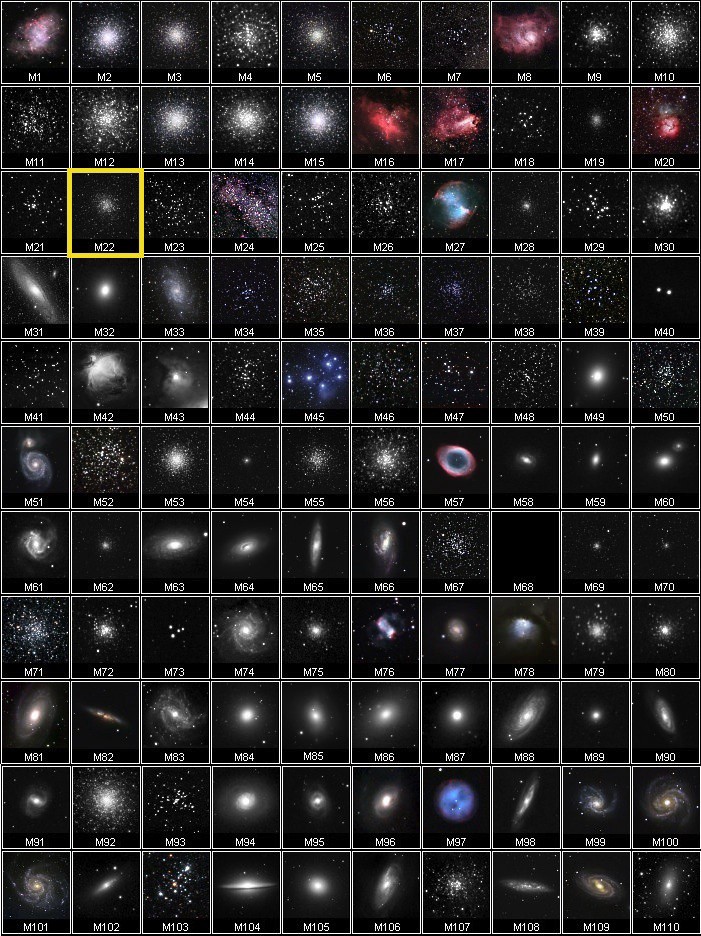
Messier Descriptions of all 110 Objects
LinkM1, The Crab Nebula
M2, Messier’s First Globular Cluster
M3, Messier’s First Original Discovery
M4, A Cinco de Mayo Special
M5, A Hyper-Smooth Globular Cluster
M6, The Butterfly Cluster
M7, The Most Southerly Messier Object
M8, The Lagoon Nebula
M9, A Globular from the Galactic Center
M10, A Perfect Ten on the Celestial Equator
M11, The Wild Duck Cluster
M12, The Top-Heavy Gumball Globular
M13, The Great Globular Cluster in Hercules
M14, The Overlooked Globular
M15, An Ancient Globular Cluster
M18, A Well-Hidden, Young Star Cluster
M19, The Flattened Fake-out Globular
M20, The Youngest Star-Forming Region, The Trifid Nebula
M21, A Baby Open Cluster in the Galactic Plane
M22, The Brightest Messier Globular
M23, A Cluster That Stands Out From The Galaxy
M24, The Most Curious Object of All
M25, A Dusty Open Cluster for Everyone
M27, The Dumbbell Nebula
M28, The Teapot-Dome Cluster
M29, A Young Open Cluster in the Summer Triangle
M30, A Straggling Globular Cluster
M31, Andromeda, the Object that Opened Up the Universe
M32, The Smallest Messier Galaxy
M33, The Triangulum Galaxy
M34, A Bright, Close Delight of the Winter Skies
M36, A High-Flying Cluster in the Winter Skies
M37, A Rich Open Star Cluster
M38, A Real-Life Pi-in-the-Sky Cluster
M39, The Closest Messier Original
M40, Messier’s Greatest Mistake
M41, The Dog Star’s Secret Neighbor
M42, The Great Orion Nebula
M44, The Beehive Cluster / Praesepe
M45, The Pleiades, the Seven Sisters
M46, The ‘Little Sister’ Cluster
M47, A Big, Blue, Bright Baby Cluster
M48, A Lost-and-Found Star Cluster
M49, Virgo’s Brightest Galaxy
M50, Brilliant Stars for a Winter’s Night
M51, The Whirlpool Galaxy
M52, A Star Cluster on the Bubble
M53, The Most Northern Galactic Globular
M54, The First Extragalactic Globular
M55, The Most Elusive Globular Cluster
M56, The Methuselah of Messier Objects
M57, The Ring Nebula
M58, The Farthest Messier Object (for now)
M59, An Elliptical Rotating Wrongly
M60, The Gateway Galaxy to Virgo
M61, A Star-Forming Spiral
M62, The Galaxy’s First Globular With A Black Hole
M63, The Sunflower Galaxy
M64, The Black Eye Galaxy
M65, The First Messier Supernova of 2013
M66, The King of the Leo Triplet
M67, Messier’s Oldest Open Cluster
M68, The Wrong-Way Globular Cluster
M69, A Titan in a Teapot
M70, A Miniature Marvel
M71, A Very Unusual Globular Cluster
M72, A Diffuse, Distant Globular at the End-of-the-Marathon
M73, A Four-Star Controversy Resolved
M74, The Phantom Galaxy at the Beginning-of-the-Marathon
M75, The Most Concentrated Messier Globular
M77, A Secretly Active Spiral Galaxy
M78, A Reflection Nebula
M79, A Cluster Beyond Our Galaxy
M80, A Southern Sky Surprise
M81, Bode’s Galaxy
M82, The Cigar Galaxy
M83, The Southern Pinwheel Galaxy
M84, The Galaxy at the Head-of-the-Chain
M85, The Most Northern Member of the Virgo Cluster
M86, The Most Blueshifted Messier Object
M87, The Biggest One of them All
M88, A Perfectly Calm Spiral in a Gravitational Storm
M89, The Most Perfect Elliptical
M90, The Better-You-Look, The Better-It-Gets Galaxy
M91, A Spectacular Solstice Spiral
M92, The Second Greatest Globular in Hercules
M93, Messier’s Last Original Open Cluster
M94, A double-ringed mystery galaxy
M95, A Barred Spiral Eye Gazing At Us
M96, A Galactic Highlight to Ring in the New Year
M97, The Owl Nebula,
M98, A Spiral Sliver Headed Our Way
M99, The Great Pinwheel of Virgo
M100, Virgo’s Final Galaxy
M101, The Pinwheel Galaxy
M102, A Great Galactic Controversy
M103, The Last ‘Original’ Object
M104, The Sombrero Galaxy
M105, A Most Unusual Elliptical
M106, A Spiral with an Active Black Hole
M107, The Globular that Almost Didn’t Make it
M108, A Galactic Sliver in the Big Dipper
M109, The Farthest Messier Spiral
M110, Andromeda Galaxy Satellite

Monday, September 7, 2020

Top Ten Brightest Messier

Top Ten Brightest Messier Objects
"Deep Sky for light polluted skies"

Top Ten Brightest Messier Objects from 1.6 to 5.1 magnitude

NGC Con ra dec B D Name
M45 0000 Tau 03 47.0 +24 07 1.6 110.0 Pleiades Open Cluster
M31 224 And 00 42.7 +41 16 3.4 178x63 Andromeda Spiral Galaxy
M44 2632 Cnc 08 40.1 +19 59 3.7 95.0 Beehive Open Cluster
M42 1976 Ori 05 35.4 -05 27 4.0 85x60 Orion Nebula
M7 6475 Sco 17 53.9 -34 49 4.1 80.0 Ptolomy Open Cluster
M6 6405 Sco 17 40.1 -32 13 4.2 25.0 Butterfly open Cluster
M24 6603 Sgr 18 16.9 -18 29 4.6 90 Sagit Star Cloud Milky Way Patch
M41 2287 CMa 06 46.0 -20 44 4.6 38.0 Open Cluster
M39 7092 Cyg 21 32.2 +48 26 4.6 32.0 Open Cluster
M22 6656 Sgr 18 36.4 -23 54 5.1 24.0 Globular Sagittarius Cluster

ra = right ascension in hours minutes.decimal seconds
dec = declination in degrees minutes
B = apparent visual magnitude
D = apparent (angular) dimension in arc minutes

One person's personal view of Messier objects rating in terms of relative ease of observing. Note, your results may vary based on Earth position, equipment and local  conditions.


Longer list of bright objects
by magnitude from .4 to 7.2


The list may include: Herschell 400 objects, Messier objects, Caldwell objects, SAC's best of NGC objects, Orion's Deep Map 600 objects, various objects of interest selected by author (around 100) Source
The Melotte Catalog
https://in-the-sky.org/data/catalogue.php?cat=Melotte&const=1&sort=0&view=0&page=2

https://in-the-sky.org/data/data.php

Object Catalogs - The Constellations
Map of the constellations

List of the constellations
Constellations in order of size

The Deep Sky

The Messier objects
Browse object catalogs
List of the 200 brightest open clusters
List of the 200 brightest globular clusters
List of the 200 brightest galaxies

Stars

List of the 200 brightest stars
List of the 200 closest stars

Your Sky - Solar System Objects

Planets

Comets
Asteroids

The Deep Sky

Visibility of the Constellations
Deep Sky Objects

Sky Diagrams

Diagram of objects in your sky
Rising and setting times
Altitude/time charts